
&w=3840&q=75)
&w=3840&q=75)
&w=3840&q=75)
&w=3840&q=75)
&w=3840&q=75)
&w=3840&q=75)
&w=3840&q=75)
&w=3840&q=75)


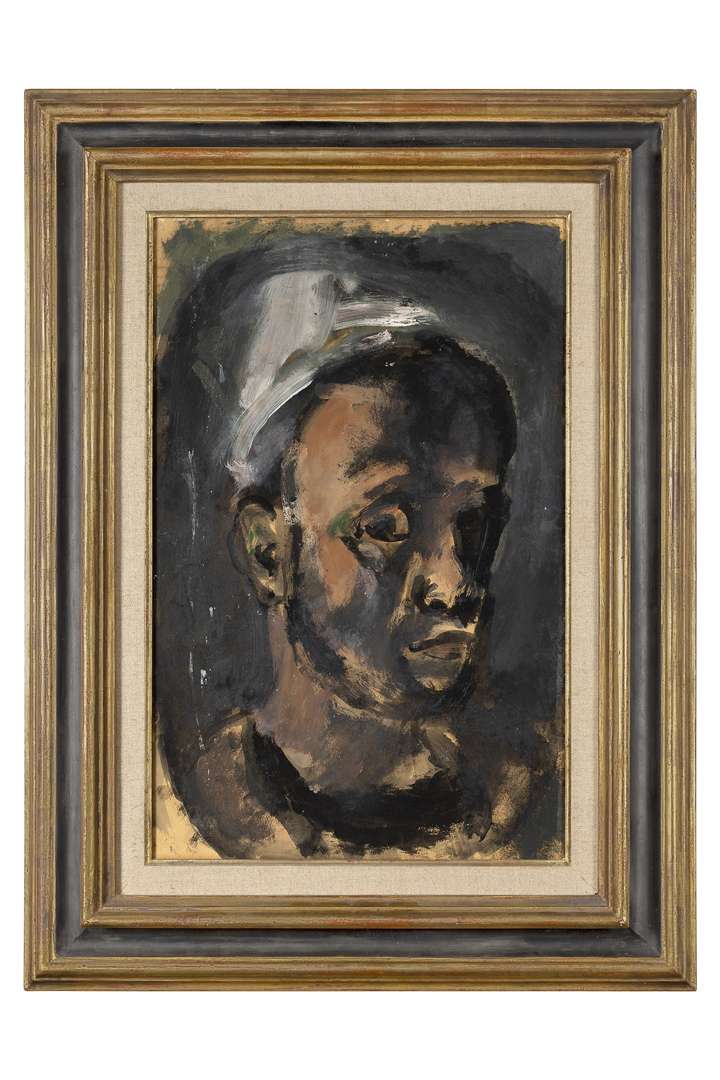
GEORGES ROUAULT (1871–1958)
Self-portrait (sketch), 1920–1921
Fees include commission and taxes.
Self-portrait (sketch), 1920–1921
Oil diluted with white spirit on paper mounted on canvas
Unsigned
Stamped ‘Atelier de/Georges Rouault’ [not Lugt] and inscribed ‘Isabelle Rouault’ on the reverse
48 x 31 cm - 18 7/8 x 12 1/4 in.
Oil on paper laid on canvas, unsigned, stamped with the ‘Atelier de/Georges Rouault’ mark and inscribed ‘Isabelle Rouault’ on the reverse
The artist’s family, France
- Christine Gouzi and Anne-Marie Agulhon [in collaboration with], Georges Rouault, Soliloques d’un peintre, Écrits, 1896–1958, Strasbourg: L'Atelier contemporain, published by François-Marie Deyrolle, 2022, reproduced on the cover
- Bernard Dorival [text by] and Isabelle Rouault [catalogue compiled by], Rouault, L’œuvre peint, Volume II, Monaco: André Sauret, 1988, described and reproduced under reference 2538, p. 294
- Self-Portraits, Paris, Galerie Skarstedt, 13 février-29 mars 2025, n° inconnu
- Painters of Passion, Adventures in Color by Kandinsky, Rouault, and Their Contemporaries, Tokyo, Panasonic Shiodome Museum of Art, 17 octobre–20 décembre 2017, n° 76
- Georges Rouault and the Expressionists, Painters of Passion, Miyagi, The Miyagi Museum of Art, 12 août–9 octobre 2017, n° inconnu
- Alexej von Jawlensky/Georges Rouault. Sehen mit Geschlossenen Augen, Halle (Saale), Kunstmuseum Moritzburg, 19 mars-25 juin 2017, cat. 57
- Georges Rouault, Lyon, Musée d’art religieux de Fourvière, 2 octobre 2013-5 janvier 2014, n° inconnu
- Georges Rouault. Cirque forain, Tokyo, Panasonic Shiodome Museum-Rouault, 6 octobre-16 décembre 2012, n°18
- Georges Rouault, Zaragoza, Ibercaja, Patio de la Infanta, 13 janvier-20 avril 2011, n° inconnu
- Georges Rouault, Genève, Interart Galerie, 30 avril-2 juillet 2010, n° inconnu
- Georges Rouault. Paysages, Troyes, Musée d’art moderne de Troyes, 7 novembre 2009-7 février 2010, n° inconnu
- Georges Rouault. Paysages, Saint-Tropez, L’Annonciade, musée de Saint-Tropez, 4 juillet-12 octobre 2009, n° inconnu
- Mystic Masque. Semblance and Reality in Georges Rouault, Boston, McMullen Museum of Art, Boston College, 30 août-7 décembre 2008, cat. n°21
- Georges Rouault, Paris ; Tokyo ; Osaka, Galerie Taménaga, 15 novembre 2007-18 mai 2008, n°18
- Georges Rouault. Forme, couleur, harmonie, Strasbourg, Musée d’Art moderne et contemporain de Strasbourg, 10 novembre 2006-18 mars 2007, cat. n°39
- Henri Matisse / Georges Rouault, Correspondances 1906–1953, Paris, Musée d'art moderne de la Ville de Paris, 27 octobre 2006-17 février 2007, n° inconnu
- Rouault. The painter who kept his spiritual liberty, Daejeon, Museum of Art, 4 mai-27 août 2006, n° inconnu
- Georges Rouault et le cirque, Chambéry, Musée des Beaux-Arts de Chambéry, 26 novembre 2004-28 février 2005, n°1
- Rouault. Première Période 1903-1920, Paris, Musée national d'art moderne, Centre Georges Pompidou, 27 février–4 mai 1992, n° inconnu
- Georges Rouault, München, Haus der Kunst ; Manchester, City Art Galleries, 23 mars-28 juillet 1974, n°54
- Rouault, Londres, The Tate Gallery, 8 octobre-13 novembre 1966, n°53
- Edinburgh International Festival 1966. Rouault, Edimbourg, The Royal Scottish Academy, 20 août-18 septembre 1966, n°53
- Georges Rouault, Frankfurt, Frankfurter Kunstverein, Adolf und Luisa Haeuser-Stiftung, 12 février-27 mars 1966, n°54
- Georges Rouault, Colmar, Musée Unterlinden, juillet-septembre 1965, cat. 29
- Rouault, Québec, Musée du Québec ; Montréal, Musée d’Art Contemporain de Montréal, 28 janvier-2 mai 1965, n°30
- Georges Rouault, Dieppe, Musée de Dieppe, 22 mai-16 septembre 1963, cat. n°25
- Georges Rouault, Bâle, Galerie Beyeler, janvier-juin 1962, n°1
- Hommage à Rouault, Gand, Musée des Beaux-Arts, 23 septembre-5 novembre 1961, n°16
- Georges Rouault, Paris, Galerie Creuzevault, 3 juin-15 juillet 1960, n° inconnu
Self-portraits occupy a unique place in the work of Georges Rouault. Concentrated mainly around the years 1895–1901, and then taken up sporadically in the following decades, they constitute less an exercise in observation than a genuine field of inner experimentation. These works form a coherent body of work from the artist’s early years, already revealing the expressive tension that would run through his entire oeuvre.
Rouault never sought a faithful likeness nor the painter’s worldly self-affirmation. On the contrary, his self-portraits appear as meditative figures, sometimes severe, often imbued with anxiety. The features are simplified, the gazes intensely fixed, the faces outlined in dark contours that already foreshadow the aesthetic of the judges, clowns and sacred figures of his mature years.
This introspective dimension brings several of his self-portraits closer to his depictions of clowns or street performers, to the extent that certain works – such as the Clown’s Head (Self-Portrait?), held at the Pushkin Museum – deliberately maintain an ambiguity between character and self-image. In Rouault’s work, the self-portrait thus becomes less a representation of an individual than a reflection on the human condition, solitude and inner fragility.
Even in the later versions from the 1920s and 1930s, executed from older drawings, the artist retains this spiritual intensity and this silent confrontation with himself. The self-portraits thus emerge as a discreet yet essential thread running through Rouault’s work, where the major moral and existential themes that would mark his entire body of work were forged at a very early stage.
In our Self-Portrait and The Apprentice Worker (AM 3170 P) held at the Centre Pompidou, separated by a few years, Georges Rouault offers two profoundly different visions of himself, whilst retaining the same introspective intensity that runs through his entire oeuvre. The Self-Portrait (sketch) from the 1920s still draws on a fluid and vibrant quality: the face emerges from the shadows through broad, diluted, almost expressionist brushstrokes, in an unstable light that seems to convey the urgency of the inner gaze. Conversely, the Beaubourg self-portrait imposes a solemn and meditative frontal pose. The modelling becomes more defined, the contours more pronounced, and the famous white cap – almost a halo – transforms the artist into a figure who is at once humble and sacred.
Whereas the sketch still reveals the painter’s psychological fragility, L’Apprenti-ouvrier affirms a genuine artistic and social profession of faith: Rouault depicts himself here not as a master, but as a craftsman, faithful to his working-class origins and his spiritual conception of painting.
This tension between suffering humanity and inner monumentality makes these two works a rare and particularly moving dialogue within Rouault’s body of self-portraits.
***
“Pale complexion, clear eyes ever alert, yet gazing inward rather than fixed on an object, a fierce mouth, a rounded forehead, a broad skull once crowned with a thick head of blond hair (and which does not regret it in the least); there is something of a dreamy clown, —a surprising blend of pity and bitterness, of mischief and candour—in the features of this painter, an enemy of cliques and conventions, and generally of all contemporary mores, whom fame is in the process of drawing out of his cellar, for he was born in a cellar in 1871, during the bombardment of Paris. ’
Jacques Maritain, 1924
Georges Rouault (1871–1958), The Apprentice Workman, 1925, oil on paper mounted on canvas, unsigned, 67 × 54 cm, Paris, Musée national d'art moderne, AM 3170 P