
&w=3840&q=75)
&w=3840&q=75)
&w=3840&q=75)
&w=3840&q=75)
&w=3840&q=75)
&w=3840&q=75)
&w=3840&q=75)
&w=3840&q=75)


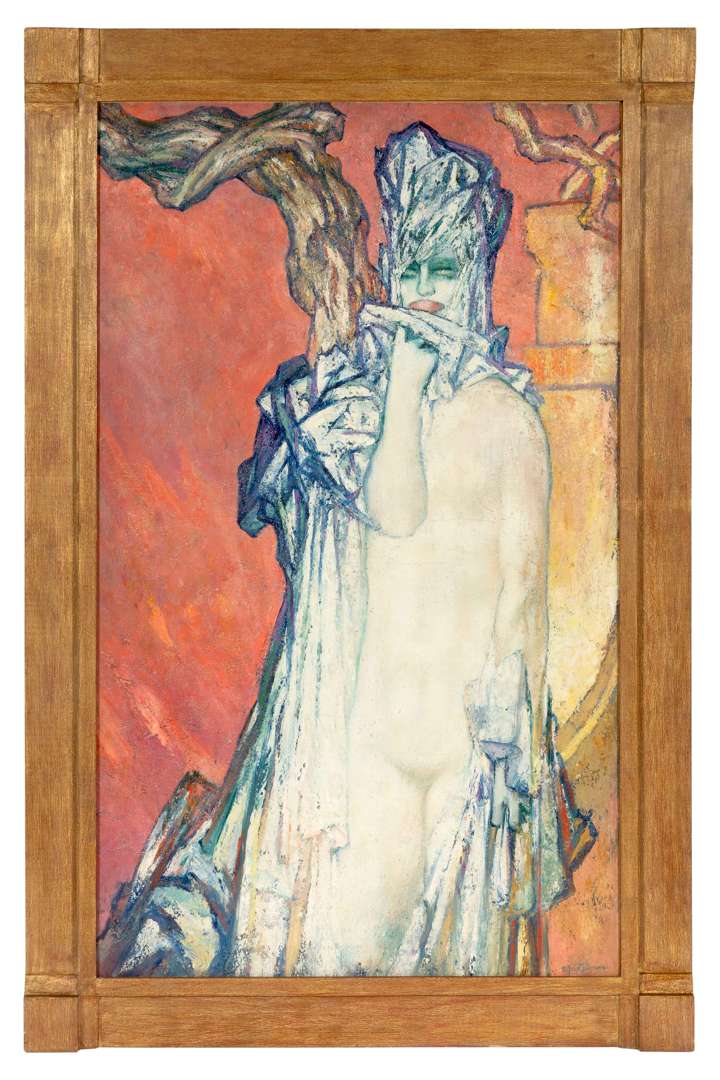
Salomé
Oil on canvas
, signed lower right
(re-stretched and previously restored)
146 x 89 cm - 57 ½ x 35 in.
- Artist's family, France
- Auction, 2nd Garden Party Sale at Cheverny, Rouillac, Cheverny, Château de Cheverny, 23 June 1990, lot 241
- Auction, Art Nouveau & Art Deco, Poulain-Le Fur, Paris, Hôtel des Ventes du Palais, 20 April 2000, lot 111
- Private collection, France (by descent)
Marcel-Beronneau, 1869–1937, Symbolist painter, exhibition catalogue, Paris, Galerie Alain Blondel, 1981, described and reproduced, no page number
Marcel-Beronneau, 1869-1937, peintre symboliste, Paris, Galerie Alain Blondel, 1981, n° inconnu
“Beneath a bluish veil concealing her chest and head, one could make out the arches of her eyes, the chalcedony of her ears, and the whiteness of her skin.”
Gustave Flaubert, Herodias
***
“It is curious to see how much this idea of Salome the dancer has obsessed the minds of so many men.
There is a painter in Paris who, for the past 15 years, has sought to express his ideal of this woman dancing to obtain the head of Saint John, and during all that time he has painted little else.
P. Marcel-Beronneau painted a Salome for the first time in 1896. It was exhibited at the Salon and attracted attention. It was a strange, mystical work, full of that fantastical imagination which the painter has displayed in many other works.
But this was merely one piece in a long series, and P. Marcel-Beronneau intends to continue his studies of Salome until he has achieved what he considers to be the embodiment of his ideal. Then he will turn his attention to other subjects.
Different interpretations of Salome:
The numerous Salomes by this artist, a persistent explorer, all possess distinct characters corresponding to the painter’s varying ideas about this woman.
Some are mystical, others simply beauty queens who, it seems, have no other purpose than to demonstrate the power of carnal beauty. A few are cruel, or sensual, possessing a sort of infernal beauty.
These are pagan or passionate; those are cold and calm.
All share a kinship of beauty owing chiefly to the painter’s remarkable choice of female types, and to his fantastical colouring, in arabesques of flowers, fruits, precious stones, drapery and the wild ornamentation of the Orient. ’
Somerville de Story, Daily Mail, 1912, quoted in the exhibition catalogue Marcel Beronneau, 1869–1937, Symbolist Painter, Paris, Galerie Alain Blondel, 1981, n. p.