
&w=3840&q=75)
&w=3840&q=75)
&w=3840&q=75)
&w=3840&q=75)
&w=3840&q=75)
&w=3840&q=75)
&w=3840&q=75)
&w=3840&q=75)


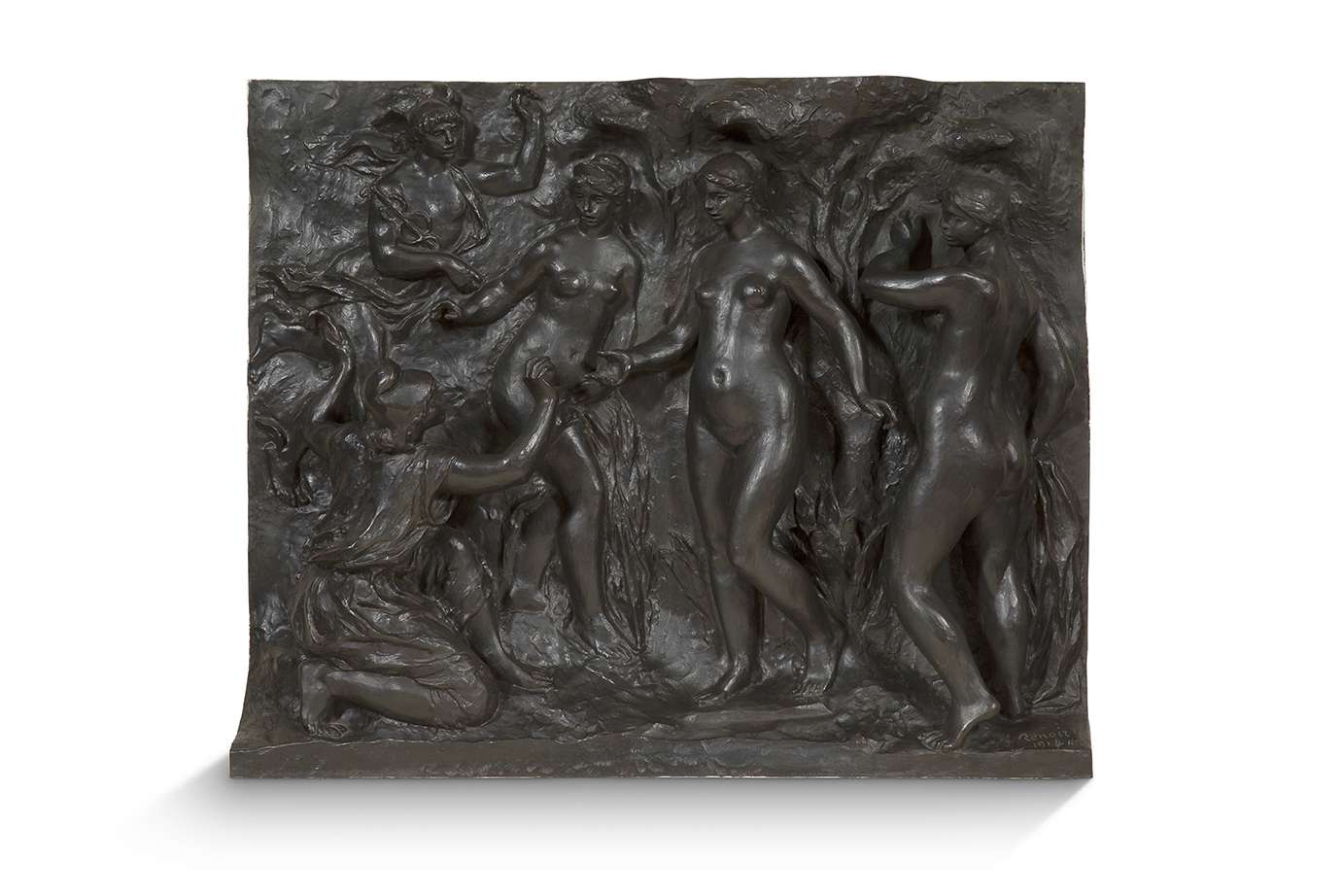
AUGUSTE RENOIR (1841–1919) AND RICHARD GUINO (1890–1973)
The Judgement of Paris
Fees include commission and taxes.
The Judgement of Paris
Bronze with a brown
patina Signed, dated ‘1914’ and numbered ‘No. 3’ without a foundry mark [Florentin Godard before 1939 or, more likely, Eugène Rudier before 1952]
Cast from a model created in 1914
73 x 91 cm - 28 3/4 x 35 7/8 in.
We would like to thank Mrs Adélaïde Paul-Dubois-Taine for her assistance in compiling this entry.
Bronze with brown patina, signed, dated ‘1914’ and numbered ‘N°3’ with no foundry mark [Florentin Godard before 1939 or, more likely, Eugène Rudier before 1952], cast after a model created in 1914
- Werner and Nelly Bär Collection, Zurich (acquired in 1951)
- Auction, An important selection of Sculpture and Drawings from the Werner and Nelly Bär Collection, Zurich, Sotheby Parke Bernet & Co., London, 30 March 1977, lot 84
- Private collection, Europe (acquired at the previous sale and subsequently passed down through the family)
- Renoir, draughtsman, exhibition catalogue, New York, Morgan Library, 17 October 2025–8 February 2026; Paris, Musée d’Orsay, 17 March–5 July 2026, Paris: Grand Palais – Rmn Éditions: Musée d’Orsay; New York: The Morgan Library & Museum, 2025, described and reproduced under no. 183, p. 209 (the plaster cast in the Musée d’Orsay)
- Guino-Renoir, the colour of sculpture, exhibition catalogue, Perpignan, Musée Hyacinthe Rigaud, 24 June–25 November 2023, Cinisello Balsamo, Milan: Silvana editoriale, 2023, described and reproduced under no. 69, p. 121 (the plaster cast from the Musée d’Orsay)
- Werner and Nelly Bär Collection, Zurich: Kunsthaus, 1965, described and reproduced under no. 183
- Paul Haesaerts, Renoir, Sculpteur, Brussels: Hermes, 1947, described under no. 7 and reproduced in plates X–XIII (another copy)
- Julius Meier-Graefe, Renoir, Leipzig: Klinkhardt & Biermann Verlag, 1929, described and reproduced on p. 409 (another copy)
- Renoir et l'amour, La modernité heureuse (1865-1885), Paris, Musée d’Orsay, 17 mars-19 juillet 2026, n° inconnu (l’exemplaire en plâtre du musée d’Orsay)
- Renoir, dessinateur, New York, Morgan Library, 17 octobre 2025-8 février 2026 et Paris, Musée d'Orsay, 17 mars-5 juillet 2026, n°183 (l’exemplaire en plâtre du musée d’Orsay)
- Guino-Renoir, la couleur de la sculpture, Perpignan, Musée Hyacinthe Rigaud, 24 juin-25 novembre 2023, n°69 (l’exemplaire en plâtre du musée d’Orsay)
- Chefs-d'œuvre des collections suisses de Manet à Picasso, Paris, Orangerie des Tuileries, 10 mai-2 octobre 1967, n°70
- Chefs-d'œuvre des collections suisses de Manet à Picasso, Lausanne, Palais Beaulieu, 1er mai-25 octobre 1964, n°70
- Plastiksammlung Werner Bär, Bern, Kunstmuseum, 26 septembre-19 novembre 1959, n°81
- Zwei Zürcher Sammlungen : Werner Bär Plastik - Kurt Sponagel Graphik, Zurich, Kunsthaus, 19 août-19 septembre 1959, n°81
- Skulpturen von Malern von Daumier bis Picasso, Zürich, Kunsthaus, 26 octobre-30 novembre 1956, n°102
- Die Plastiksammlung Werner Bär, Winterthur, Kunstmuseum, 16 septembre-11 novembre 1951, n°70, pl. II
- Renoir, l’œuvre sculpté, l’œuvre gravé, aquarelles et dessins, Paris, Galerie Beaux-Arts, 15 octobre-10 novembre 1934, n°4 (un autre exemplaire)
- Französische Kunst des XIX. und XX. Jahrhunderts, Zürich, Zürcher Kunsthaus, 5 octobre-14 novembre 1917, n°221, p. 74 (un autre exemplaire)
- La Triennale, Paris, Jeu de Paume, 1er mars-15 avril 1916, n°153 (un autre exemplaire)
“Renoir sought to turn his *Venus Victorious* into a monument. He wanted a plinth for it, adorned with a relief depicting the entire scene of the election. He had already depicted this scene numerous times, in drawings, pastels and oil paintings. When Renoir finds a subject that suits him and for which he has found a successful visual interpretation, he is not quick to abandon it. Renoir began by asking his sculptor to sketch a bas-relief that might eventually be used to adorn the plinth of the Petite Vénus. To this end, he gave him, as a reference, a photograph of a drawing made in 1908, the year in which he also produced a Judgement of Paris in oil on canvas.
It was in his Paris studio that Guino crafted this small plaque with its subtle reliefs, resembling a medal and measuring no more than 12 cm in height by 19 cm in width. This small work lacks ease and emphasis; the central figure, in particular, is insignificant. But this was merely a first draft. Building on it and referring to the photograph of the same design, Guino revisited the theme, this time in high relief. This took place at ‘Les Collettes’ during the year 1914. As the new version was to serve as the plinth for the Grande Vénus Victorieuse, its dimensions were increased to 73 cm high by 91 cm wide. The central figure, which had looked out of place on the wax model, would no longer be inspired by it, nor by the initial drawing, but rather by the two Venuses already created in the round. The work is impressive. The composition is both dynamic and subject to a strict order.
The handsome Paris, in a pleated robe, a Phrygian cap resting on his abundant hair, entranced, almost on his knees, extends the apple of victory in a graceful gesture to an opulent Aphrodite. On either side of the chosen one, Hera and Athena, her disappointed companions, sketch out—as far as is possible for figures by Renoir—gestures of astonishment and defiance. The guide to the three goddesses, winged Hermes, almost blending into the sky, witnesses the contest and, with his arm raised like a referee’s, seems to ratify the judgement.
The model is firm. The variations in the background, which soberly suggest the natural landscape, happily foreshadow and support the prominent features. Obeying the rules of a varied yet simple composition, a few guiding lines intersect seamlessly. Empty and full spaces alternate with rigour and suppleness.”
Paul Haesaerts, Renoir, Sculpteur, Paris: Hermes, 1947, p. 25
- Auguste Renoir (1841–1919) and Richard Guino (1890–1973), The Judgement of Paris, patinated plaster, signed and dated ‘1914’, 76.2 x 94.5 cm, Paris, Musée d’Orsay, RF 2745
- Auguste Renoir (1841–1919) and Richard Guino (1890–1973), The Judgement of Paris, bronze with brown patina in five unsoldered sections, signed and dated ‘1914’ without a foundry mark, 75 x 91.5 cm, unlisted Auction, 19th- and 20th-Century Prints, Paintings and Sculptures […], Thierry de Maigret, Paris, Hôtel Drouot, 28 June 2024, lot 76 (lot not sold)
- Auguste Renoir (1841–1919) and Richard Guino (1890–1973), Judgment of Paris, bronze with brown patina, signed, dated ‘1914’ and numbered ‘V’ without a foundry mark, 74.3 x 90.2 cm, Cleveland, The Cleveland Museum of Art, 1941.591
- Auguste Renoir (1841–1919) and Richard Guino (1890–1973), Judgment of Paris, bronze with brown patina, signed, dated ‘1914’ and numbered (?) without a foundry mark, 74.9 × 90.8 cm, Minneapolis, Minneapolis Institute of Art, 55.16
- Auguste Renoir (1841–1919) and Richard Guino (1890–1973), Het Parisoordeel, 1914, bronze with brown patina, signed, dated ‘1914’ and numbered ‘VII’ without a foundry mark, 75 x 93 cm, Amsterdam, Stedelijk Museum, BA 172
- Auguste Renoir (1841–1919) and Richard Guino (1890–1973), The Judgment of Paris, 1916, bronze with brown patina, signed, dated ‘1916’(?) and numbered ‘VI’ without a foundry mark (?), 73.7 cm x 90.8 cm, Wellesley, Davis Museum at Wellesley College, 1981.46
- Auguste Renoir (1841–1919) and Richard Guino (1890–1973), The Judgement of Paris, 1914, bronze with brown patina, signed, dated ‘1914’ and numbered ‘VIII’ without a foundry mark, 75 cm x 92 cm, Saarbrücken, Saarland Museum, Modern Gallery, NI 1203
- Auguste Renoir (1841–1919), The Judgement of Paris, c. 1913–1914, oil on canvas, signed lower right, 73 x 92.5 cm, Hiroshima, Hiroshima Museum of Art
- Auguste Renoir (1841–1919) and Richard Guino (1890–1973), ‘The Little Judgement of Paris’, study, 1913, plaster, 11 × 12 cm, Cagnes-sur-Mer, Musée Renoir