
&w=3840&q=75)
&w=3840&q=75)
&w=3840&q=75)
&w=3840&q=75)
&w=3840&q=75)
&w=3840&q=75)
&w=3840&q=75)
&w=3840&q=75)


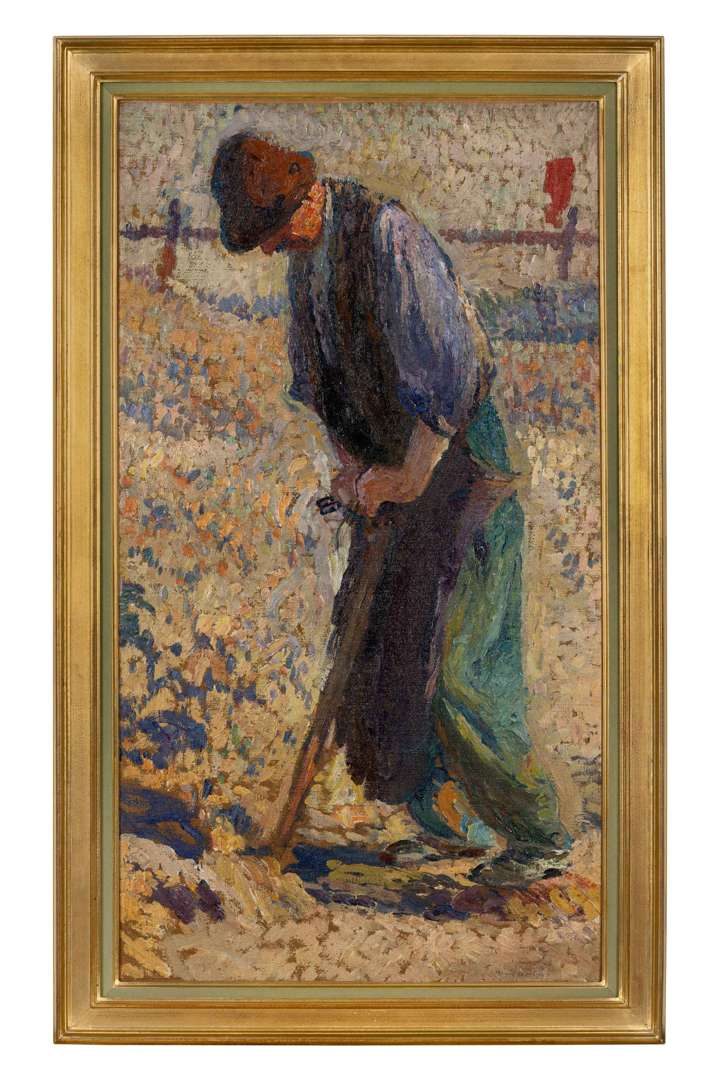
HENRI MARTIN (1860–1943)
Worker on the Place de la Concorde
Fees include commission and taxes.
Worker on the Place de la Concorde
Oil on canvas
. Signed lower right
(re-stretched)
. 95 x 52 cm – 37 x 20 1/2 in.
Mrs Marie-Anne Destrebecq-Martin and Mr Charles-Louis Duriez-Destrebecq have confirmed the authenticity of this work. A notice of inclusion in the archives for the preparation of the catalogue raisonné of Henri-Jean-Guillaume Martin, dated 10 May 2026, will be provided to the purchaser.
Oil on lined canvas, signed lower right
- Auction, Modern Paintings, Ader-Picard-Tajan, Paris, Palais d’Orsay, 26 June 1979, lot 84 (titled *Peasant in the Fields*)
- Private collection, France (acquired at the previous sale and subsequently passed down through the family)
“In 1918, Henri Martin exhibited a number of landscapes once again, prompting Pierre Mille to write in *La Gazette des Beaux-Arts*: ‘First and foremost, we must pay tribute to Henri Martin, whose three paintings are equally delightful. They are a source of sure and tranquil joy for the eye and the mind.’
This echoes Delacroix’s sentiment: ‘A painting must above all be a feast for the eyes.’
Henri Martin was then commissioned to create what would be his most significant body of work, alongside the Salle du Capitole in Toulouse: the decoration of the Salle des Délibérations of the Council of State at the Palais-Royal. He devoted five years to this project.
Of this considerable body of work, *The Harvest* in 1920, *The Port of Marseille* and *The Thinker* in 1922 were warmly received by the press, which consistently and unanimously praised his superior understanding of decorative art. I shall quote just a few lines, which I find particularly pertinent and subtle, from J. Dorin in *La Gazette des Beaux-Arts*:
"... This quality, which cannot be learned but is innate, has long been the hallmark of Henri Martin. His paintings possess a decisive character. They merely confirm a history of great labour and great determination. Henri Martin is one of those rare Impressionists who did not allow themselves to be mesmerised by the process of dividing tones...”
A very apt technical observation. Henri Martin never applied the division of pure tones. He would spend a long time searching for his tones on the palette to achieve the exact expression of what his eye saw! The juxtaposition or multiplication of brushstrokes seeks, above all, to render the vibration of the atmosphere, but also to go ever further in the finesse and purity of tone, which is no easy feat. In an evening sky, for example, how does one achieve that rare hue, which is at once slightly green, slightly mauve, and slightly golden? Mixing the three would produce a muddy tone, but if one juxtaposes them, one obtains a vibration far closer to reality. His pointillism – a word that made him smile and even annoyed him a little – was therefore intended solely to bring him closer to his vision.
And J. Dorin continues, regarding the Port of Marseille:
"... Here, he gives greater prominence to the bustling life of the port than to the silent, solitary labour of thought; and not without reason: today, what we call the intellectual is, if not a pariah, then at the very least the true pauper of the civilised world. Henri Martin has isolated him in a tall, deep forest, whilst the burly dockers labour in the sea air and under a blazing sun!”
On the final panel, La Place de la Concorde, exhibited in 1926, how is one to choose between so many articles? In La Gazette des Beaux-Arts, Rocheblave, professor of art history, writes:
"A great, peerless composition receives unanimous acclaim and crowns the career of one of the most sincere artists of our time. In this great triptych, Henri Martin has reached the pinnacle of his art and technique, the one so profoundly true, accurate and grand, the other so vibrant, so evocative to the eye and so moving to the imagination. This vast painting is a reality ablaze with poetry, where the figures and architectural lines, the planes, contribute to direct truth through their accuracy and volume, and to the dream through this radiant atmosphere in which the activity of the workers at their tasks is bathed as in a symbol of Parisian life. It is art of the very highest order, which defies categorisation, though it is above all a personal art.”
In La Gazette des Beaux-Arts, Focillon, the famous art historian, writes:
"This master, whom we like to see as a realist of yesteryear, is, in fact, the eloquent witness of an idealistic era. He was the first to dare to bring poetry into modern art with such brilliance, and I have not forgotten the struggles he had to endure..."
This is followed by an enthusiastic and vivid description of La Place de la Concorde, and he concludes: "Around contemporary humanity, he makes a fiery light and the changing poetry of the hours to vibrate. In this Salon, this serene youthfulness, after such a long and courageous career, is both an honour and a lesson.”
Jacques Martin-Ferrières, Henri Martin, his life and work, Paris: Presses du compagnonnage, 1967, pp. 90–91
This work is a figure study for the right-hand panel of *Works on the Place de la Concorde* (*Labouring France Appearing before the Council of State*), Paris, Council of State, General Assembly Hall, circa 1920–1925.