
&w=3840&q=75)
&w=3840&q=75)
&w=3840&q=75)
&w=3840&q=75)
&w=3840&q=75)
&w=3840&q=75)
&w=3840&q=75)
&w=3840&q=75)


CARTIER
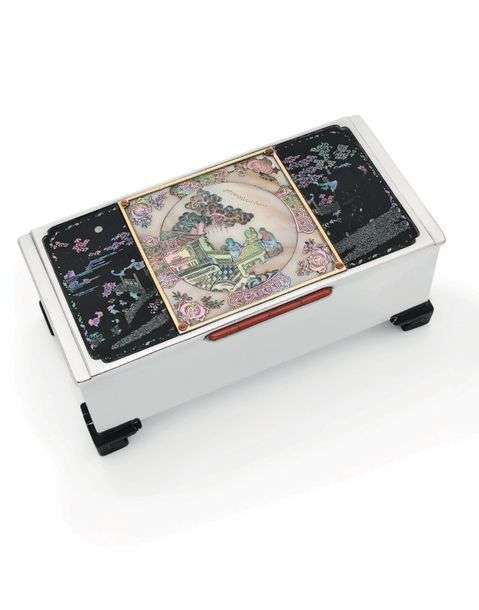
Rectangular box with two compartments in silver (<800) and 18k yellow gold (750). The lid is composed of plates decorated with Chinese scenes of landscape, pagodas and characters. In the center, a mother-of-pearl marquetry decorated with a medallion and framed by a gold net enhanced at the corners of a coral bead supported by a burgundy lacquer scene.
Carved wooden legs in mahogany type.
Signed and numbered. French work.
Circa 1925.
Size: 18 x 9.7 x 7cm approx.
Restoration on two feet.
Some missing mother-of-pearl.
Original case
Much of the jewelry and objects created in Paris during the Art Deco period drew their inspiration from various cultures| India, Persian, Egyptian, Chinese and Japanese motifs served as a support for creation in both jewelry and decorative arts.
As for the Egyptian style pieces, there are two types of creations made by Cartier in this Asian style, those that incorporate real Chinese or Japanese elements such as the engraved jade or lacquer plates found on our box, or those whose design is Chinese or Japanese style but which were entirely made by Cartier. The particularity of this first category is one of the great specificities of the House of Cartier which distinguishes it from all other French jewelry houses.
"Burgauté" lacquer is the term generally used to designate a lacquer inlaid with mother-of-pearl tinted in pink, green, blue and purple in order to obtain vivid contrasts... The burgau is the common name given to the pearly mussel. Originating in China, this technique spread to the Ryukyu Islands (between China and Japan) at the time of the Qing dynasty, then to Japan itself, which became the center of the mother-of-pearl industry in the 19th century.
Most of the lacquer used by Cartier was probably from Japan or the Ryukyu Islands. The house used this kind of material for its
BIJ2021
Rectangular box with two compartments in silver (<800) and 18k yellow gold (750). The lid is composed of plates decorated with Chinese scenes of landscape, pagodas and characters. In the center, a mother-of-pearl marquetry decorated with a medallion and framed by a gold net enhanced at the corners of a coral bead supported by a burgundy lacquer scene.
Carved wooden legs in mahogany type.
Signed and numbered. French work.
Circa 1925.
Size: 18 x 9.7 x 7cm approx.
Restoration on two feet.
Some missing mother-of-pearl.
Original case
Much of the jewelry and objects created in Paris during the Art Deco period drew their inspiration from various cultures| India, Persian, Egyptian, Chinese and Japanese motifs served as a support for creation in both jewelry and decorative arts.
As for the Egyptian style pieces, there are two types of creations made by Cartier in this Asian style, those that incorporate real Chinese or Japanese elements such as the engraved jade or lacquer plates found on our box, or those whose design is Chinese or Japanese style but which were entirely made by Cartier. The particularity of this first category is one of the great specificities of the House of Cartier which distinguishes it from all other French jewelry houses.
"Burgauté" lacquer is the term generally used to designate a lacquer inlaid with mother-of-pearl tinted in pink, green, blue and purple in order to obtain vivid contrasts... The burgau is the common name given to the pearly mussel. Originating in China, this technique spread to the Ryukyu Islands (between China and Japan) at the time of the Qing dynasty, then to Japan itself, which became the center of the mother-of-pearl industry in the 19th century.
Most of the lacquer used by Cartier was probably from Japan or the Ryukyu Islands. The house used this kind of material for its
BIJ2021