
&w=3840&q=75)
&w=3840&q=75)
&w=3840&q=75)
&w=3840&q=75)
&w=3840&q=75)
&w=3840&q=75)


118
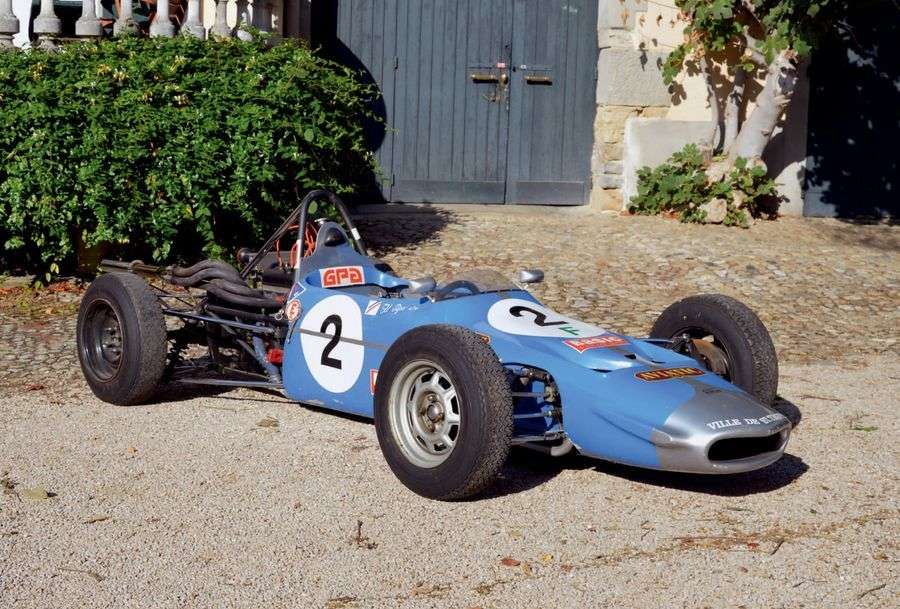
1971 - MONOPLACE FORMULE FRANCE MARTINI MK 6
The item was sold for 15 600 €
Fees include commission and taxes.
1971 - MONOPLACE FORMULE FRANCE MARTINI MK 6
Authentic single-seater
A history of success in competition
In running order
Since the introduction of the prestigious World Drivers' Championship (the original name given by the FIA to today's Formula 1 World Championship) in 1950, numerous other national or international championships have emerged at a lower level. Thus in 1968, the French motorsports federation (the FFSA) launched Formula France.
The regulations published in December 1967 stipulated notably a French chassis, as well as the engine and gearbox from the Renault 8 Gordini 1300. The modifications allowed were limited: skimming the cylinder head, balancing the crankshaft and flywheel, and fitting new air intake trumpets. On the other hand, the moving parts (pistons, conrods etc.) and the intake manifold had to remain strictly standard. The 4-cylinder 1255 cc engine developed 103 bhp at 6750 rpm and was fitted with two twin-barrel Weber 40 carburettors. In 1971, Formula France changed its name to become Formula Renault, with the biggest alteration being the arrival of the 1600 cc engine from the Renault 12 Gordini for the 1972 season.
The chassis presented here was developed by the small French company Martini, named after its founder Tico Martini, a former racing driver and manufacturer of karts in Great Britain. He specialised in the construction of single-seaters for Formula 3 and
Formula France, then Formula Renault and finally Formula 2. In the mid-1970s, Martini was the leading French manufacturer of racing cars. Many up-and-coming young drivers in French motorsport earned their spurs driving Martini cars, drivers such as Jacques Laffite and Jean-Pierre Jarier, who both went on to race in Formula 1.
Built in 1971, this Martini MK6 single-seater is still fitted with the Gordini 1300 engine, in accordance with its original specification. After a racing career at the start of the 1970s, chassis number 010 reappeared in 1984 after spending several years in a private
Authentic single-seater
A history of success in competition
In running order
Since the introduction of the prestigious World Drivers' Championship (the original name given by the FIA to today's Formula 1 World Championship) in 1950, numerous other national or international championships have emerged at a lower level. Thus in 1968, the French motorsports federation (the FFSA) launched Formula France.
The regulations published in December 1967 stipulated notably a French chassis, as well as the engine and gearbox from the Renault 8 Gordini 1300. The modifications allowed were limited: skimming the cylinder head, balancing the crankshaft and flywheel, and fitting new air intake trumpets. On the other hand, the moving parts (pistons, conrods etc.) and the intake manifold had to remain strictly standard. The 4-cylinder 1255 cc engine developed 103 bhp at 6750 rpm and was fitted with two twin-barrel Weber 40 carburettors. In 1971, Formula France changed its name to become Formula Renault, with the biggest alteration being the arrival of the 1600 cc engine from the Renault 12 Gordini for the 1972 season.
The chassis presented here was developed by the small French company Martini, named after its founder Tico Martini, a former racing driver and manufacturer of karts in Great Britain. He specialised in the construction of single-seaters for Formula 3 and
Formula France, then Formula Renault and finally Formula 2. In the mid-1970s, Martini was the leading French manufacturer of racing cars. Many up-and-coming young drivers in French motorsport earned their spurs driving Martini cars, drivers such as Jacques Laffite and Jean-Pierre Jarier, who both went on to race in Formula 1.
Built in 1971, this Martini MK6 single-seater is still fitted with the Gordini 1300 engine, in accordance with its original specification. After a racing career at the start of the 1970s, chassis number 010 reappeared in 1984 after spending several years in a private