
&w=3840&q=75)
&w=3840&q=75)
&w=3840&q=75)
&w=3840&q=75)
&w=3840&q=75)
&w=3840&q=75)
&w=3840&q=75)
&w=3840&q=75)


RENE BOIVIN
"Paris Sparrow" music video
Fees include commission and taxes.
"Paris Sparrow" music video
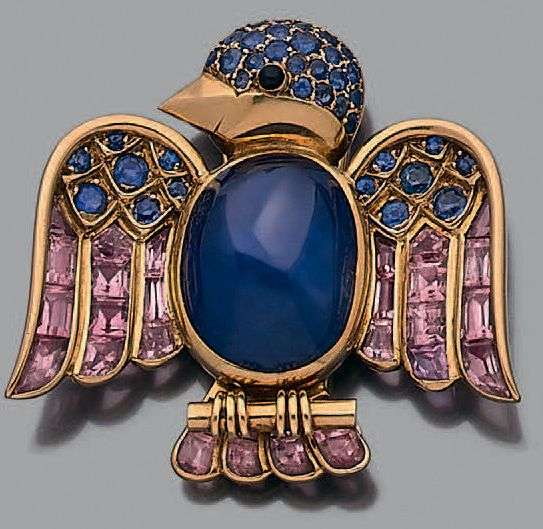
In 18-carat yellow gold (750), set with a large cabochon sapphire for the body and sapphires and pink tourmalines for the head and wings. Circa 1945.
Dimensions: approx. 4 x 3.
7 cm. Weight: 22.2g.
Accompanied by a certificate from Mrs Françoise Cailles attesting that it is a creation by René Boivin.
RENE BOIVIN
A yellow gold clip designed as a bird, set with sapphires and pink tourmalines. Circa 1945.
Accompanied by a certificate from Françoise Cailles stating: René Boivin's creation.
Bibliography: Preliminary
sketch reproduced in
*Françoise Cailles: René Boivin, Jeweller*.
Éditions de l'Amateur, Paris, 1994, p. 295
Coming from a family of silversmiths and jewellers, René Boivin established himself in the 1890s, around the time he married Jeanne Poiret, sister of Paul Poiret. Together, they developed an original and modern style, creating some of the most daring jewellery of the early 20th century. The jewellery from the René Boivin House on which we shall focus our attention is that created from the 1920s onwards. Indeed, when René Boivin died prematurely in 1917, his wife and collaborator Jeanne Boivin boldly took over the management of the House. Her sensitivity and taste likely guided her when, in 1919, she hired a young designer named Suzanne Belperron, who had just graduated from the École des Beaux-Arts and had won first prize in the Arts Décoratifs competition. This collaboration enabled Maison Boivin to take off once more, a momentum that was renewed with the arrival of Juliette Moutart, who worked for Jeanne Boivin and her daughter Germaine for nearly 30 years. Their sources of inspiration were varied, ranging from shells and marine motifs for Jeanne Boivin to animal and floral motifs for Juliette Moutart, and fantastical or whimsical themes for Germaine Boivin. These collaborations between talented women enabled Maison René Boivin to offer highly innovative jewellery, unique pieces that proved a resounding success. The most frequently produced pieces were rings and bracelets. The materials used were also highly original, as they employed new materials in jewellery such as wood, crystal and agate… combined with precious or semi-precious stones… Many creations would go on to become legendary, such as the ‘tranche’ bracelet, the ‘barbare’ bracelet, the ‘quatre corps’ ring available in a range of colours, the often articulated ‘starfish’ brooches, and animal-themed pendants such as the ‘crab’, ‘sea lion’ or ‘Parisian sparrow’...
This piece of jewellery is highly symbolic, according to Françoise Cailles: “The bird was taking flight. It sold very well after the war, as a symbol of liberation.”
This brooch was commissioned from BOIVIN by Yvonne CARETTE (1899–1973), a renowned fashion designer who enjoyed a brilliant career in the United States between the two world wars.
Originally based on Avenue Montaigne in Paris, she made a name for herself after the First World War with elegant, cropped and supple designs, free from corsets, following in the footsteps of Paul
Poiret. She inherited her talent for costume design from her father, a master tailor who owned a building on Boulevard Haussmann where he had his workshop, frequented by a distinguished clientele.
She then moved to the United States, settling in Los Angeles, where she captivated the world of cinema and counted numerous actresses among her clients, including Paulette Godard. Her designs were featured in Vogue and Harper’s Bazaar.
She created them using live models of all sizes to accommodate different body types.
At the outbreak of the Second World War, she returned to France and joined the Resistance.