
&w=3840&q=75)
&w=3840&q=75)
&w=3840&q=75)
&w=3840&q=75)
&w=3840&q=75)
&w=3840&q=75)
&w=3840&q=75)
&w=3840&q=75)


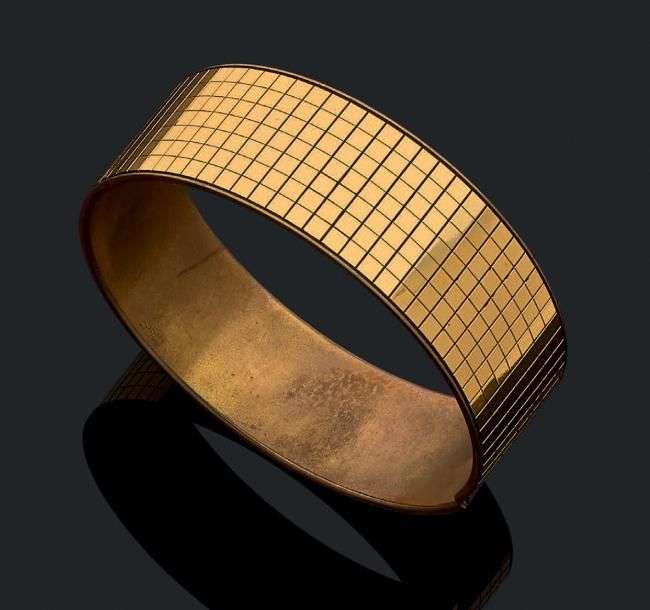
RENE BOIVIN
"Irradiant" bracelet
Fees include commission and taxes.
"Irradiant" bracelet
Comprising a rigid rod decorated with a gold mosaic.
Diam.: 7 cm – Width: 2.2 cm –
Weight: 25.6 g
. Accompanied by a certificate from Françoise Cailles confirming that this is a Boivin design dating from around 1932–35
René Boivin: Jeweller by Françoise Cailles, Edition de l'amateur, p. 340 – Jewellery featuring the same design
Born in 1864 to parents who were cloth merchants, and trained in the jewellery trade by his brother—a goldsmith and engraver—René Boivin founded the jewellery house bearing his name in 1890. In 1893, he married Jeanne
Poiret, sister of the famous fashion designer Paul Poiret. Together, they developed an original and modern style, strongly influenced by Haute Couture and contemporary artistic movements – Cubism, Art Deco – to create jewellery that would rank among the most daring of the early 20th century.
The most sought-after pieces from the René Boivin house remain the creations that emerged from the 1920s onwards. Indeed, following the untimely death of her husband, Jeanne Boivin took over the management of the company; at the same time, she hired the young designer Suzanne Belperron, who had just graduated from the École des Beaux-Arts and won first prize in the Arts Décoratifs competition. The two women were responsible for a new direction in
Boivin’s designs, with a style and sensibility that was undoubtedly more feminine, featuring less geometric and angular compositions and celebrating curves and rounded forms. This collaboration enabled the Boivin
house to take off once more, with fresh impetus provided by the arrival of Juliette Moutard, who succeeded Suzanne Belperron in 1931 and remained in Jeanne Boivin’s employ until 1970, when Juliette Moutard handed over her brushes to Marie-Caroline de Brosses.
Coming from a family of silversmiths and jewellers, René Boivin established himself in the 1890s, around the time he married Jeanne Poiret, sister of Paul Poiret. Together, they developed an original and modern style, creating some of the most daring jewellery of the early 20th century. The jewellery from the René Boivin House on which we shall focus our attention is that created from the 1920s onwards. Indeed, when René Boivin died prematurely in 1917, his wife and collaborator Jeanne Boivin boldly took over the management of the House. Her sensitivity and taste likely guided her when, in 1919, she hired a young designer named Suzanne Belperron, who had just graduated from the École des Beaux-Arts and had won first prize in the Arts Décoratifs competition. This collaboration enabled Maison Boivin to take off once more, a momentum that was renewed with the arrival of Juliette Moutart, who worked for Jeanne Boivin and her daughter Germaine for nearly 30 years. Their sources of inspiration were varied, ranging from shells and marine motifs for Jeanne Boivin to animal and floral motifs for Juliette Moutart, and fantastical or whimsical themes for Germaine Boivin. These collaborations between talented women enabled Maison René Boivin to offer highly innovative jewellery, unique pieces that proved a resounding success. The most frequently produced pieces were rings and bracelets. The materials used were also highly original, as they employed new materials in jewellery such as wood, crystal and agate… combined with precious or semi-precious stones… Many creations would go on to become legendary, such as the ‘tranche’ bracelet, the ‘barbare’ bracelet, the ‘quatre corps’ ring available in a range of colours, the often articulated ‘starfish’ brooches, and animal-themed pendants such as the ‘crab’, ‘sea lion’ or ‘Parisian sparrow’...