
&w=3840&q=75)
&w=3840&q=75)
&w=3840&q=75)
&w=3840&q=75)
&w=3840&q=75)
&w=3840&q=75)
&w=3840&q=75)
&w=3840&q=75)


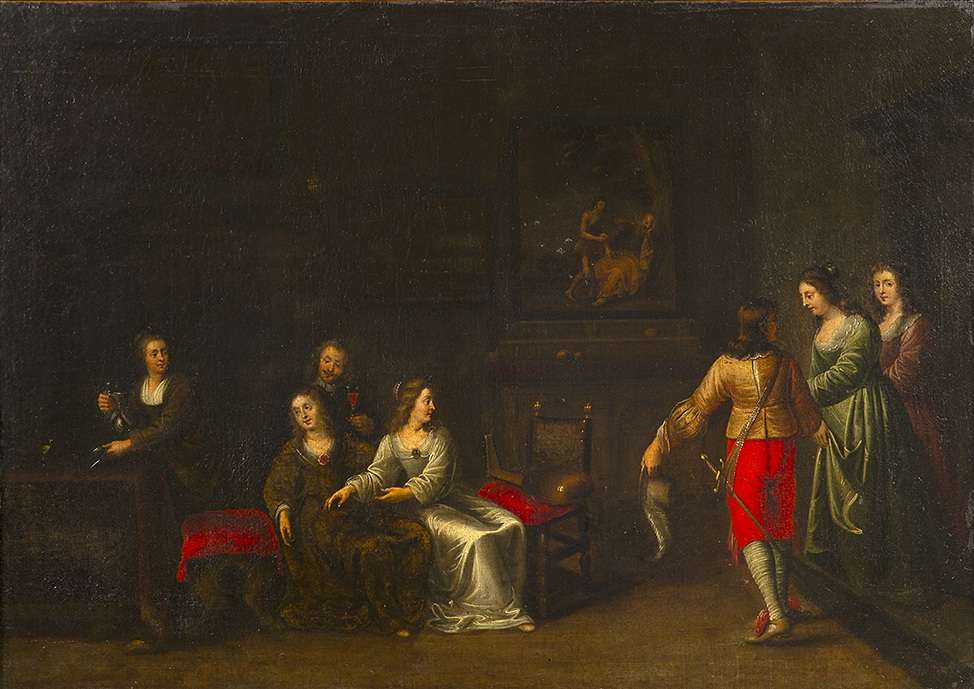
Christoffel Jacobsz VAN DER LAMEN (Brussels, 1606 – 1651)
A cheerful atmosphere indoors
A cheerful atmosphere indoors
Canvas
, 72 × 101 cm – 28 3/8 × 39 3/4 in.
A cheerful atmosphere indoors, canvas
Private collection, France.
Born in Brussels in 1607, Christoffel van der Lamen probably began and continued his apprenticeship under his father, Jacob. In 1636, he joined the Guild of Saint Luke in Antwerp, where he pursued his career until his death in 1651.
He soon specialised in ‘vrolijke gezelschap’, literally ‘merry companies’. Sometimes gathered in the cosy atmosphere of a drawing room, sometimes set in the charming setting of a flower-filled garden, elegant groups engaged in a variety of activities: card games, gallant conversation, impromptu concerts or lively discussions. More popular in the United Provinces, the genre had developed particularly following the work of Willem Buytewech and Esaias van de Velde (1587–1630). Among its followers were Dirck Hals (1591–1656) in Haarlem, Pieter Codde (1599–1678) and Willem Duyster (1599–1635) in Amsterdam.
The success of these subjects reached our Flemish artist, who adopted their conventions: in the warm atmosphere of a drawing room, elegant figures gather for a joyful moment to the sound of the lute, intoxicated by the wine filling their glasses. As is often the case in such merry gatherings, one of the figures invites us to step into the scene and share in the excitement. Standing discreetly apart from her companion who is about to enter, a young woman in a pink dress looks beyond the painting and meets our gaze directly. We are invited to join the circle, whose apparent light-heartedness should not make us forget its moral dimension. Thus, under the gaze of a biblical or mythological scene, the women allow themselves to be seduced by gallant companions, whilst the wine further sweetens the moment. In this subdued setting, van der Lamen works with finesse on the satins and velvets of his fabrics. The background, playing a secondary role, consists almost entirely of earthy tones, allowing the array of colourful dresses and the radiant touches of red here and there to stand out all the more. The painter demonstrates his attention to detail in the rendering of the hairstyles, adorned with pearls, and in the depiction of the materials. More so than his northern counterparts, he emphasises the decorative nature of these elegant gatherings of figures.