
&w=3840&q=75)
&w=3840&q=75)
&w=3840&q=75)
&w=3840&q=75)
&w=3840&q=75)
&w=3840&q=75)
&w=3840&q=75)
&w=3840&q=75)


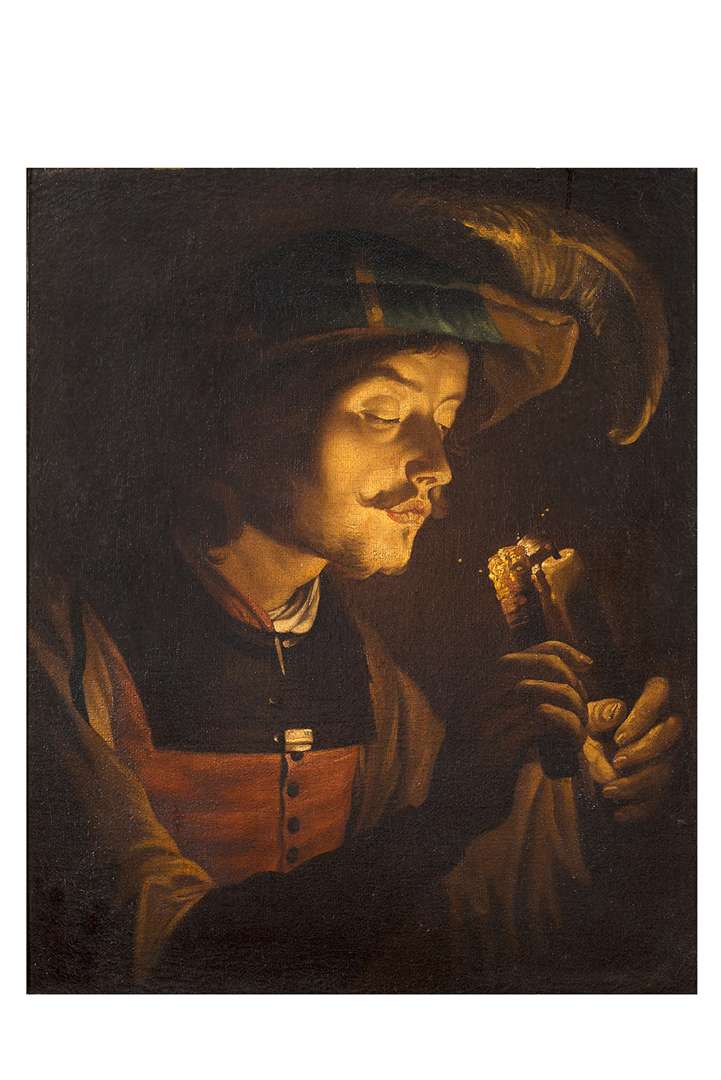
Attributed to Matthias STOM (Amstelveen, 1589/90 – after 1650)
The man lighting a candle with a poker
The man lighting a candle with a poker
Canvas, 70 x 55 cm – 27 1/2 x 21 5/8 in.
A man lighting a candle with a firebrand, canvas
. On the reverse, a label bearing the number 7003 and a customs label.
Galerie Georges Giroux (according to a label on the reverse); private collection, Belgium.
Gianni Papi, Matthias Stom. A Caravaggesque Painter in Lombard Collections, exhibition catalogue, Pinacoteca Tosio Martinengo, Brescia, 18 September 2025 – 15 February 2026, Skira, p. 184.
Vincenzo Abbate, Pittori del Seicento a Palazzo Abatellis, exhibition catalogue, Palermo, Electa Editore, 1990,
p. 154.
T. H. Fokker, Nederlandsche schilders in Zuid-Holland, 1929, p. 18.
Matthias Stomer, who is documented in Arcione in 1630–1631, was probably born in the late 16th century. He subsequently travelled to Italy to complete his apprenticeship, influenced by the career of Gerrit van Honthorst (1592–1656). In Rome, he studied the works of van Honthorst, but above all those of Caravaggio (1571–1610), of whom Gherardo della Notte—as he was known—was himself a follower. He was in Messina in 1630, then in Naples for around ten years, and his works were scattered amongst the churches along his travels. In 1640, he was in Sicily and three of his paintings were acquired by Antonio Ruffo (c. 1610–1678), Duke of Messina, a collector and patron of Rembrandt. In the 1650s, he was in Bergamo before the sources lose track of him.
Deeply influenced by Caravaggio, Stomer borrowed his chiaroscuro and tight framing. Whilst our painter preferred to use typical, idealised figures in his religious compositions rather than those of his master, he nevertheless adopted live models for subjects depicting everyday life, as he does here with this young man attempting to light a candle with an ember. Glowing red-hot, the ember makes the figure emerge from the darkness.
This subject was painted on several occasions by Matthias Stomrer. He uses the same composition as in the paintings held at the Accademia Carrara in Bergamo (inv. 58AC00217), the Galleria Regionale della Sicilia – Palazzo Abatellis in Palermo (inv. 369), at the National Museum in Warsaw, and in a private collection. It can also be compared with the version formerly held in the Bartel Collection in Kassel, with which it bears a striking resemblance. There are also other early copies of this distinctly Caravaggesque composition.
This motif of a young man using a burning piece of wood to stoke the flames is found in the work of other painters who followed Caravaggio. For instance, Honthorst (Fig. 1) and Georges de La Tour (1593–1652) (Fig. 2) both explored this theme, depicting the moment when a breath is about to kindle the flame. For the painters, this was a tour de force demonstrating their ability to capture the fleeting reflections of the glow from an unstable, faint fire on flesh, fabrics and the surroundings.
Fig. 1
Gerrit van Honthorst, Boy Blowing on an Ember, c. 1621–1622, Chicago Art Institute (inv. 2018.135)
Fig. 2
Georges de la Tour, The Smoker, Tokyo, Fuji Art Museum © Tokyo Fuji Art Museum Collection