
&w=3840&q=75)
&w=3840&q=75)
&w=3840&q=75)
&w=3840&q=75)
&w=3840&q=75)
&w=3840&q=75)
&w=3840&q=75)
&w=3840&q=75)


Philippe Jacques VAN BRÉE (1786, Antwerp – 1871, Saint-Josse-ten-Node, Brussels)
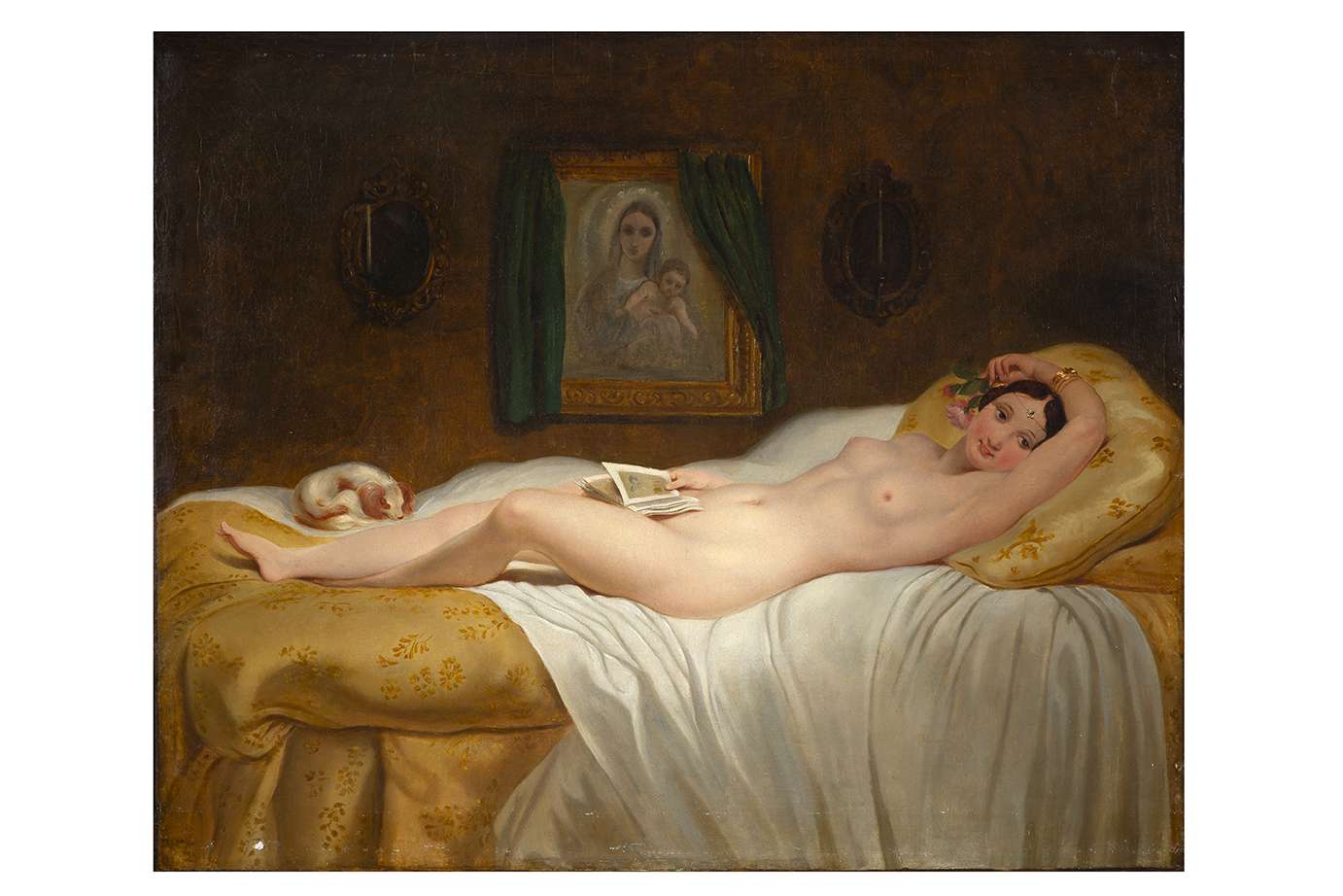
Odalisque
Odalisque
Canvas
, signed and dated 'Rome' in the top right-hand corner: P. Van Brée / Rome
66 x 94 cm - 26 x 37 in.
Odalisque, canvas, signed and dated in the upper right-hand corner
Private collection, Germany.
Born in Brussels in 1786, Philippe-Jacques Van Brée’s first teacher was his brother, Mathieu-Ignace (1773–1839), who was thirteen years his senior. From 1811 onwards, he exhibited at the Brussels Salon. That same year, he left for Paris and joined the studio of Girodet (1767–1824), from whom he adopted the smooth, refined style of the Neoclassical painters. Between 1816 and 1818, he travelled to Rome, funded by the Pankaufes, a wealthy couple of patrons. Deemed not productive enough for his patrons’ liking, his stay in Italy was interrupted for two years, during which he returned to France.
From his very first stay on the peninsula, Van Brée confirmed his taste for drawing and a style inherited from the school of David (1748–1825).
By 1821, Van Brée was back in Rome, from where he made a name for himself throughout Europe. Close to his fellow Belgians, he also moved in local high society circles. At the turn of the 1830s, he returned to Brussels and resumed his participation in the triennial Salons, where he exhibited for a few years before his style fell out of favour in favour of a new generation of Romantics—a situation also experienced at the same time by his contemporary François-Joseph Navez (1787–1869).
Van Brée was in Rome when he painted this languid nude, drawing obvious inspiration from Giorgione (1477) and Titian (1510). From the former, he adopts the positioning of the legs and the arm that wraps itself above the head (Fig. 1). From the latter, he takes the alert face, the gaze turned towards the viewer, the understated adornments, the flowers, and the little dog curled up at her feet (Fig. 2). Positioned as if mirroring these odalisques, the young woman stands out with a more mischievous air and a more slender physique. Whilst red reigns supreme in Venetian art, it is a luminous, warm yellow that dominates in our painter’s work. Here, there is no landscape, no palace, but the hushed confines of a single room over which a Virgin and Child watches. Concealed behind a curtain, which is conveniently drawn, this clearly arouses in the infant Jesus an irrepressible desire to draw closer to the naked body. Somewhat provocative in form, Van Brée confirms that he is the heir to the teaching he received. He thus presents a smooth, glossy, almost porcelain-like painting, resolutely inspired by the classical tradition, whose coldness he subtly tempers through the delicacy and charming expressiveness of his figures.