
&w=3840&q=75)
&w=3840&q=75)
&w=3840&q=75)
&w=3840&q=75)
&w=3840&q=75)
&w=3840&q=75)
&w=3840&q=75)
&w=3840&q=75)


Jean-Charles LANGLOIS (Beaumont-en-Auge, 1789 – 1870, Paris)
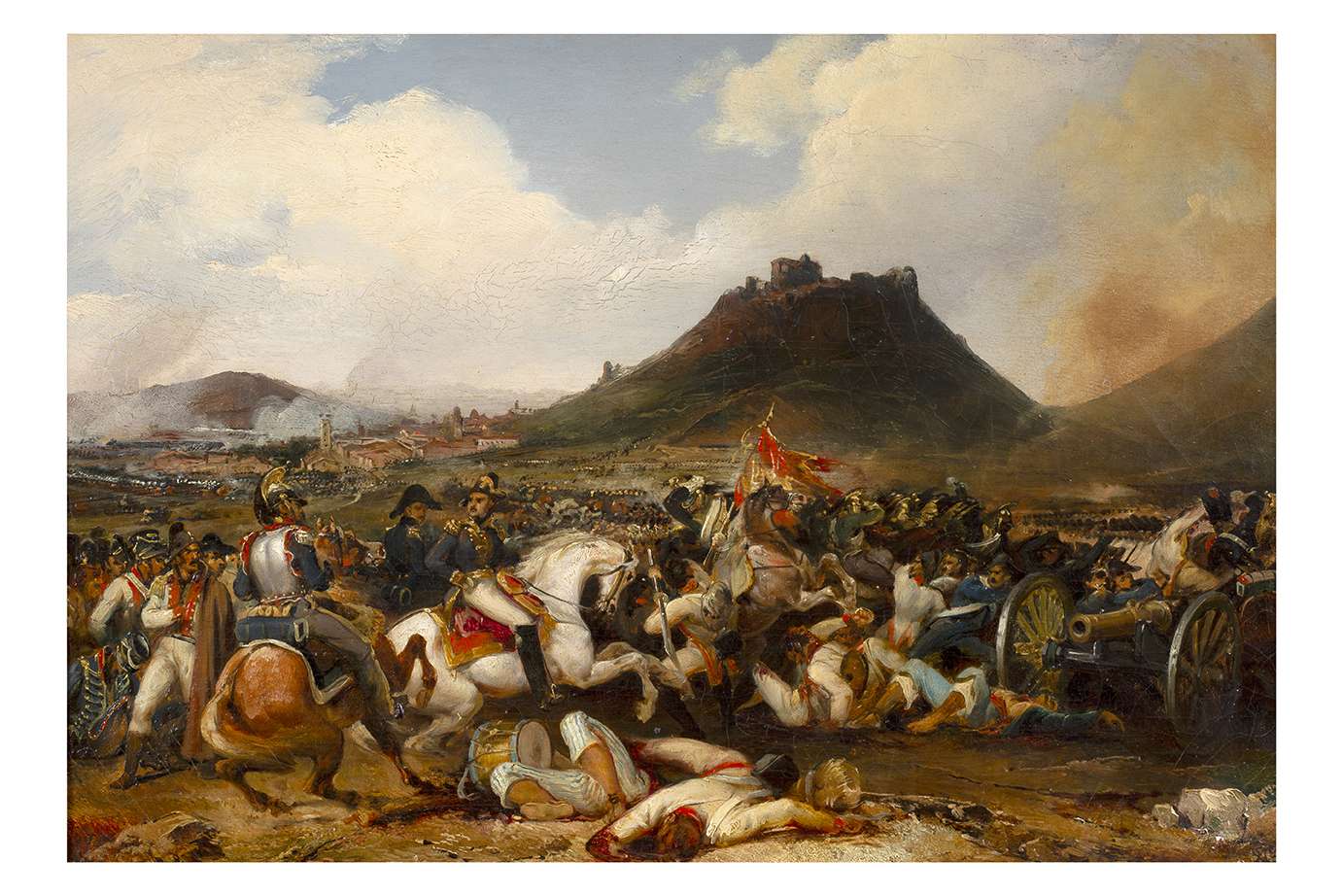
The Battle of Castalla on 21 July 1812
The Battle of Castalla on 21 July 1812
Original
canvas, 35 x 50 cm – 13 3/4 x 19 3/4 in.
This may be a variation on the large-format version (Fig. 1) held at Versailles (inv. 5625) and commissioned in 1836 by Louis-Philippe. However, given the loose brushwork and a few differences in the motifs, it could also be a preparatory sketch for the final work.
The Battle of Castalla on 21 July 1812, original canvas
Private collection, France.
“Of all my pupils, Mr Langlois is the one of whom I am most proud; his efforts and tireless zeal have, in a short space of time, set him apart from the young men who intend to pursue a career in the arts,”[1] wrote Horace Vernet of our painter. Born in Normandy to a father who ran an inn, he received a good education, entered the École Polytechnique and chose to pursue a military career. Until then, nothing predestined him to receive instruction from his famous master
. Perhaps seeking a new purpose, he took up painting following the fall of the Empire and, upon his return to Paris in 1817, frequented the studios of Géricault and then Vernet. Nevertheless, whilst continuing his military career, he combined it with this passion for painting, which he had become deeply enamoured with, and quickly built a reputation as an excellent battle painter. Maxime du Camp wrote: “Colonel Langlois truly worked like a magician and created reality. It is said of a portrait that it is lifelike: all that is missing is the subject’s voice; of his battle scenes, one might say: all that is missing is the sound.”[2].
Having exhibited at the Salons of 1824 and 1827 in particular, Louis-Philippe commissioned him in July 1836 to produce a composition depicting the Battle of Castalla on 21 July 1815, which he presented at the Salon of 1838 (Fig. 1). A triumphant victory for the French army, the battle took place during the Spanish War of Independence, in which the Empire, as was often the case, was pitted against the United Kingdom, then allied with Bourbon Spain and Portugal. Langlois captures the moment when the 24th Dragoon Regiment launches a surprise charge against the Spanish ranks, which are facing another French division.
Bodies litter the ground in the foreground, others are piled beneath the horses’ hooves and the wheels of the cannons; the officers continue to issue orders; the dragoons’ sabres cleave through the crowd; blood beads on the battlefield, dust rises above the mass; everything here conveys the violence of the moment, the chaotic and deafening atmosphere of the clash of armies. Théophile Gautier refers to this angle adopted by the painter in one of his reviews: ‘One thing that Monsieur Langlois has rendered with the terrible sincerity that such a vast canvas—which envelops the viewer like a natural horizon—allows and demands, is the aspect of butchery, carnage, slaughterhouse and carcass disposal that war represents. "[3]
Immersive, the scene is reminiscent of the artist’s penchant for the new spectacles of illusion, of which the panorama is one of the most popular. Setting off for the East in the 1830s, a journey that would inspire him to create, in turn, these works conceived in 360°.
[1] François ROBICHON, André ROUILLE, Jean-Charles Langlois, 1789–1870: The Spectacle of History, exhibition catalogue, Caen, Musée des Beaux-Arts, 9 July – 17 October 2005, cited on p. 19.
[2] Maxime Du Camp, Souvenirs littéraires, Paris, Hachette, 1882 (3rd edition: 1906), p. 357.
[3] Colonel Langlois, 1789–1870: A Painter of the Napoleonic Epic: Collection of the Langlois Museum, Caen, exhibition catalogue, Boulogne-Billancourt, Bibliothèque Marmottan, 11 October 2000 – 24 February 2001, cited on p. 28., op. cit., cited on p. 28.
A reproduction with variations on the large-scale version (Fig. 1) commissioned in 1838 by Louis-Philippe and held at Versailles (inv. 5625).