
&w=3840&q=75)
&w=3840&q=75)
&w=3840&q=75)
&w=3840&q=75)
&w=3840&q=75)
&w=3840&q=75)
&w=3840&q=75)
&w=3840&q=75)


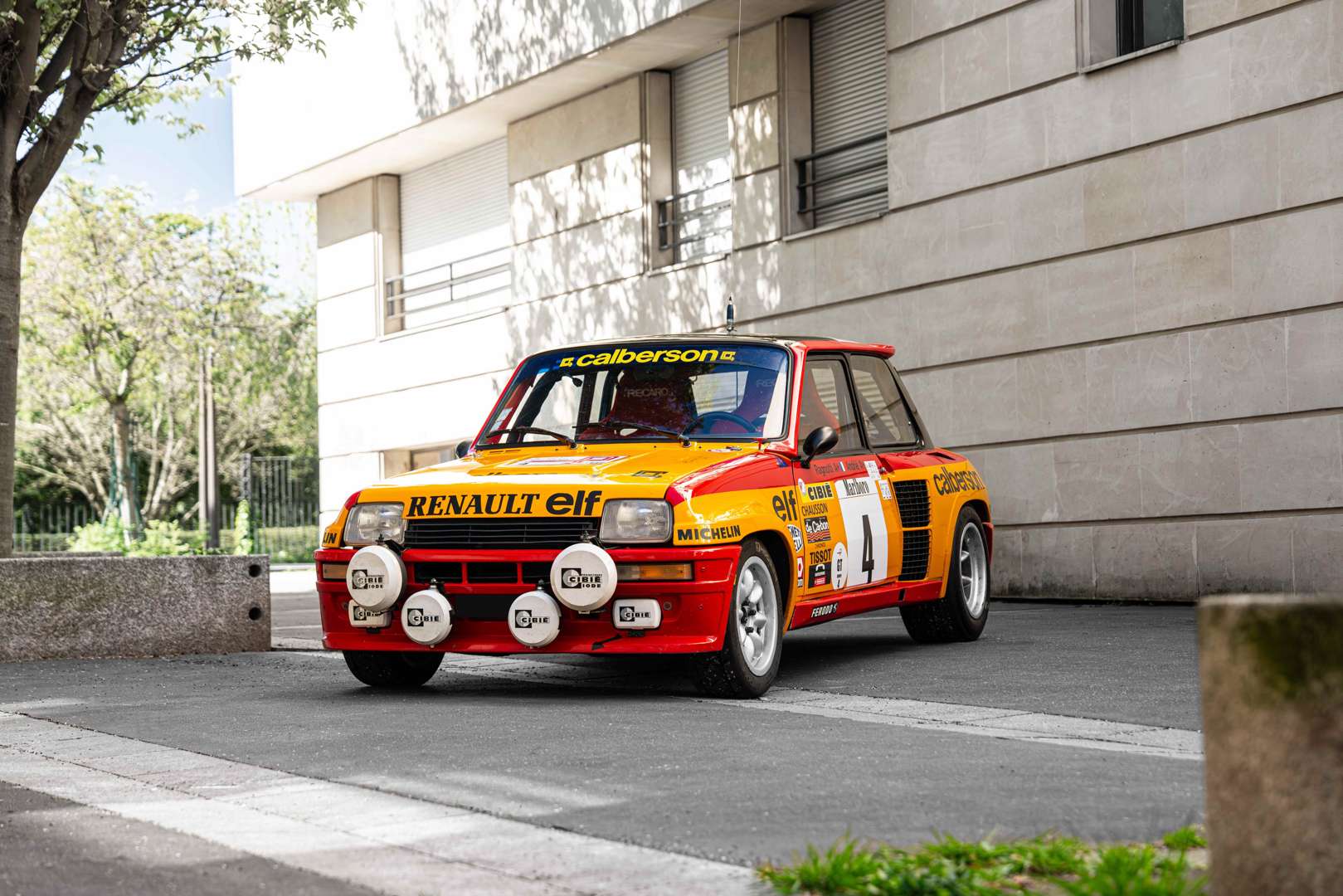
1980 – Renault 5 Turbo Group 4 Calberson
Chassis no. B000036
French registration document
- A landmark car in Renault’s racing history
- Official car, the only one prepared by Renault F1 and not Viry-Châtillon!
- First R5 Turbo homologated in Group 4, the only Calberson in existence
- Undeniable authenticity and history
- Numerous stage wins in the 1980 Tour de France and Tour de Corse with Jean Ragnotti
- Development car for the 1981 Monte Carlo Rally
- Registered on 8 September 1980 under number 126 TZ 91, the R5 Turbo chassis #B000036 is the first R5 Turbo homologated in Group 4, and as such, the very first of its kind. Built not in Viry-Châtillon but in the Formula 1 department in Antony, alongside Alain Prost’s single-seater, it benefits from a truly unique treatment: its 1.4-litre turbocharged engine is the only one in the entire R5 Turbo series to have been prepared by Renault’s F1 workshop. ‘Coco’ Prié, the legendary pit mechanic, remembers its assembly in this exceptional setting perfectly.
Fitted from the outset with the spectacular Calberson livery, named after the famous carrier that had previously sponsored the A310 V6, the R5 Alpines of Fréquelin and Ragnotti, and the Alpine A442s at Le Mans, #B000036 is an official works car in every sense of the word, both technically and visually.
Its mechanics feature remarkable specifications, inherited directly from the competition programme: a Chausson air-to-water intercooler, a specific turbocharger without an integrated wastegate, a dedicated exhaust manifold, a dry sump with an oil reservoir, a close-ratio gearbox with a 40% ZF limited-slip differential, a pedal assembly with twin master cylinders as on single-seaters, and that large sensor plate derived from the Porsche 928. An architecture that directly foreshadowed the 1983 Tour de Corse version, developing around 260 hp and which would evolve to the 350 hp of the Maxi.
- Its baptism of fire took place at the 1980 Tour de France Automobile, a 2,700 km race held in late September. Driven by Jean Ragnotti, co-driven by Jean-Marc Andrié, #B000036 immediately caused a sensation: fastest time on the very first special stage, despite a spin at 120 km/h that forced ‘Jeannot’ to drive 200 metres in reverse, guided solely by the rear-view mirror. The R5 won six consecutive special stages, leaving Darniche’s Stratos more than two minutes behind in the fog at Le Burzet. The gearbox was changed in a record twelve minutes flat in Nîmes, an absolute record according to Coco Prié! The car would retire due to an ignition problem, but it had definitively demonstrated its superiority. The Stratos was looking decidedly past its best.
At the next Tour de Corse, the in-house engine specialist, Philippe Chasselut, had worked further to reduce the turbo’s response time, and Ragnotti claimed the first four stage wins. A puncture temporarily set him back, but he returned to the lead ahead of Darniche. In Castagniccia, in pouring rain, the driver’s talent and the R5’s exemplary handling in the wet widened the gap. The retirement came from a broken alternator belt, just as victory seemed assured. A cruel disappointment, but a striking demonstration of the car’s qualities.
In the Cévennes, Ragnotti was entered in a Calberson-liveried R5 Turbo Gr. 3, which would serve as Saby’s mount for the upcoming Monte Carlo. In preparation for this event, where the Régie entered a new car painted in the new yellow, white and black colours identical to those of the F1 cars, #B000036 was then used as a test car for tyre trials on snow with Jean Ragnotti. Numerous period photographs document this time.
- At the request of Jean Sage, then head of Renault F1, the car was quietly returned to the Renault Sport reserves and subsequently used for gravel testing. There is also a video of the car with Jean Ragnotti on the private circuit of the Wambergue brothers, a famous family of racing drivers. We obtained, directly from the family, the film of this test session in which we see #B000036 going head-to-head with the brand-new Audi Quattro! Fantastic footage…
Kept by Jean Sage at the Régie, #B00036 was sold in May 1989 to a major collector in the Loire region. It was he who put it up for sale in 1997 at Maître Poulain. It was then bought by a French collector who entered it only in the Rallye du Var and then the Tour de Corse Historique in the early 2010s before having to part with it in 2014. As luck would have it, it was his son who acquired it at an auction in Monaco at RM Sotheby’s in 2022! Deeply attached to this car that was part of his childhood, he took the plunge and decided to enter the Tour de Corse Historique at the wheel, where it caused a sensation amongst numerous cars that were merely new replicas of vintage models... Since then, extensive work has been carried out by the talented William Roze (Heritage Mécanique) near Tours. The gearbox has been dismantled and inspected, whilst the original engine and fuel injection system have been completely rebuilt. The original shock absorbers have been dismantled and reconditioned, and all discs and pads replaced, with a full inspection of the running gear. Naturally, the car has retained its original 4-piston calipers and Minilite magnesium wheels.
A truly miraculous state of preservation
- Forty-six years after its exploits, #B000036 is in a state of authenticity that we will likely never see again in a racing car of this calibre. It still sports its original Calberson livery (repainted in 1983). Its running gear, the authenticity of which is attested by a substantial photographic album from the Tour de France and the Tour de Corse, is period-correct. The mechanics are strictly original, featuring its large, Tour de Corse-specific turbocharger. The extremely rare 15-inch Minilite magnesium wheels are still in place. The interior has retained its carpets, its patina and its extremely rare on-board computer. A review of period photographs confirms that every detail, right down to the bonnet fasteners, has been preserved.
The only deviations from the 1980 configuration are minimal and fully documented: a recent turbo pressure gauge, the rear section of the roll cage slightly ‘oversized’, and seats and seatbelts to VHC standards (the original seats are, of course, supplied with the car). Everything else is period, factory-fitted and original.
- Its authenticity has been formally recognised by the key figures of the era themselves, starting with ‘Coco’ Prié, who was present at the 2013 Tour de Corse Historique. It bears an inscription on the bonnet by Jean Ragnotti: “Bravo for my old car!” and the brand’s historian, Gilles Vallerian, assisted us in compiling its history, such is his knowledge of and admiration for this car’s story.
The R5 Turbo and its history
The Renault 5 Turbo was born in 1977 from the vision of Jean Terramorsi, deputy director of Renault’s Product Division, who envisaged a true rally car based on the brand’s star model. A mid-mounted turbocharged engine, reinforced chassis, special suspension, a body combining steel, polyester and aluminium, and an extravagant rear track: unveiled in 1978, the R5 Turbo sparked a frenzy of excitement from its very first appearance at the 1979 Tour d’Italia, where Fréquelin gave the Stratos and Porsche a run for their money before retiring. What followed was glorious: Monte Carlo 1981, Tour de Corse 1982 and 1985, Tour de France Auto 1984 and 1985, and the development leading up to the Maxi 5 Turbo. Ragnotti, Thérier, Fréquelin, Saby, Auriol, Chatriot, Prost: all the great names in French rallying have sat behind its wheel. The Régie’s little firecracker has joined the Alpine Berlinette in the pantheon of rally cars.
#B000036 is undoubtedly one of the most significant factory R5 Turbos in existence.
The first Gr. 4-homologated R5 Turbo, and the only example in Calberson livery in this category, the other two Calberson R5s being a Gr. 3 and a Gr. 5 prototype, both of which have since disappeared.
It (#B00036) combines, in a stunning state of preservation, everything that makes a major historic car valuable: absolute uniqueness, certified factory origin, a track record of success at the highest level of competition, and impeccable authenticity.
Eligible for all VHC events and equipped with a PTH, it is a true racing car… and the finest of its kind available today.