
&w=3840&q=75)
&w=3840&q=75)
&w=3840&q=75)
&w=3840&q=75)
&w=3840&q=75)
&w=3840&q=75)
&w=3840&q=75)
&w=3840&q=75)


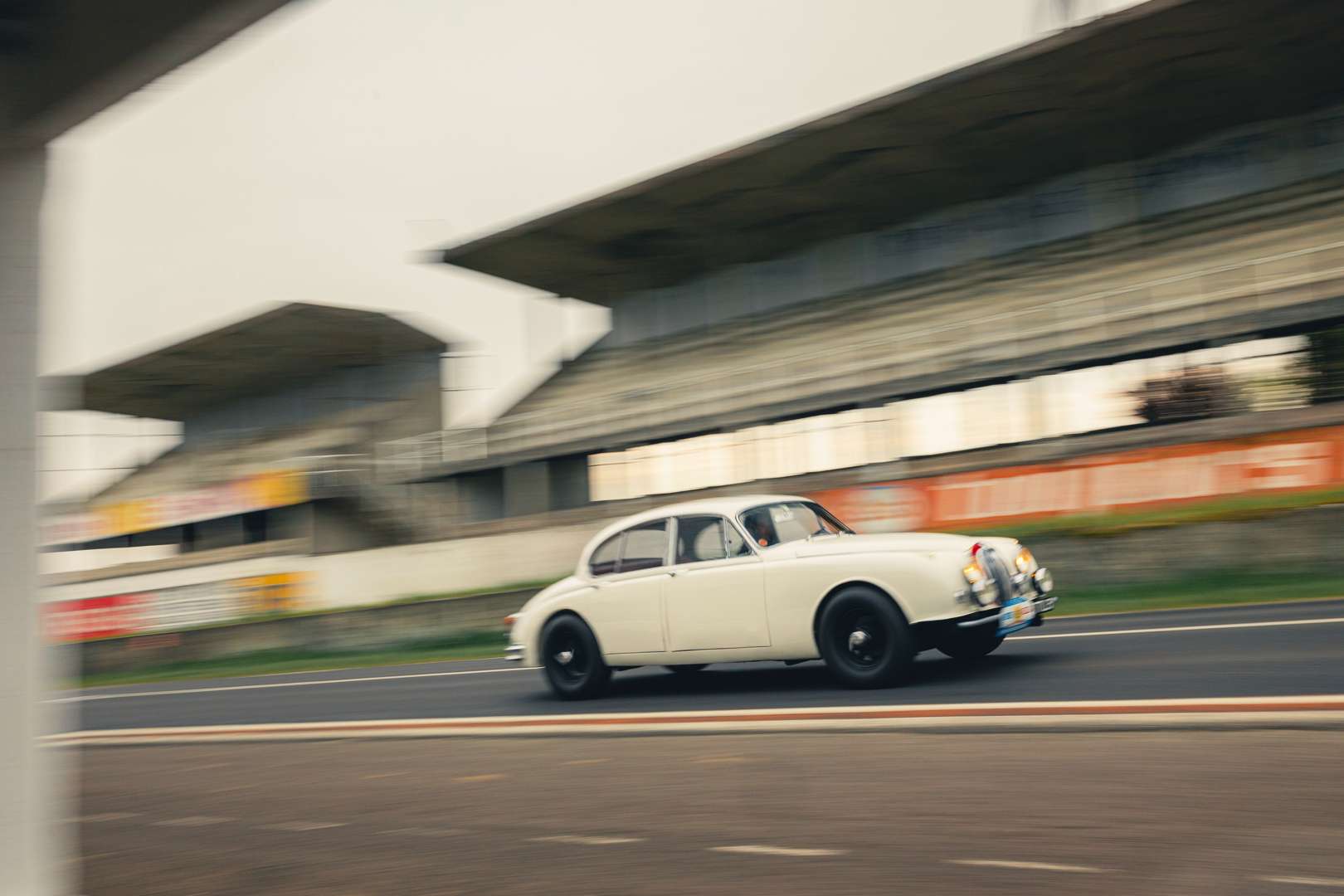
1961 Jaguar MK2 3.8 Tour de France Factory Edition
Fees include commission and taxes.
1961 – Jaguar Mk2 3.8 – Factory-prepared – Tour de France Automobile
French registration document — Sold without MOT
Chassis no. 217687
An officially prepared Jaguar Mk2, boasting an exceptional track record in the hands of Bernard Consten and Annie Soisbault, whose clear and thoroughly documented history commands respect.
- Winner of the 1961 Tour de France Automobile with Bernard Consten
- Impressive track record, notably including two entries in the Tour de France (1961 and 1962), the Tour de Corse, the Cévennes and Mont Ventoux with Annie Soisbault
- Factory-prepared, 3.8-litre competition engine producing 240/250 hp, close-ratio gearbox, direct steering, limited-slip differential, etc…
- Crystal-clear provenance and traceability, exceptional and well-documented condition
- One of only two surviving ex-Consten Mk2s, eligible for the biggest international historic events
- Buoyed by its triumphs at the 24 Hours of Le Mans, Jaguar was then enjoying a golden age and offering an ambitious range. It was in this spirit that the idea took root in William Lyons’ mind to install the prestigious XK engine under the bonnet of a saloon. Unveiled at the London Motor Show in 1959, the Mk2 replaced the Mk1 and immediately established itself as the world’s fastest production saloon. The proof was in the results: fitted with the 3.8-litre engine, it enabled Bernard Consten to win the Tour de France Automobile four times in a row, from 1960 to 1963.
Chassis No. 217687 is precisely the one with which ‘Monsieur Tour Auto’, French rally champion in 1958, 1961, 1962 and 1967, secured his third Tour de France Automobile victory in 1961. A key figure in French motorsport, Bernard Consten has to his credit six appearances in the 24 Hours of Le Mans, a victory in the Coupe des Alpes, the Liège-Rome-Liège, and the 1961 Targa Florio – where he certainly showed off all his talent at the wheel of his Alfa Romeo SZ against a host of Italian rivals (8th overall and 1st in his 1300cc class ahead of no fewer than 17 Alfa Romeo SZs and 7 seconds clear of the runner-up… a remarkable feat!), the Mille Miglia, not to mention appearances at the Nürburgring, the 1,000 km of Paris and the 12 Hours of Sebring. After such a brilliant and busy career, he served as president of the FFSA from 1968 to 1973, then organised the Tour de France Automobile from 1969 to 1980. Modest, passionate and admired by all, he passed away in 2017 at the age of 85.
To understand how the factory managed its racing commitments, one had to look to Charles Delecroix, head of the Royal-Elysée dealership in Paris. It was he who, from Paris, represented the British brand on the French market in the 1950s and 1960s, and it was in his workshops that the Jaguar Mk2s entered in competition — including Bernard Consten’s — were prepared. To be even more precise, the cars registered with the number 777 belonged to the importer; the others, including the 1960 5 KG 75 and the 1962 6932 MU 75, were owned by Consten himself. Over the years, his friend Gérard Lanvin, who looked after his cars, became his official and loyal mechanic. Between the two of them, trust was one of the keys to their success. Adjustments and fine-tuning were carried out without delay, and until Gérard Lanvin joined Alfa Romeo from his Lovauto garage in Boulogne, it was he who oversaw the development of Consten’s cars.
- Following his victory in the 1960 Tour de France Automobile in a Mk2 (registered 5 KG 75), Royal Elysée commissioned a new 3.8-litre model from the factory, prepared for competition. Entrusted to Consten, it was registered 777 LL 75, just in time for the 1961 Tour de France. The car sported an Old English White livery with a grille edged in red, flanked by its long headlamps. The engine tuning boosted power to 240/250 hp according to the press of the time, nearly 30 hp more than the previous year. But that’s not all: the air intake system without air filters for the carburettors, the direct steering, the limited-slip differential and the ‘close-ratio’ gearbox transformed the car and its performance. The slim tubular front bumper, designed to accommodate Dunlop Racing tyres, also allowed for the fitting of large brake ducts to ensure better cooling, the exhaust system, which lacks baffles but features two identical tailpipes, and a second fuel tank mounted in place of the spare wheel – whilst retaining the original fuel filler, unlike those that would follow – complete the list of modifications. Whilst the interior is left to the tuners’ discretion, all retain their wood trim but swap their front seats and rear bench for special bucket seats. ‘217687’ still retains its original upholstery, its two bucket seats and a few accessories, including a passenger-side starter button to restart the car more quickly in the event of a ‘spin’, or its quick-release bonnet, amongst other things…
For this edition, the route of approximately 5,300 km is divided into five stages, returning to the traditional start and finish in Nice. Compared to 1960, the route has been slightly updated: the Nürburgring is no longer on the programme, Spa has been replaced by Brussels, with nine hill climbs and six circuits, plus two brand-new timed trials in Corsica!
Bernard Consten once again put his experience to good use, leading the race for the vast majority of the stages despite fierce competition from the four other Jaguar Mk2 Tour de France cars, including Jopp-Baillie’s No. 86. A symbol of his superiority, the man who was not yet known as ‘Monsieur Tour Auto’ at the time left the competition trailing in the Massif Central during the night-time climb up Mont Revard. With a 28-second lead over Jopp’s Mk2, his performance would have placed him 5th overall in the GT and Touring car categories; only the four Ferraris driven by Mairesse, Gzendebien, Oreiller and Simon managed to be faster!
- As soon as the 1961 Tour de France was over, the car was exhibited at the Motor Show on the Jaguar stand alongside the new E-Type. At the last edition held at the Grand Palais, our Jaguar, basking in glory, was purchased by Annie Soisbault, a tennis champion and internationally renowned racing driver. She entered it in rallies during the 1962 and 1963 seasons: Lyon-Charbonnières, Paris-Saint-Raphaël (3rd), and the Tour de France with her loyal co-driver Louisette Texier. A colourful character: of Armenian origin, born Arpine Hovanessian, a survivor of the genocide, she became a showgirl in Paris before turning to motor racing in her fifties, inspired by her meeting with the driver Jean Behra at Montlhéry in 1955. She died in 2021 at the age of 108!
This female duo nearly achieved the feat in 1962, securing numerous podium finishes until a broken half-shaft while they were leading the Ladies’ Cup. They did not stop there, however, going on to compete in the Tour de Corse a few weeks later, the Critérium des Cévennes, the Rallye de l’Ouest, the Rallye de la Baule and the Mont Ventoux, securing a 5th place in the Touring class and two Ladies’ Cups along the way!
- It then sold the chassis to Bayonne-based specialist Vincent Villanueva, who competed in the Rallye Bordeaux Sud-Ouest in 1964. The car then passed into the hands of an enthusiast from the Paris region (with whom we made contact very recently to complete its history), before moving to the north of France, where it remained until 1988, before returning to Paris and crossing the Atlantic in 1990. In the United States, collector Robert (Bob) Rubin, owner of the Bridgehampton circuit on Long Island, took the utmost care of it for over 28 years! 29 pages of invoices from Northumberland Enterprises Corporation between 2006 and 2017 bear witness to meticulous maintenance, carried out with a constant focus on preserving its remarkable original condition.
- Re-imported to France in 2021 by a distinguished gentleman driver, himself linked to the history of the Tour de France, this exceptional Jaguar has since undergone a meticulous cosmetic restoration, faithfully restoring its 1961 appearance. When we took it for a test drive, its mechanics impressed us with their performance. The engine runs smoothly, the gearbox is a delight and, even more surprisingly, the direct steering makes the driving experience far more precise, sporty and efficient. Whilst its Dunlop Sport tyres show their age, we were unable to test its full potential on the old Reims-Gueux circuit, but its braking is incomparably more responsive. Sold with four new 185×15 tyres, perfectly suited to both road use and competition, its future owner will be able to enter it immediately in the biggest international events, for which it enjoys top-tier eligibility.
Authentic factory-prepared Mk2s with such a track record are extremely rare on the market. All in all, Royal Elysée purchased five cars for Consten and one for Soisbault, not a single one more. Of the ex-Consten Jaguar Tour de France cars that have survived to this day, ours is one of only two, the second being well known on the historic scene. In addition to its extensive service history, a letter from Jaguar dated October 1969, included in the file, confirms that chassis no. 217687 was specially prepared for the event. This is therefore an absolutely exceptional opportunity to acquire an official Jaguar racing car that has retained its authenticity.