
&w=3840&q=75)
&w=3840&q=75)
&w=3840&q=75)
&w=3840&q=75)
&w=3840&q=75)
&w=3840&q=75)
&w=3840&q=75)
&w=3840&q=75)


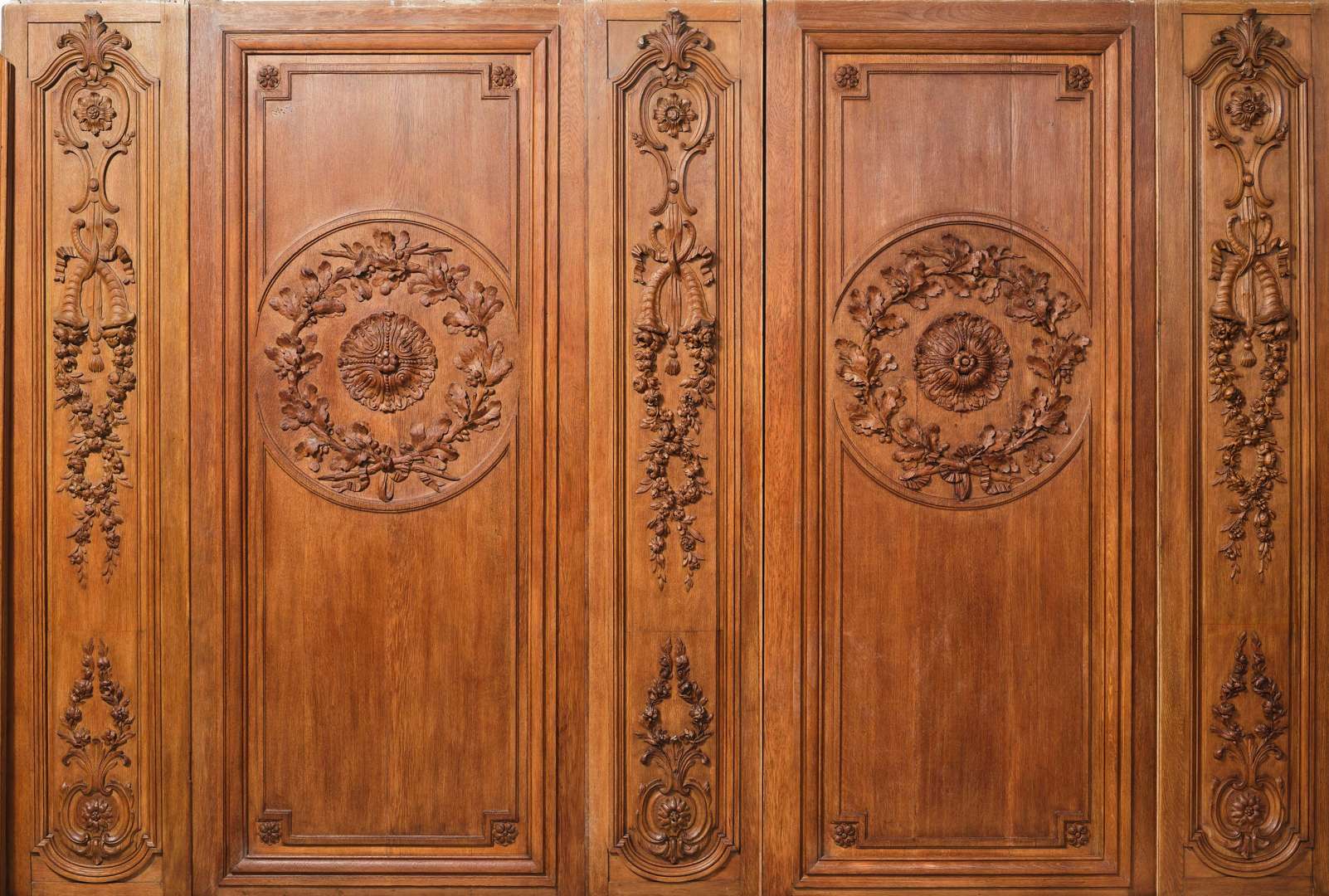
IMPRESSIVE WOODWORK FROM THE HÔTEL DE GRAMONT
A complete set entirely in natural oak, moulded and carved, alternating large panels of high panelling with a rich central decoration featuring a large fleur-de-lis surrounded by a ribboned oak wreath on a flat rectangular field with small fleur-de-lis in the spandrels, and narrow panels of upper panelling richly carved with cornucopias, floral garlands and symmetrical rocaille motifs. The set comprises:
– Five large panels (upper panelling) with large finials (all with unique designs)
– Twelve narrow panels (upper panelling) with rich decorations of cornucopias (all with unique designs)
– A large semi-circular pediment carved with a trophy bearing the attributes of love (quiver and burning torch) in a central medallion framed by a laurel wreath and flanked by two cornucopias overflowing with fruit and flowers.
Louis XVI style, by Eugène Barriol (1865–1938).
Included are two double doors matching the design (modern, reusing the lower panelling), seven small panels matching the lower panelling, and other complementary elements such as skirting boards.
Panel height: 258 cm – Average width of a large panel: 100 cm – Width of a narrow panel: 48 cm. Large pediment: 122 x 194 cm.
(Subsequent adaptations, additions and modifications)
– Acquired by the Duke of Gramont, Armand Antoine Agénor (1879–1962), for his mansion built in 1910 at 42 bis Avenue Georges Mandel, Paris
.– In the Hôtel de Gramont, 42 bis Avenue Georges Mandel, Paris 16th arrondissement
.– Passed in 1962 to the heirs of the Duke and Duchess of Gramont.
– On-site sale in Paris 16th arrondissement, 42 bis Avenue Georges Mandel, 8–9 October 1969; auctioneers: Mr Etienne Ader, Mr Jean-Louis Picard, Mr Antoine Ader, lot no
.12.– Private collection to the present day.
– Catalogue of the sale held in Paris’s 16th arrondissement, 42 bis Avenue Georges Mandel, 8–9 October 1969; auctioneers: Mr Etienne Ader, Mr Jean-Louis Picard, Mr Antoine Ader, lot no. 12.
– France-soir, 10 October 1969, article by R.W. entitled "Before demolishing the Hôtel de Gramont (…)", illustrated with a photograph of our woodwork in situ
.– “Half a century at the Hôtel Gramont” in Connaissance des Arts no. 141 (November 1963), featuring our woodwork.
– François Gilles, Composer-recomposer les grands décors sculptés de l'Ancien Régime, la collection du musée des Arts Décoratifs de Paris, doctoral thesis supervised by Maaike van der Lugt, University of Versailles-Saint-Quentin (in progress).
Woodwork from a bygone era…
This set of woodwork was designed at the beginning of the 20th century by Eugène Barriol (1865–1938) for the Duke of Gramont’s immense mansion, situated between 42 bis Avenue Georges Mandel and 27 bis Rue Decamps; this mansion was fitted out in 1910 by the architect Maugue in a style that was unmistakably Louis XVI. It was demolished in 1969.
This place, more than just a residence, was part of the tradition of the great collectors’ mansions which, at the turn of the 19th and 20th centuries, turned Paris into an indoor theatre where the Ancien Régime was re-enacted. Duke Armand de Gramont, deeply involved in the construction and design of his mansion, created a sophisticated interior, imbued with erudition and memory, where antique woodwork was given a new lease of life, not as relics, but as active elements of a way of life.
For nearly half a century, our wood panelling thus belonged to the Duke of Gramont; it bore witness to receptions attended by the highest ranks of the aristocracy and Parisian society, perpetuating the atmosphere of the salons of the Faubourg Saint-Germain. Countless figures such as Robert de Montesquiou or the Countess Greffulhe (the Duke of Gramont’s mother-in-law), emblematic of a world of elegance and charm, were regular guests there.
Marcel Proust masterfully observed this world and transposed it into In Search of Lost Time. Indeed, it was the Duchess of Gramont’s mother-in-law, the Countess Greffulhe, who inspired the character of the Duchess of Guermantes. It is therefore not unreasonable to see the Hôtel de Gramont as a possible source when he describes “pretty woodwork—I believe it was Bagard who did it—you know, those slender strips so supple that the cabinetmaker would sometimes shape them into little shells and flowers, like ribbons tying a bouquet”.
Beyond their exceptional decorative quality, these wood panelling thus stand as witnesses to a bygone world, whose mark has left a deep imprint on French culture and the literary imagination.
Having remained in place for nearly half a century, they were finally dispersed at the on-site sale organised in October 1969 by the auctioneers Ader and Picard, before entering a private Parisian collection, and are now once again being offered for sale at Aguttes.
One cannot help but perceive a Proustian resonance in them in more ways than one: these panelling pieces carry within them a memory made up of echoes. Thus, beyond their decorative quality, these panelling pieces bear witness to a particular moment in the history of taste: a time when people were no longer content merely to preserve the 18th century, but sought to relive it, to embody it, to inhabit it anew, and yet again…
It should be noted that another set of Louis XV-period panelling from the same provenance is now held at the Getty Museum in Los Angeles [Inv. No. 73.DH.107].
We express our deep gratitude to Mr François Gilles, an eminent specialist in wood panelling, whose work on Eugène Barriol has enabled us to identify the creator of this panelling.
Note by Mr François Gilles:
This panelling is an exceptional testament to the almost historical rigour that certain sculptors applied, in the late 19th and early 20th centuries, to the design of interior decorations. Eugène Barriol, successor to his uncle Jean Montvallat, had made a speciality of reassembling antique panelling, acquired as part of the transformations of old Paris. We owe to them, in particular, the interiors of the Hôtel d’Edmond de Rothschild, the Château des Voisins, the Hôtel de Fels, the Hôtel Lévy, the Hôtel de Breteuil, and so on.
It was through their work with these “old woods”—which they moulded and photographed to preserve their memory—that they acquired the ability to create “in the style of” to faithfully complement historic interiors. In the Hôtel de Gramont, several period interiors had been restored, but certain salons were also given a “period-style” decoration designed to blend as harmoniously as possible with these historical elements. To remain as true as possible to the original style, Barriol drew inspiration from ornamentation selected from panelling he had handled during his career (Palais-Royal, Hôtel Canillac Villedeuil on Place des Vosges, Château d’Aulnay).
Along with the panelling known as the “Quai Malaquais”, currently on display at the Getty Museum in Los Angeles, this panelling is one of the very last remaining examples of what the exceptional yet short-lived Hôtel de Gramont once was. It also bears witness to the undeniable talent of the sculptor Eugène Barriol, who was able to deceive the eyes of his contemporaries, transporting them into a world where appearances would always remain those of the Ancien Régime.