
&w=3840&q=75)
&w=3840&q=75)
&w=3840&q=75)
&w=3840&q=75)
&w=3840&q=75)
&w=3840&q=75)
&w=3840&q=75)
&w=3840&q=75)


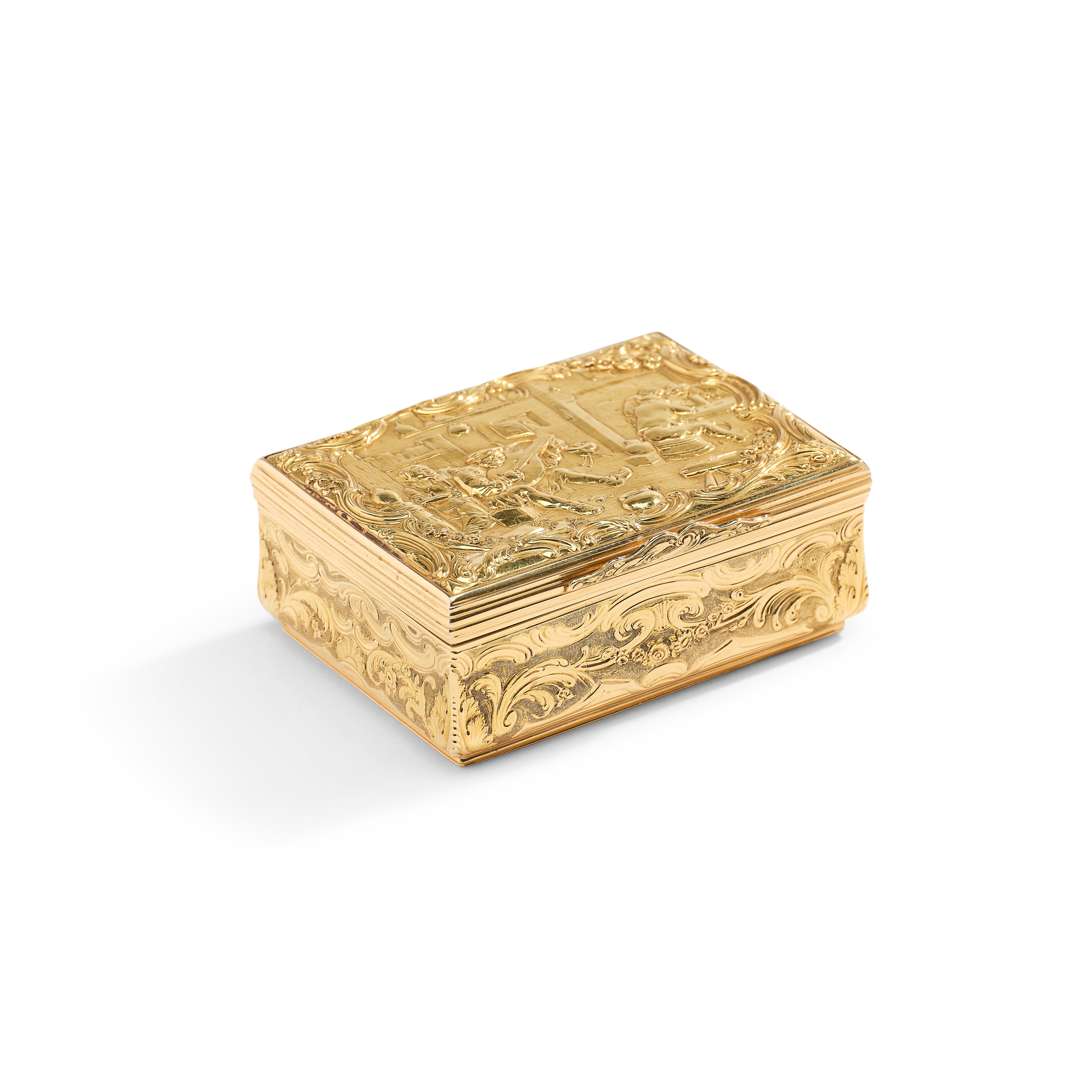
A RARE SNUFF BOX PRESENTED BY CHARLES LONG TO ANTONIO CANOVA
Rectangular snuffbox, baluster-shaped, in chiselled and engraved yellow gold on all sides. The lid is decorated with a tavern scene featuring a lute player, in the style of Teniers, within a rocaille frame. The inside of the lid is engraved with a dedication: “Charles Long, / Al suo Amico / Antonio Canova.” The sides and base are decorated with engraved rocaille and scrollwork.
England, London, date letter T for 1818. No silversmith’s mark.
Height: 2.8 cm - Width: 7.3 cm - Depth: 5.6 cm - Weight: 163.8 g.
(Light, even wear)
– Collection of Henry D. Hill (1899–1994) and his brother Sidney, of the Berry-Hill Gallery, New York
.– Reportedly the collection of the Duchess of Windsor (1896–1986)
– A private French collection, reportedly derived from the former.
– The Magazine of Antiques, Volume 53, No. 2, 1948. Pages 104 and 106 (our snuffbox reproduced).
– Henry and Sidney Berry-Hill, The Fascinating History of the Century of the Snuffbox, Abelard Press, New York, 1953. Our snuffbox is illustrated on the title page.
Charles Long (1760–1838), the future 1st Baron Farnborough, was one of the great art lovers and patrons of the arts in England at the turn of the 18th and 19th centuries. A statesman, collector and renowned ‘connoisseur’, he maintained a long-standing and close relationship with Antonio Canova (1757–1822), the most famous Neoclassical sculptor of his time. Canova, based in Rome and admired throughout Europe, found in Charles Long a privileged contact in the British world, who was at once a friend, an admirer and a link to the English elite.
Charles Long had known Antonio Canova for nearly thirty years and continued, at the start of the 19th century, to act as an intermediary in his dealings with the Prince Regent. The inscription engraved on the inside of the lid of our snuffbox – “Charles Long, / Al suo Amico / Antonio Canova” – thus takes on its full significance: it places this snuffbox firmly in the realm of an intimate gift, offered as a token of esteem and a lasting friendship between a great English connoisseur and the Italian artist whom he counted among his close friends.
Such an object, linking one of the greatest sculptors of his time to one of his closest British supporters, is extremely rare, both for its personal nature and for the quality of the bonds it embodies.