
&w=3840&q=75)
&w=3840&q=75)
&w=3840&q=75)
&w=3840&q=75)
&w=3840&q=75)
&w=3840&q=75)
&w=3840&q=75)
&w=3840&q=75)

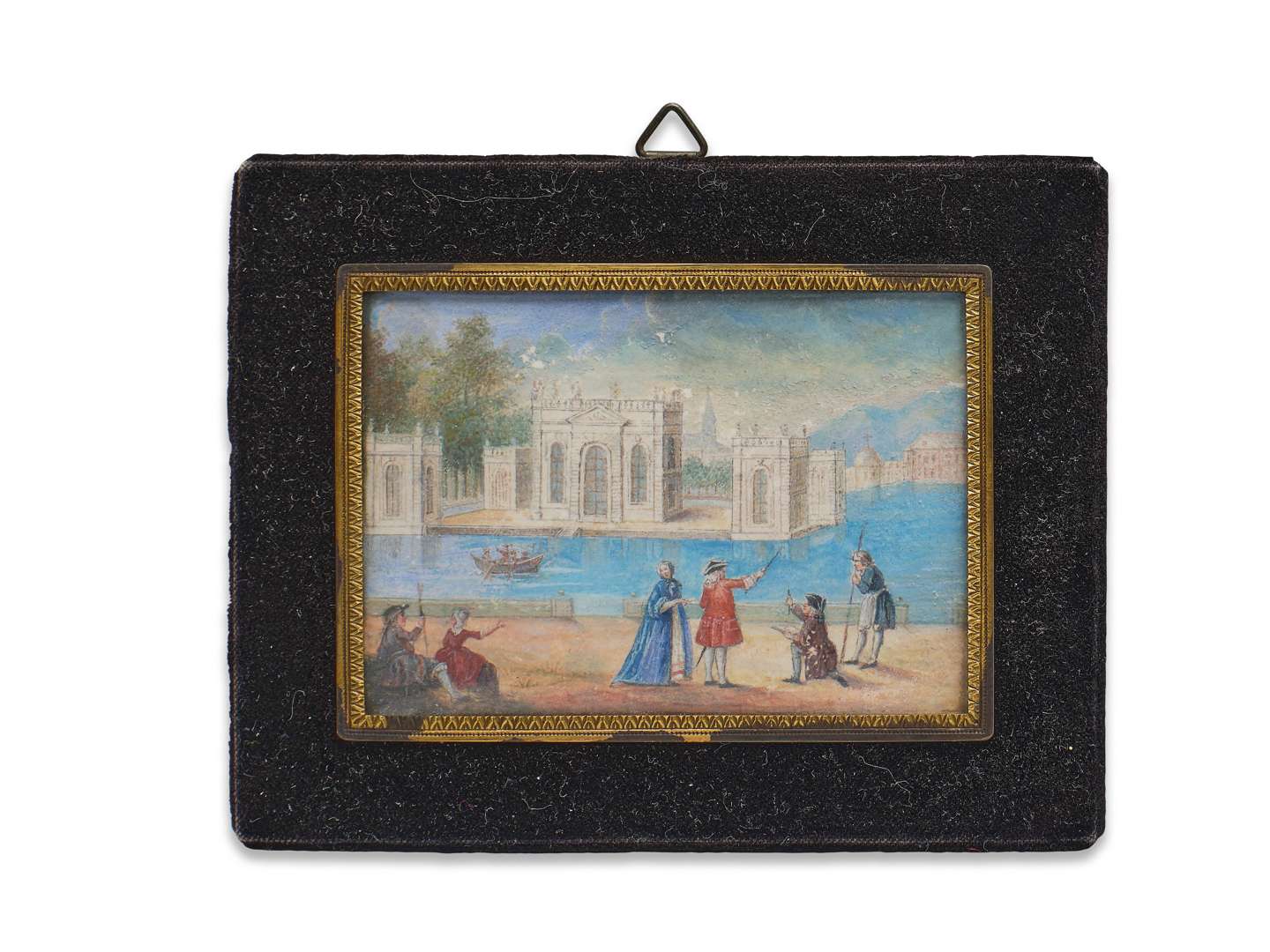
Attributed to Louis Nicolas Van Blarenberge (1716–1794)
A miniature painted in gouache on paper, depicting figures in an architectural landscape featuring canals. Probably an architect presenting his work.
Height: 7.7 cm – Width: 5.4 cm (visible)
(Minor imperfections visible)
Fees include commission and taxes.
A miniature painted in gouache on paper, depicting figures in an architectural landscape featuring canals. Probably an architect presenting his work.
Height: 7.7 cm – Width: 5.4 cm (visible)
(Minor imperfections visible)
A rare miniature painted in gouache on paper depicting the five pavilions on the island of the Château de Dampierre, presented by the presumed architect Jean Cailleteau, known as ‘Lassurance’ (kneeling, on the right), to the presumed Duke of Luynes (in a red coat) and the presumed Queen of France (in a blue cloak). They are standing by the jetty, accompanied by a guard on the right and a pastoral couple on the left. The rowboat is visible, carrying guests out onto the water. In the background are the Chevreuse Valley, the château and the silhouette of the bell tower of Dampierre-en-Yvelines.
France, 18th century, circa 1743.
Height: 7.7 cm - Width: 5.4 cm (visible)
(Minor visible damage, later mounting, possibly the lid of an old snuff box)
This rare miniature depicts with remarkable precision the five pavilions on the island of the Château de Dampierre, built in 1742–1743 for Duke Charles-Philippe d’Albert de Luynes, most likely by the architect Lassurance the Younger. Situated at the far end of the large reflecting pool, this elegant pleasure complex replaced older structures that were already famous in the 17th century.
The Memoirs of the Duke of Luynes provide a direct account of this: the Queen of France, Marie Leszczyńska, visited the pavilions on Monday 16 June 1743, shortly after their completion (the presumed subject of our miniature). Festivities were subsequently held there in her honour and that of the Mesdames (4 August 1745, then September 1749), combining music, rowing boat trips and rural entertainment in pastoral costumes. Louis XV himself stayed there briefly during his visit in 1748.
Of this remarkable architectural complex, only the central pavilion (the salon) survives today; the other four, having fallen into ruin, were demolished during the winter of 1856–1857. The rich carved woodwork of the central pavilion, adorned with hunting medallions and musical trophies, was reassembled around 1850 in the château’s grand salon, a testament to the exceptional refinement of this décor.
Thanks to its topographical accuracy and the liveliness of its animated scene, this miniature is a document of the highest order, recreating with rare fidelity a pleasure garden setting—now almost entirely lost—that lay at the heart of Dampierre’s social life during the reign of Louis XV.