
&w=3840&q=75)
&w=3840&q=75)
&w=3840&q=75)
&w=3840&q=75)
&w=3840&q=75)
&w=3840&q=75)
&w=3840&q=75)
&w=3840&q=75)


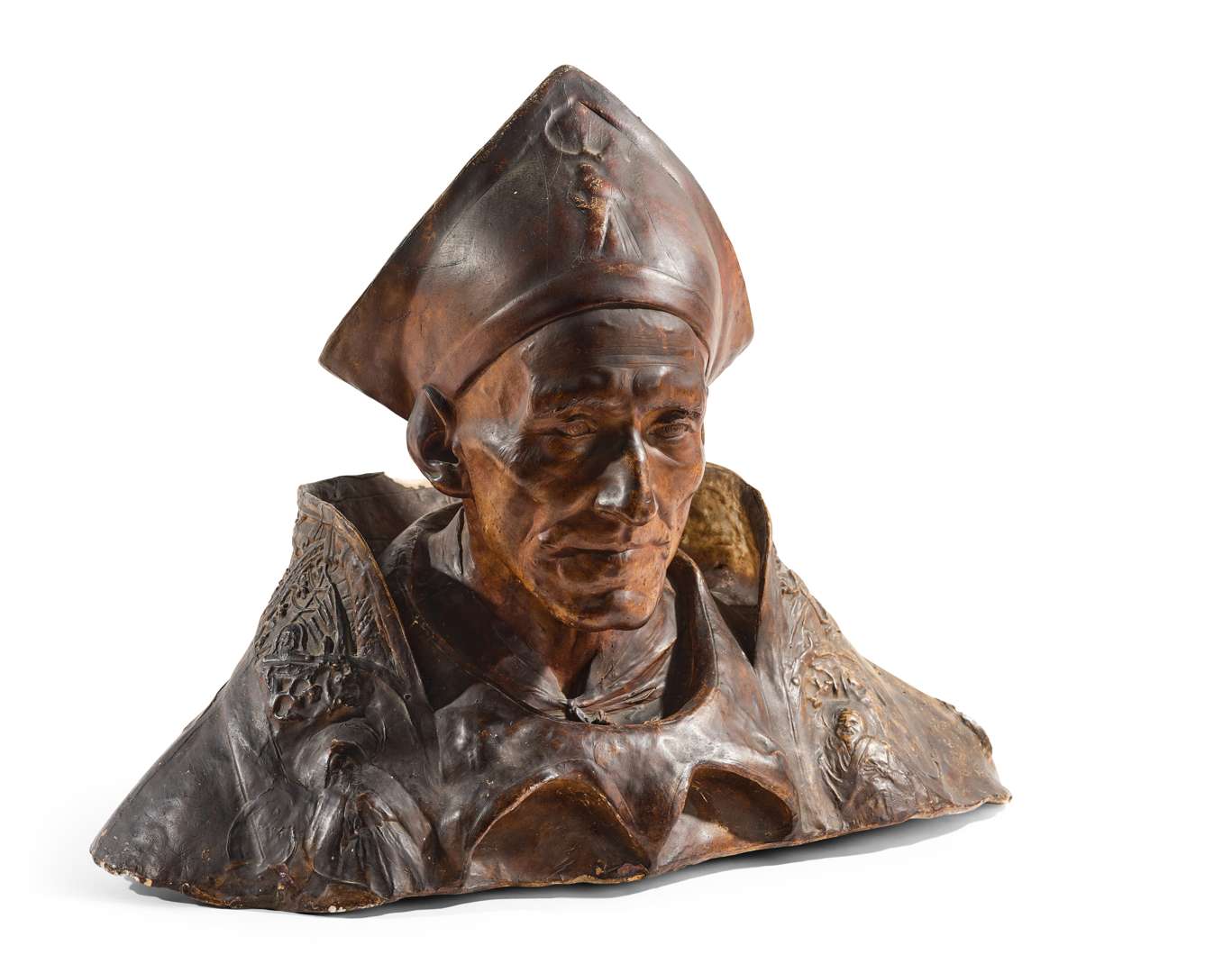
Jean-Joseph CARRIÈS (1855–1894)
The Bishop
Fees include commission and taxes.
The Bishop
A patinated plaster bust of a bishop wearing a cope and mitre. Inscriptions carved into the back of the cope: "I created this / work with / the constant / memory / of Madame de / Galhau // and I / dedicate it / devoutly / to her memory / J. Carriès / Bingen, foundryman". Signed, dated and located on the right shoulder: “Joseph Carriès / Paris / 1886”
Late 19th century.
Height: 50 cm - Width: 66.5 cm - Depth: 36 cm
(Minor damage and visible losses)
– Possibly from the collection of Victor Desfossés (1835–1899), Paris
.– Possibly from the estate sale of the aforementioned held on 26 April 1899 at his residence at 6 Rue Galilée in Paris, with P. Chevallier and G. Duchesne as auctioneers, lot no. 96 (sold for 4,600 francs). Described with the comment “The patina of this bust is most remarkable”. Sold as part of a series of three busts described as follows: “These plaster busts were patinated by the artist”.
– Most likely from the collection of Arsène Alexandre (1859–1937), Paris.
– Most likely from the previous sale of 18–19 May 1903 at the Georges Petit gallery, Paul Chevallier auctioneer, lot no. 167 (illustrated; the characteristic signature appears identical)
– Possibly from the collection of Louis-Gustave Mühlbacher (1834–1907), Paris.
– Possibly from the estate sale of the previous owner on 13, 14 and 15 May 1907 at the Georges Petit gallery, with Paul Chevallier and Lair-Dubreuil as auctioneers, lot no. 186 (sold for 2,050 francs)
– Reportedly acquired at an earlier sale (not located) at the Château de Castelnau, Cher.
– Collection of Monsieur de Gauléjac, then passed down through the family to the present day.
– Catalogue of the sale of the Victor Desfossés collection, 26 April 1899 at his residence at 6 Rue Galilée, Paris, P. Chevallier and G. Duchesne, auctioneers.Lot no
.96.– Catalogue of the sale of the Arsène Alexandre collection, 18–19 May 1903, Galerie Georges Petit, Paris, Paul Chevallier, auctioneer. Lot no. 167 (reproduced)
– Catalogue of the sale of the Louis-Gustave Mühlbacher collection, 13, 14 and 15 May 1907 at the Georges Petit gallery, Paul Chevallier and Lair-Dubreuil, auctioneers. Lot no. 186
.– Jean Carriès, imagier et potier: étude d’une œuvre et d’une vie by Arsène Alexandre, Paris 1895. Pages 55–56.
A plaster model of this work was exhibited at the 1883 Salon by the artist and was awarded an honourable mention, followed by a commission from the State for a bronze version (decree of 30 June 1883). The plaster model presented at the Salon is probably the copy held at the Zimmerli Art Museum at Rutgers [Inv. No. 2002.0095], dated 1883.
The Musée des Beaux-Arts de la Ville de Paris (Petit Palais) holds two versions of our bust, one in glazed stoneware [Inv. No. PPS1200] dated 1892 bearing a dedication to Madame Leclanché, and the other in plaster with exactly the same dedication as ours, made to Madame de Galhau, including the signature of the caster Bingen [Inv. No. PPS576].
The Musée d’Orsay holds the bronze version acquired by the State from the artist in 1889 [Inv. No. RF 881]. It should be noted that this latter version at the Musée d’Orsay bears the dedication to Madame Leclanché.
Our version is distinguished primarily by its signature, its date of 1886 and the specific Parisian location indicated on the shoulder, which appears to be a unique feature.
Our patinated plaster cast reveals the artist’s enduring obsession with the subtle nuances and variations of patinas and other surface colourings. It illustrates Carriès’s admiration for the realistic portrayal of figures with strong features, a style particularly evident in Italian Renaissance sculpture.
It was in 1883 that Carriès met Pierre Bingen, the great innovator of the lost-wax technique, used during the Renaissance. The lost-wax process produces a bronze that is extremely faithful to the surface details and textures of the original terracotta, plaster or wax. In fact, it is a bronze commissioned by the State in 1889 that is now on display at the Musée d’Orsay. A bronze whose rich patina is very similar to the three known plaster versions of the work (of which ours is one).