
&w=3840&q=75)
&w=3840&q=75)
&w=3840&q=75)
&w=3840&q=75)
&w=3840&q=75)
&w=3840&q=75)
&w=3840&q=75)
&w=3840&q=75)


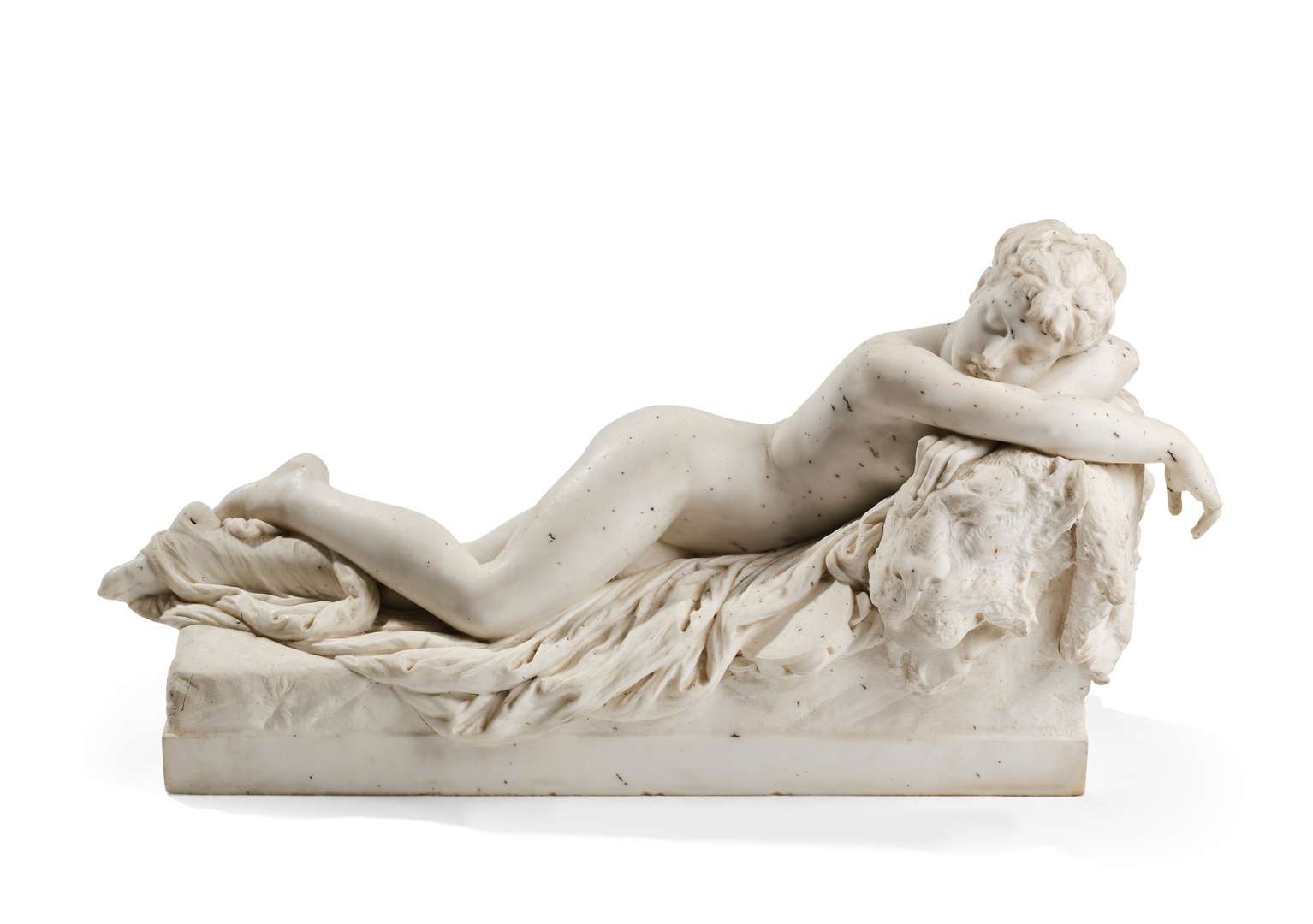
Prosper d'ÉPINAY (1836–1914)
Marie de Rolla, known as Marion
Marie de Rolla, known as Marion
A carved figure in slightly mottled white marble.
Signed, dated and marked: “d'Epinay, Rome, 1880”
Height: 42 cm – Width: 83 cm – Depth: 25 cm
(Minor damage visible on the foot and hand)
– Patricia Roux-Foujols, Prosper d'Épinay, a Mauritian sculptor at the princes’ court, L'Amicale Ile Maurice France, 1996. Pages 100 and 101.
Poverty! Poverty! It is you who are the courtesan.
It is you who, in this bed, bore this child
Whom Greece would have cast upon the altar of Diana!
Look—she prayed this evening as she fell asleep…
– Rolla, Alfred de Musset, 1833.
Our marble sculpture, previously unpublished, dated 1880 and located in Rome, is linked to a group of three very similar works catalogued by Patricia Roux-Foujols (see bibliography), all devoted to the representation of Marie, known as Marion, from Rolla.
These sculptures refer to the character of Marie (known as Marion, her courtesan name) from Alfred de Musset’s poem Rolla, published in 1833. This poem recounts the tragic fate of Jacques Rolla, a bourgeois of his time, who descended from one vice to another and who, after squandering the family inheritance, spent a night with a young fifteen-year-old courtesan who, for her part, had been forced to embrace this life to escape poverty. In a surge of compassion that revealed the true nobility of her heart, Marion offered to give him her gold necklace to help Rolla escape his misery... Alfred de Musset’s work concludes with Rolla’s suicide, as he gazes upon the beauty of Marion, with her such a kind heart.
This ambiguity, between prostitution and innocence, lies at the heart of Musset’s text and finds a particularly apt echo in Prosper d’Épinay’s sculptural treatment, through the closed eyes, the loose hair and the gentle, contemplative forms.
The figure’s posture seems to draw direct inspiration from the famous ancient Hermaphroditus, attributed to Polykleitos. The most famous example, from the Borghese collection and now housed in the Louvre, was readily accessible to the artist. The rediscovery, in 1880, of another Roman example, now housed in the Museo Nazionale Romano, coincides with the period during which these works were created. This convergence is all the more significant given that our marble sculpture is located in Rome, where d’Épinay ran his studio on Via Sistina from 1864 to 1912.
The group of works to which our marble sculpture can be linked thus has its creative origins in the early 1880s:
– An early terracotta version, smaller but corresponding exactly to our model, captures all its distinctive features: the lion’s skin on which the figure rests and the small tambourine against which she leans. Undated, it may be slightly earlier than, or contemporary with, our marble sculpture, given that Prosper d’Épinay usually progressed from the terracotta model to the marble execution. It was sold at the Hôtel Drouot on 7 and 8 April 1893 (lot 38), then reappeared for sale at Sotheby’s on 23 November 2010 (lot 81, sold for £46,850).
– A plaster model is also recorded: kept in the artist’s studio until 1912, then in the collection of the Duke of Gallese, it was sold to an antique dealer in 1991 and remains untraceable today.
– Finally, a marble version was exhibited at the 1884 Salon under number 3491; it was subsequently sold at Christie’s in New York on 11 February 1997 (lot 57, sold for USD 134,500). This marble version differs slightly from our example, however: the most suggestive accessories have been omitted in favour of a more classical setting. A proper bed and a woven mat now replace the lion’s skin and the sensually dishevelled hair. The figure is no longer reclining on an allusive support, but is situated in a domesticated, more demure space, which lessens the sensual charge and the ambiguity of the earlier versions.
The marble sculpture we present here thus appears to be one of the earliest known versions of this theme of Rolla’s Marion. In its conception, it stands out clearly from later versions, where the composition is reconfigured within a framework more in line with the expectations of the Salon. It retains an initial boldness in the treatment of the body and its staging, whilst the use of marble serves to consecrate the sensual figure in a form of completion hitherto unseen.