
&w=3840&q=75)
&w=3840&q=75)
&w=3840&q=75)
&w=3840&q=75)
&w=3840&q=75)
&w=3840&q=75)
&w=3840&q=75)
&w=3840&q=75)

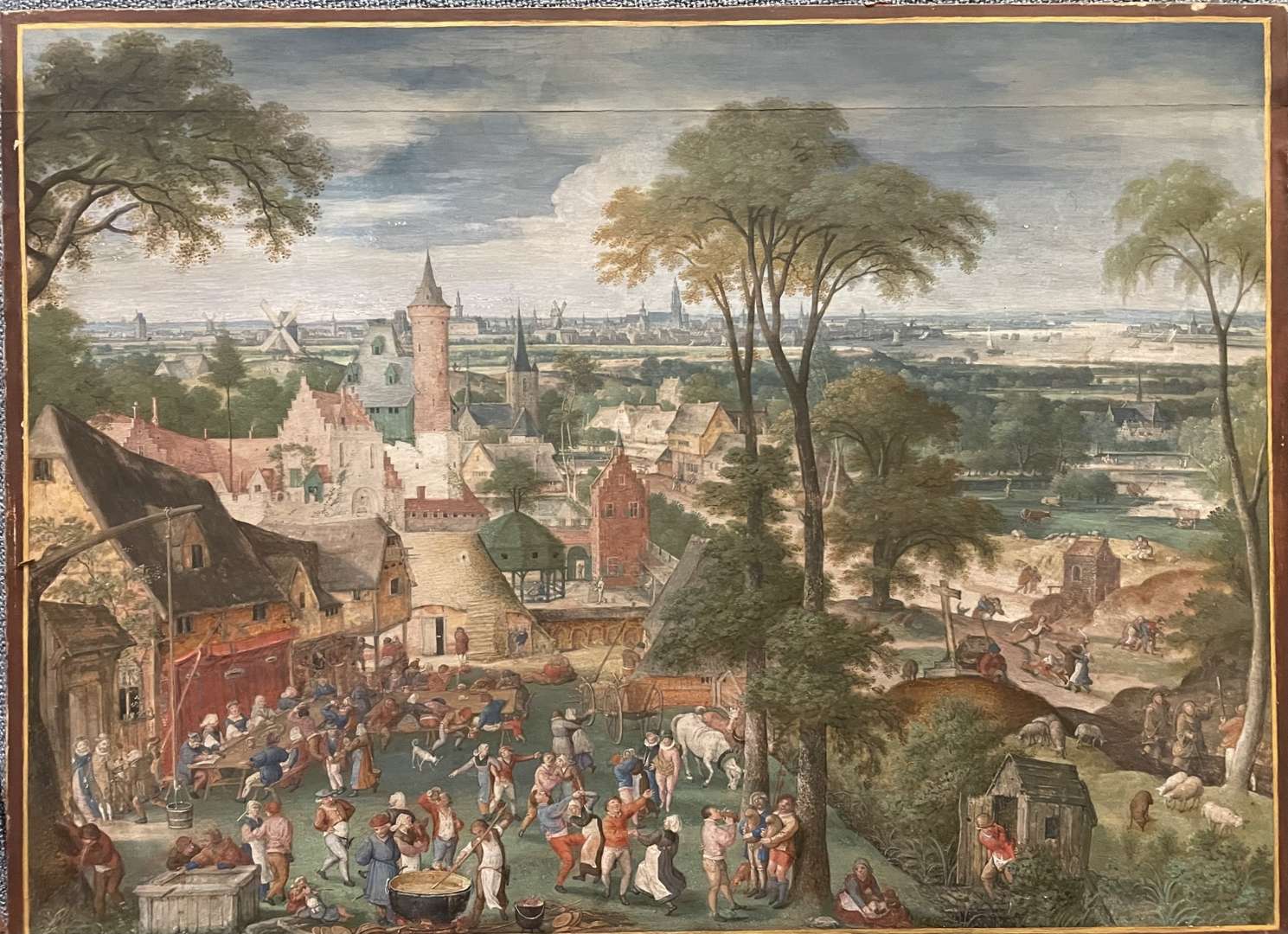
Hans BOL (Mechelen, 1534 – 1593, Amsterdam)
A country wedding
A country wedding
Gouache on vellum, mounted on a parquet-style oak panel (extended by the artist at the top by approximately 2 cm)
19.7 × 27.8 cm – 7 3/4 × 11 in.
Gold frame border.
Born in Mechelen in 1534, Hans Bol began his apprenticeship at the age of fourteen under a master whom Karel van Mander, in his book on painters (‘Het Schilder-Boeck’), describes as ‘ordinary’1. After two years, he left for Germany and studied in Heidelberg for a further two years before returning to settle in his hometown. A skilled draughtsman, a talented watercolourist and an etcher appreciated by publishers of his time such as Hieronimus Cock (1518–1570), Bartholomeus de Momper (1535–1595/97), Gerard de Jode (1508–1591) and Philips Galle (1537–1612), his work spread rapidly and was admired for the variety of his compositions, the wealth of detail and figures he wove into narrative scenes that were as harmonious as they were appealing.
By the late 1550s, he had established himself as a recognised master, particularly appreciated for his small-format works. His success was such that his work was widely copied during his lifetime, a phenomenon that may have prompted him, in the 1580s, to cease his work as an etcher, reduce his output of drawings and devote himself more to gouache, mainly in the form of miniatures. In the eyes of his contemporaries, the finesse of his line made him the obvious successor to Pieter Brueghel the Elder 2 (c. 1525–1569). Although more dynamic, his commitment to working with the pen in a ‘controlled style’ 3, with his fine, precise contour lines, attests to his assimilation of the master’s manner and his reinterpretation of it.
A Lutheran, he was forced to flee Mechelen in 1572 for Antwerp, where he joined the Guild of Saint Luke in 1574. Supported, moreover, by a patron named Anthoni Couvreur 4, he continued his brilliant career without difficulty and continued to be crowned with the laurels of success. Some time later, in 1584, he was forced, for the same reasons, to leave the city for Berg-op-Zoom and took refuge in the camp of William of Orange. He subsequently stayed in Dordrecht and Delft before settling permanently in Amsterdam until his death in 1593.
This charming gouache we present depicts the joyful theme of a peasant wedding in the vicinity of Antwerp, recognisable by its topographical silhouette viewed from the north. The modest format, the gold border framing the scene and the particularly meticulous execution of this gouache bring it close to the art of miniature painting, which the artist had mastered. Undoubtedly intended to be placed amongst the curiosities found in the wunderkammer, it fits perfectly into Bol’s output from the 1580s onwards. Drawing on his plein air studies, he would then carefully compose a setting suitable for a group of figures.
Here in the foreground, the festivities are in full swing to the sound of the doedelzakken: the bride and groom, seated under a canopy on the left, are identified by the largest of the three floral wreaths suspended from the stretched fabric; all around, the guests dance and chat; one is spitting out the excesses of the feast against a tree, others are preparing the next course in a large steaming cauldron, one is getting dressed outside the lavatory, likely in a hurry not to miss a moment of the festivities, and yet another dog is gnawing on the bone it has just stolen. Then, if our gaze drifts beyond this immediate horizon, life continues in successive planes to the right, where monks are ploughing the land, herds are grazing, a peasant is resting at the foot of a wayside cross, and a couple is being robbed by thieves. As noted by Stefaan Hautekeete (curator of the collection of old drawings at the Royal Museums of Fine Arts of Belgium, who is preparing a catalogue raisonné of Hans Bol’s complete works), this is probably the artist’s only gouache in which the figures are by another hand, as yet unidentified, although the characters are depicted in scenes characteristic of Bol.
Then our gaze glides over the successive planes of the buildings with their crenellated facades until it is drawn into the distance and invited to follow the contours of the city of Antwerp. Its characteristic silhouette emerges, reminding us that Hans Bol was among the first of his school to take such care over the topographical accuracy of cities. On this subject, Karel van Mander writes that Hans Bol particularly distinguishes himself in small landscapes, which he handles with rare precision and clarity, in a confident, clear, assured manner, without hesitation, with a delicate, graceful finish 5. This same profile (also viewed from the north, but slightly further east) is found in other compositions, such as a very fine oil on panel, dated 1575 and held in a private collection (Fig. 1). Several centuries later, it would be difficult to contradict him, as this view of Antwerp on the horizon so clearly demonstrates. The exact site of the wedding, however, is more difficult to identify, but it appears in two other works by the artist: a first pen-and-ink drawing captures the chosen location and brings it to life for the first time with figures (Fig. 2. Private collection); a gouache on the same theme, dated 1587 and enlivened by further figures, has also been identified (Fig. 3. Private collection).
This gouache brilliantly illustrates the narrative virtuosity and meticulous execution for which Hans Bol was renowned in the final decades of the 16th century. A refined work intended for a cabinet of curiosities, it fully reflects collectors’ enthusiasm for these precious miniatures, which combine observation of reality with poetic invention.
Hans Bol, Peasant Wedding, pen and brown ink with brown wash, private collection.
Hans Bol, Peasant Wedding, gouache, 16 x 23 cm, private collection (see Lempertz auction, Cologne, 16 May 2025, lot 1147).
(Micro-earthquakes)