
&w=3840&q=75)
&w=3840&q=75)
&w=3840&q=75)
&w=3840&q=75)
&w=3840&q=75)
&w=3840&q=75)
&w=3840&q=75)
&w=3840&q=75)


Pierre-Nicolas BRISSET (Paris, 1810 – 1890)
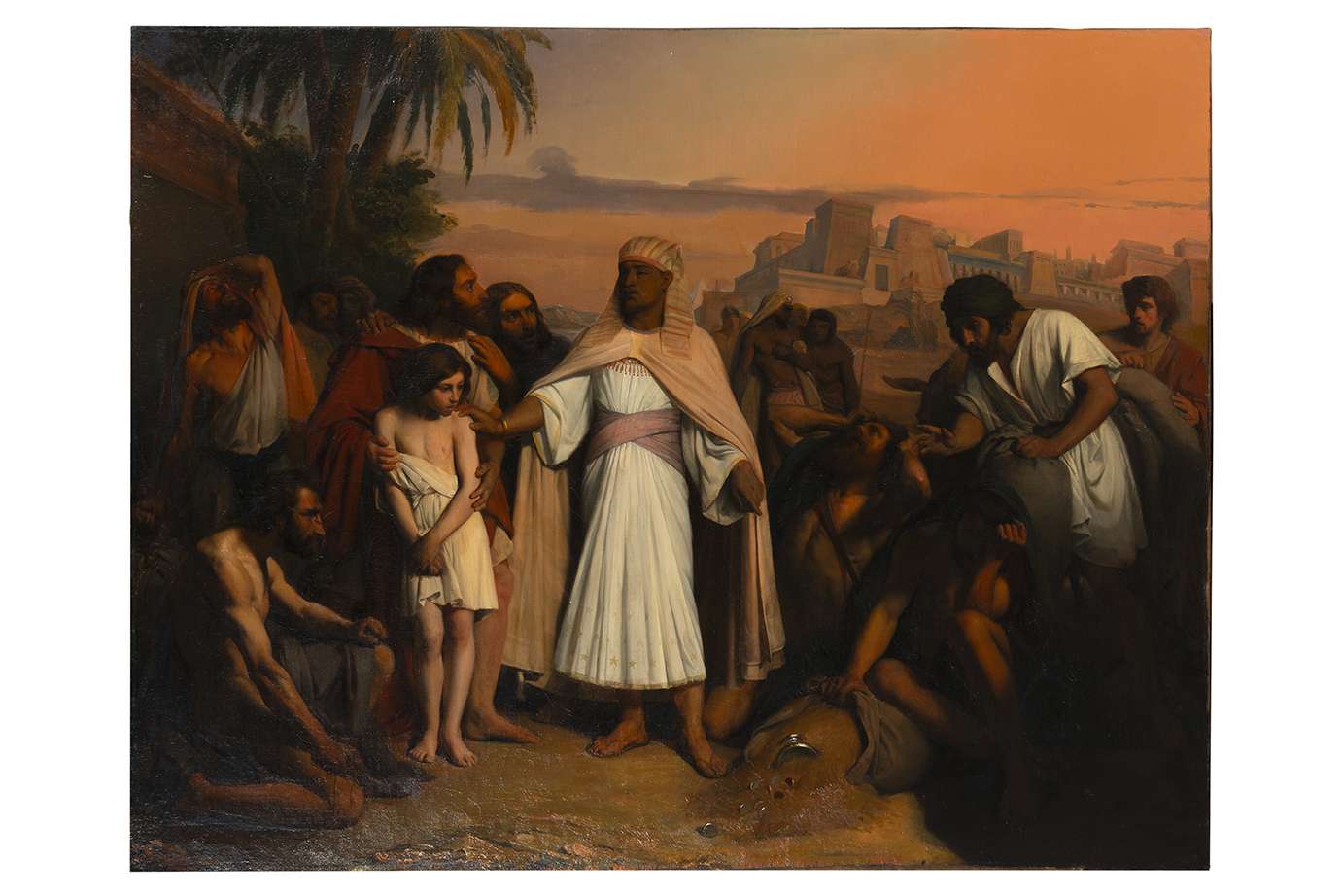
Joseph’s cup found in Benjamin’s sack, 1839
Fees include commission and taxes.
Joseph’s cup found in Benjamin’s sack, 1839
Original painting
, signed lower left: Pre Brisset,
113 x 145 cm – 44 1/2 x 57 1/8 in.
Charles Sakr Gallery; acquired from the gallery by the current owner in 2006, private collection (Netherlands).
‘Without a doubt, Mr Brisset’s painting is better executed and more effective than Mr Duval’s (…) I am far from disputing the qualities of this artist, who is already distinguished in his execution, which make his painting one of the three best in the competition.’ Le Journal des Artistes
The episode is found in chapters 43–45 of Genesis. All of Jacob’s sons appear before Joseph, without recognising the brother they sold years earlier. Now the chief administrator of Egypt, Joseph wishes to test their loyalty before revealing himself to them. Having come from the land of Canaan to buy grain because of the famine, they are welcomed by Joseph, who secretly has a silver cup hidden in the sack of Benjamin, the youngest of the brothers and their father’s favourite son. As the brothers set off back towards Canaan, Joseph sends his steward in pursuit. The steward accuses them of stealing his master’s silver cup, despite the generosity they had received: Joseph had not only sold them grain, but had also returned to their sacks the money they had brought to pay for it.
The cup is eventually found in Benjamin’s sack. This theft condemns him to slavery. Distraught, the brothers try to defend him, knowing the special love their father has for him. The eldest even goes so far as to offer to take his place and put himself in Joseph’s service. Moved by this sacrifice and by the transformation of his brothers, Joseph finally reveals himself to them. He forgives them and invites them to settle in Egypt with their father, where they can live in safety and be spared from famine.
A pupil of Picot, this is the second time Brisset has entered the Grand Prix, buoyed by his second place in the 1837 competition. He has learnt the lesson of his master, whose teaching is fundamentally based on drawing. A showcase of skill for young painters, the competition is also an opportunity to demonstrate mastery of anatomy and the expression of passions, as is the case here, with the faces conveying a whole range of emotions linked to the subject: despair, turmoil, fear, guilt, authority. The scene is set in an Egypt that the painter had never yet visited, yet which evokes the era’s fascination with a dreamt-of Orient.
Whilst the Prix de Rome was won that year by Hébert (Fig. 1. Paris, Musée de l’École nationale supérieure des beaux-arts, inv. PRP 83), our young painter won it the following year with The Departure of Caius Gracchus (Paris, Musée de l’École nationale supérieure des beaux-arts, inv. PRP 84).