
&w=3840&q=75)
&w=3840&q=75)
&w=3840&q=75)
&w=3840&q=75)
&w=3840&q=75)
&w=3840&q=75)
&w=3840&q=75)
&w=3840&q=75)


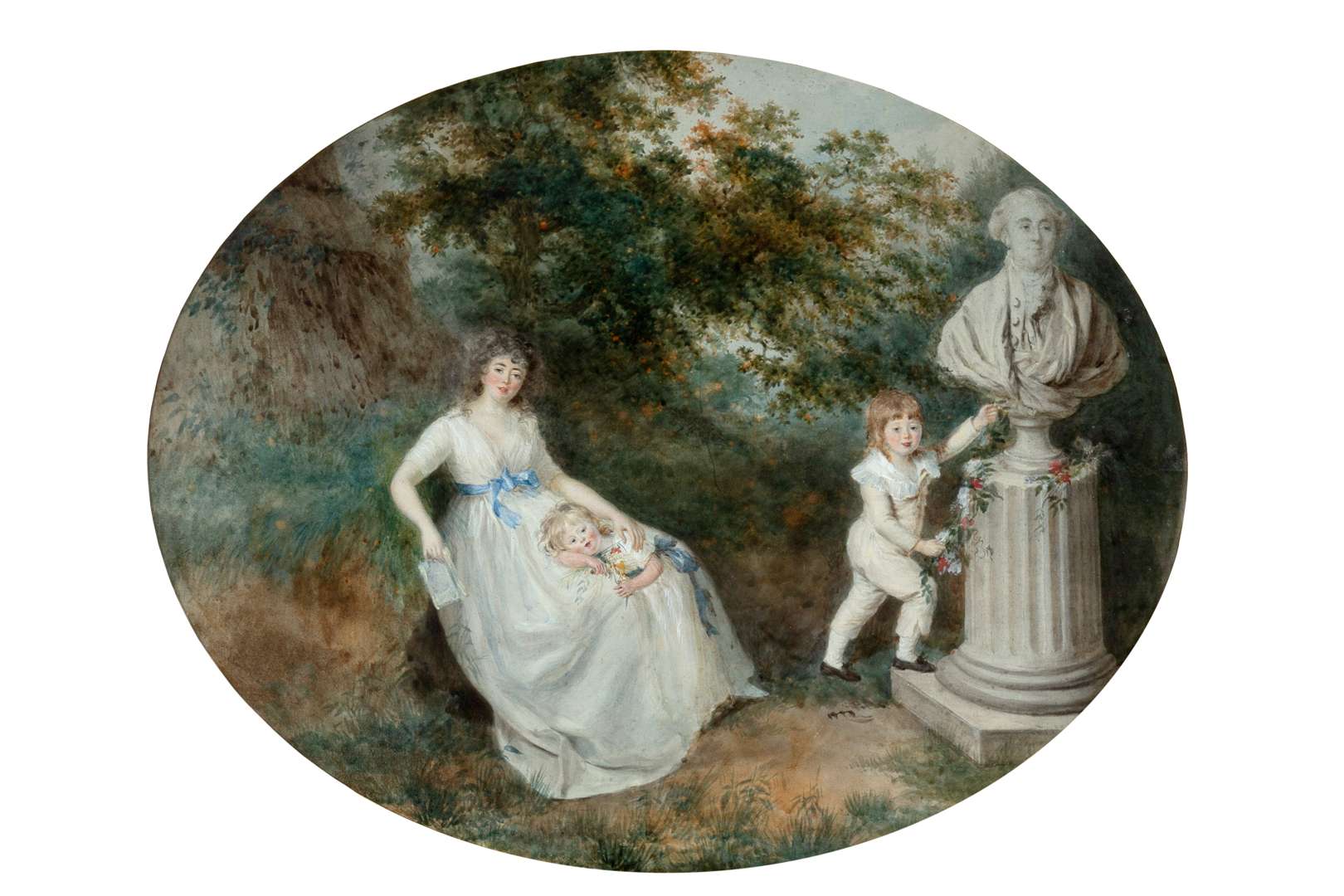
Firmin MASSOT (Geneva, 1766 – 1849)
Madame de Staël with her two children, Albert and Auguste, standing near the bust of Jacques Necker in the gardens of Coppet Castle, 1794
Fees include commission and taxes.
Madame de Staël with her two children, Albert and Auguste, standing near the bust of Jacques Necker in the gardens of Coppet Castle, 1794
Watercolour and gouache on paper,
30 × 37.5 cm – 11 13/16 × 14 3/4 in.
(In a Louis XVI frame)
Private collection, Europe.
Valérie LOUZIER-GENTAZ, ‘The Portrait of Juliette Récamier by Firmin Massot’, 1807. In: Bulletin des musées et monuments lyonnais, 1996, No. 3. New Acquisitions 1990–1995. p. 27 (ill.).
Our gouache depicts an intimate scene of Madame de Staël with her two sons in the grounds of Coppet Castle. On the right is a bust of her father, Jacques Necker; this likeness also features in another portrait of Madame de Staël by Firmin Massot, now held at Coppet Castle (Fig. 1). The famous financier purchased Coppet Castle in 1784 and settled there permanently after resigning from his post as Minister of Finance in September 1790. His wife, Suzanne Curchod, hosted one of the most popular salons in Paris during the 1780s. One would encounter encyclopaedists, philosophers, writers – everything that Enlightenment France had to offer a young woman eager for knowledge. In
1794, Madame Necker took in the painter Firmin Massot, who was fleeing the revolutionary unrest in Geneva: “Driven out of Geneva by the revolutionary unrest, Massot, in whom Madame Necker took an interest, was taken in by her in the canton of Vaud in 1794. The kind châtelaine helped him to marry and secured commissions for him. He painted her at that time and her daughter a little later.” (Y. Bezard, Mme de Staël, d’après ses portraits, ed. V. Hattinger, 1938, p.12). Our portrait must date from this period, as her two sons, born in 1790 and 1792, appear to be between three and five years old. Madame de Staël did indeed stay at the Château de Coppet fairly regularly during the Revolution. It became the site of her political exile during the Empire following her criticism of Napoleonic rule.
Germaine de Staël is the emblematic figure of the independent woman of Enlightenment France. A philosopher, writer and free spirit, she advocated total freedom of body and mind for women. Her stances against Napoleon earned her a compulsory exile in the canton of Geneva, and she took up residence at the Château de Coppet from 1803 onwards. The Empire’s political police monitored her every move. Her book *De l’Allemagne* was banned and destroyed; only four copies of the 1810 edition survived the censorship. Madame de Staël returned to Paris during the Restoration. She died on 14 July 1817.