
&w=3840&q=75)
&w=3840&q=75)
&w=3840&q=75)
&w=3840&q=75)
&w=3840&q=75)
&w=3840&q=75)
&w=3840&q=75)
&w=3840&q=75)


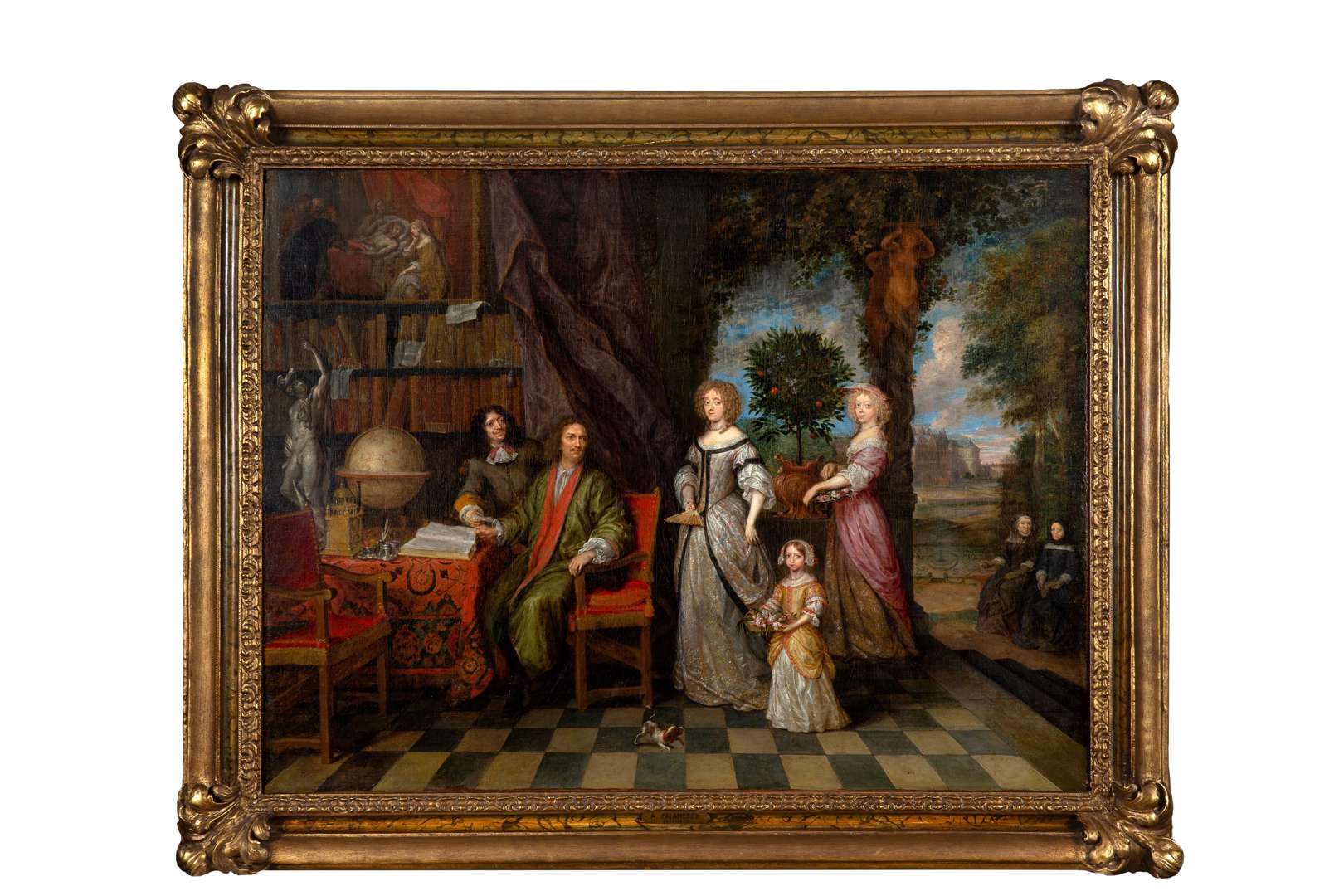
Gonzales COQUES (Antwerp 1618 – 1684)
Family portrait at the court of Coudenberg Castle
Fees include commission and taxes.
Family portrait at the court of Coudenberg Castle
Canvas
85 x 112 cm – 33 7/16 x 44 1/8 in.
Sotheby’s, London, posthumous sale of the Countess of Kilmorey, 3 December 1924, lot 63 described as ‘Gonzales Coques’; private collection, France.
‘The Little Van Dyck’ was the nickname given to Gonzales Coques for his skill as a painter of full-length portraits, the more modest sizes of which were well suited to the private collections for which they were intended. A painter of the bourgeoisie, he emerged as a less expensive alternative to Rubens (1577–1640), Van Dyck (1599–1641) or Cornelis de Vos (1584–1651), painters of monumental portraits whose aim was not so much to evoke intimacy as to assert wealth and power. A Flemish artist born in Antwerp, Coques did not turn to the well-trodden paths of genre portraiture or convivial gatherings, but rather to the portrait that one of his biographers describes as ‘narrative’[1]. He is documented as a master in his hometown around 1640–1641, having studied under Pieter Brueghel II or III (1564–1638/1589–1639) and David Ryckaert III (1612–1661). Our painter also saw Rubens, though he never actually met him. On the other hand, it is highly likely that, beyond his exchanges with Van Dyck in Antwerp, he followed this painter across the Channel, as some of his compositions betray a direct influence from what his fleeting master painted at the court of Charles I.
In this undefined space, which blends the intimacy of a study with the open air of a terrace, a family poses whilst, in the distance, Coudenberg Castle situates us at the Habsburg court, near Brussels. At his desk or study table, the father of the family receives a letter handed to him by a page who bows slightly behind him. His wife, standing beside him, is accompanied by their two daughters, the younger of whom remains unperturbed despite the yapping of a small, excited dog. A few paces away from the group, seated in front of thick foliage, two governesses are chatting.
Without succumbing to an allegorical setting, Coques carefully selects the elements of his composition, drawing from a repertoire of conventional forms, yet each of which carries within it a reference to the model’s life, his moral and personal values, or his (primarily secular) concerns. By individualising his figures, he breathes life into them whilst remaining committed to physical realism. Most certainly the patron of the work, the man at his desk presents himself as a scholar. The painting and the bookcase behind him, the still life before him comprising a writing set, the presence of an ancient Mercury and the globe identify him as such, whilst the clock, the ultimate symbol of vanitas, warns him against the arrogance of scientific endeavour. Titian may have introduced this kind of motif, but in his work it referred more to social status or the virtue of temperance, due to its regular movements. In addition to the richness of the clothing, the fan held by his wife also hints at a comfortable financial situation. Holding a tray of flowers, the eldest of the sisters picks the fruit of an orange tree, evoking not only fertility but perhaps also an impending marriage. The presence of the castle, for its part, likely refers to the duties of the head of the family, who was undoubtedly employed at the court of Leopold William of Habsburg (1614–1662). In doing so, the painter transfers the importance and grandeur of the castle to the subject herself. At the same time, he thus emphasises the ethical and moral values of his patrons as well as their comfortable social and financial standing.
For his portraits, Coques employs formulas he has tested in several of his compositions, no doubt due to their success. The motif of the learned man is thus found in a portrait of Cornelis de Bie (Fig. 1. Berlin, Gemäldegalerie, c. 1660–1665. Inv. 864B) and perhaps even more so in a portrait of the Roose brothers. The young woman picking fruit or flowers also appears in the Portrait of a Family with Six Children (Fig. 2. London, National Gallery, c. 1664. Inv. NG821), or even in Van Dyck’s drawing of Margaret Lemon (Fig. 3), engraved by W. Hollar in 1646 and perhaps known to Coques. The motif of the atlantes, for its part, is the same as in the Portrait of Jan-Baptista Anthoine and his Family (Fig. 5. London, Royal Collection, 1664. Inv. RCIN 405339) or the Portrait of a Man and his Two Daughters (Fig. 6. London, Wallace Collection, c. 1664. Inv. P162). The finesse of the child’s face also serves as a reminder that Coques excelled as a portraitist of miniatures.
By bringing these various motifs together in a skilfully constructed composition, Gonzales Coques goes beyond the simple family portrait to present a genuine social and moral portrayal of his patrons. Through the precision of the details and the subtlety of the symbolic references, he demonstrates his talent for a ‘narrative’ portrait in which the subject’s identity and values are revealed through the image. Thus, Coques establishes himself as a major figure in 17th-century Flemish portraiture, capable of adapting the legacy of the great masters to a bourgeois clientele seeking representation and intimacy.
[1] See on this subject Marion Lisken-Pruss, Gonzales Coques (1614–1684). Der kleine Van Dyck (Pictura Nova. Studies in 16th- and 17th-Century Flemish Painting and Drawing XIII), Turnhout, Brepols 2013, 495 pp.