
&w=3840&q=75)
&w=3840&q=75)
&w=3840&q=75)
&w=3840&q=75)
&w=3840&q=75)
&w=3840&q=75)
&w=3840&q=75)
&w=3840&q=75)


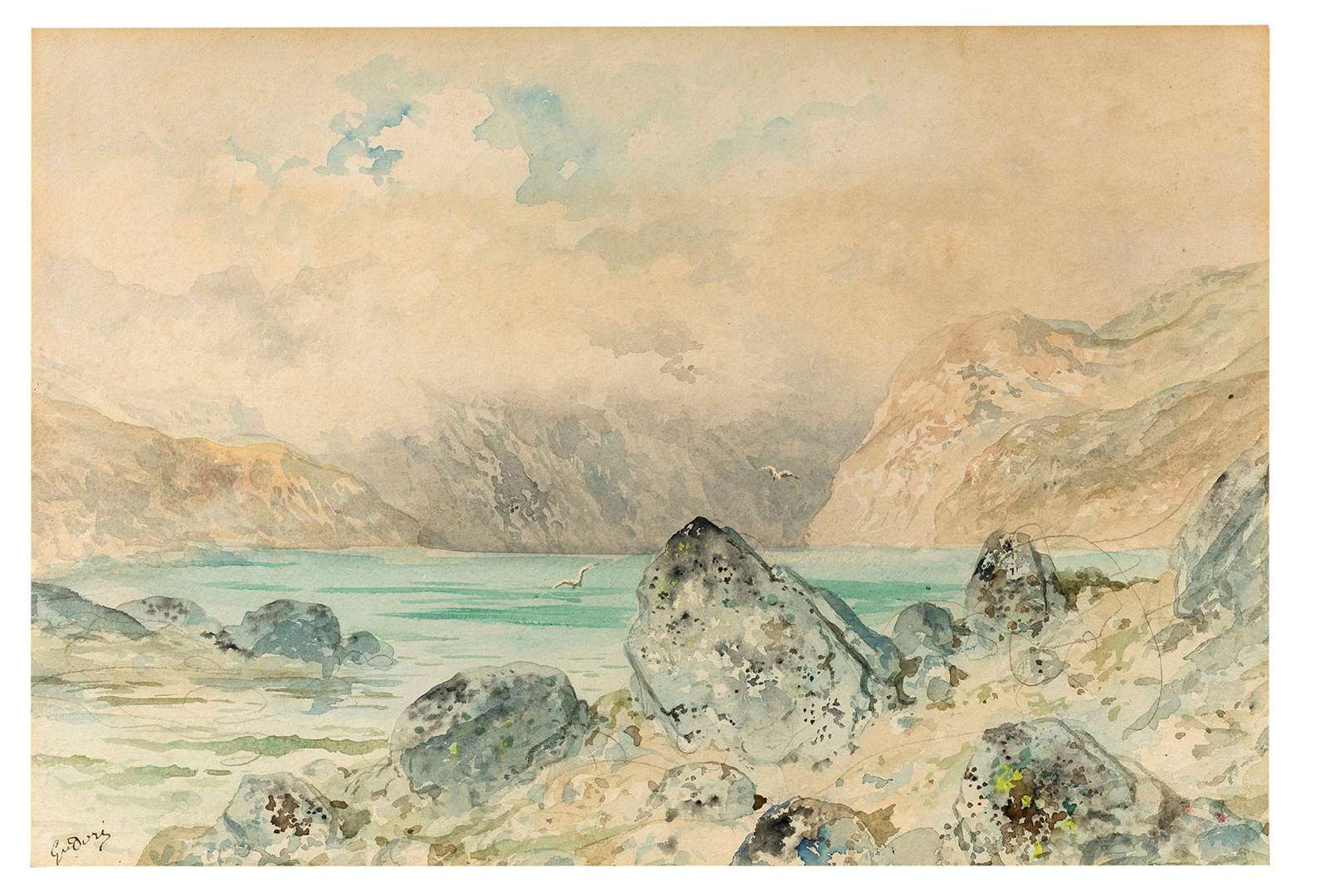
Gustave DORÉ (Strasbourg, 1832 – 1883, Paris)
A presumed view of a lake in Scotland
Fees include commission and taxes.
A presumed view of a lake in Scotland
Watercolour and black pencil
Signed lower left: G Doré
35.5 x 52 cm – 14 x 20 1/2 in.
Private collection, France.
“Whoever is tasked with writing my biography may already note that it was these landscapes that stirred in me the first vivid and lasting impressions, and which thus shaped my tastes in art.”
Gustave Doré
Born in 1832, Louis-Auguste-Gustave Doré was the son of a mining engineer then stationed in Strasbourg. From the earliest years of his life, the young boy showed precocious talent as a draughtsman, expressing it in the margins of his school notebooks and his letters. It was through a child’s eyes that he first observed the landscapes of Alsace, whose influence he himself recognised, as he wrote in his diary: “The person who will be tasked with writing my biography may already note that it was these landscapes that aroused in me the first vivid and lasting impressions, and which therefore shaped my tastes in art.” A privilege of youth, the freshness and innocence of his gaze were the starting point for his appetite for the genre. In 1857, he even attempted to make a name for himself as a landscape painter by presenting eight canvases at the Salon, including *A Torrent, a Memory of the Alps*, *The Storm*, *A Memory of the Vosges* and *A View Taken in Alsace*.
Throughout his life, Gustave travelled and enriched his repertoire of forms, sketching from life before rearranging his memories within his studio. Whilst he retained a particular fondness for the Vosges, he developed a genuine passion for the Alps as well as for Scotland, which he explored in 1873. Among these places, so different yet sharing the vastness of their horizons and the abundance of mountains, lakes and forests, it would be tempting to see a Scottish fjord and the dark ridges of the Vosges forests. As Philippe Kaenel writes, Doré is a ‘multifaceted landscape artist (…) His work features landscapes that are satirical, eccentric or telescopic, prehistoric, biblical, historical or cosmic, fairy-tale-like, idyllic or fantastical, hellish and celestial, woodland and alpine, maritime and underwater, urban and rural, topographical, tourist-oriented or imaginary… ”. Emerging from this multifaceted art, these two views are invitations to daydreaming, to a wandering of the mind, a quality reinforced by the evanescent quality of the watercolour. Influenced by Alexandre Calame (1810–1864), he borrows from him the vastness of space and the contemplative spirit, relegating to the background any topographical pretensions these slightly naturalistic landscapes might have.
Although better known as an illustrator and caricaturist, these watercolours nevertheless recall his ‘unbridled love of mountains and mountainous landscapes | a love that has never wavered to this day’. In saying this, Doré refers to his picturesque education, the cradle of his interest in the genre, which is not unlike a certain definition of the term. In one of his essays in 1792, William Gilpin (1724–1804) described the picturesque, noting with regard to mountains that they should be placed in the background “where their immensity, reduced by distance, can be grasped by the eye, and where their monstrous features take on a gentleness that is not their own”. Between the mountain hollows and the ridges on the horizon, these two views demonstrate that Gustave Doré retained and applied this lesson in the following century.