
&w=3840&q=75)
&w=3840&q=75)
&w=3840&q=75)
&w=3840&q=75)
&w=3840&q=75)
&w=3840&q=75)
&w=3840&q=75)
&w=3840&q=75)


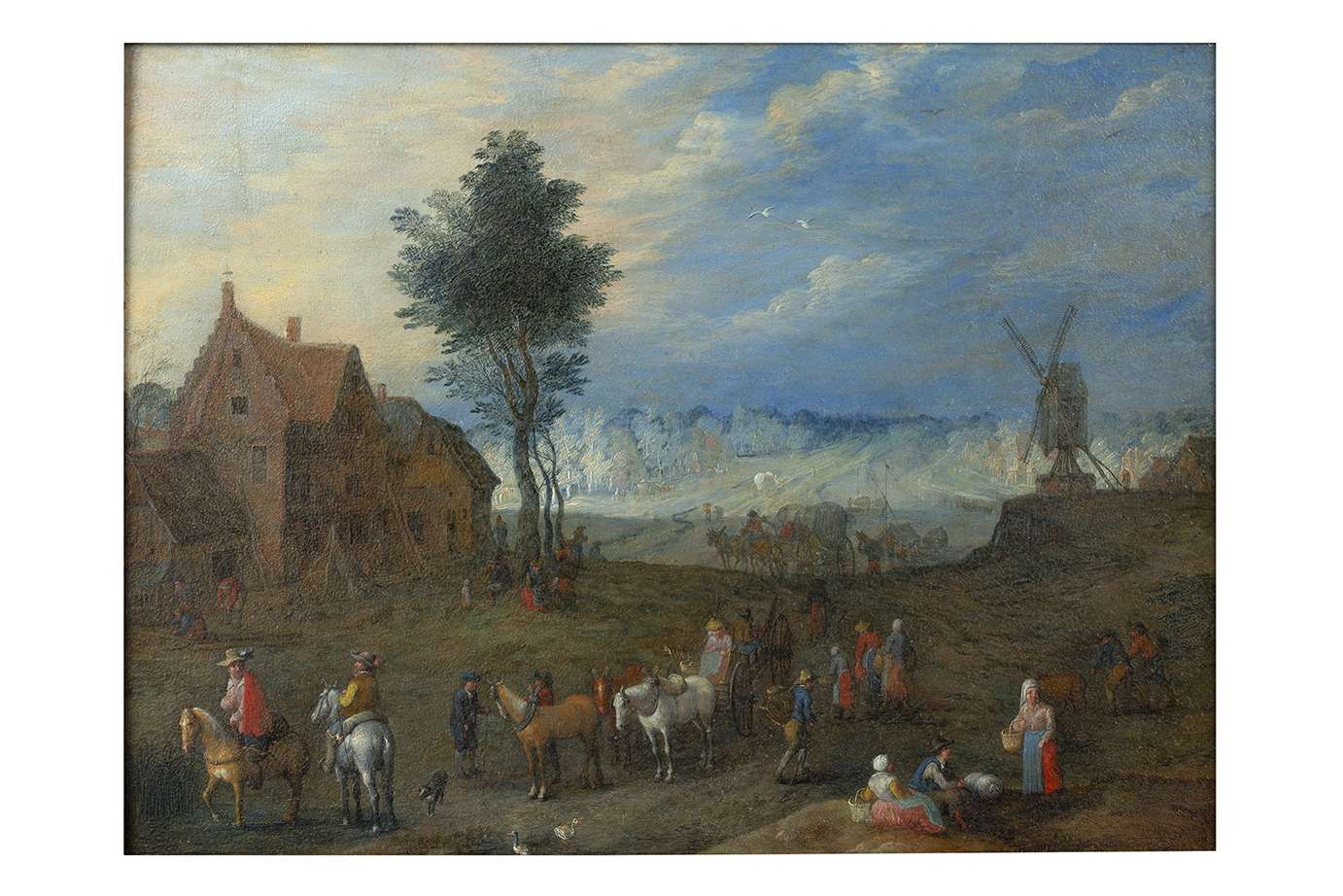
Joseph van BREDAEL (Antwerp, 1668 – 1739)
Carts and horsemen at the entrance to a village
Fees include commission and taxes.
Carts and horsemen at the entrance to a village
Copper
Signed lower centre: J. BREDAEL
35.8 x 26.5 cm – 15 1/8 x 10 3/8 in.
Bears a Christie’s lot number on the reverse.
(Restored)
Born into a dynasty of Flemish painters, Joseph van Bredael was the grandson of Pieter van Bredael (1629–1719) and the youngest son of Joris van Bredael (1661–1706). At the age of eighteen, he joined the studio of the painter and dealer Jacob de Witte (1591–1631) alongside his first cousin Jan Frans van Bredael (1686–1750). Both were tasked with copying the works of their illustrious predecessors, Jan Brueghel the Elder (1568–1625), known as ‘de Velours’, and Philips Wouwerman (1619–1668). This training left a lasting mark on Joseph’s art, whose work remained deeply influenced by these four years of apprenticeship. Shortly before his death, he left his native land and settled in Paris in 1735, where he enjoyed the patronage of the Duke of Orléans. Joseph van
Bredael’s success was largely due to his ability to reinvent the world of the 17th century whilst adapting it to the sensibilities of his own era. From his elder, he adopted the use of sinuous lines, the juxtaposition of figures from diverse backgrounds engaged in various activities, as well as certain characteristic motifs: the windmill that turns with the wind or houses with irregular silhouettes. To reinforce the impression of an ancient work, he dresses his figures in 17th-century fashion rather than that of the 18th century. His palette follows the principle of brown tones in the foreground that gently fade into greens and blues until our gaze is lost in the distance, but van Bredael makes it his own by rendering it softer and more luminous than in Brueghel’s work. His more naturalistic approach to the landscape also reflects a distinctive style. Attentive to detail, Joseph van Bredael paints his figures with a pictorial freedom that contrasts with the more linear manner of his model. Executed on copper
, this work is a fine example of the artist’s work on this medium. The metal’s particularly smooth surface allows Van Bredael to recapture the miniaturist precision found in Brueghel the Elder’s work. Small in size yet possessing a panoramic scope, these landscapes were designed to be viewed up close: one could take them down from the wall, hold them in one’s hand and be captivated by the richness of their detail.