
&w=3840&q=75)
&w=3840&q=75)
&w=3840&q=75)
&w=3840&q=75)
&w=3840&q=75)
&w=3840&q=75)
&w=3840&q=75)
&w=3840&q=75)


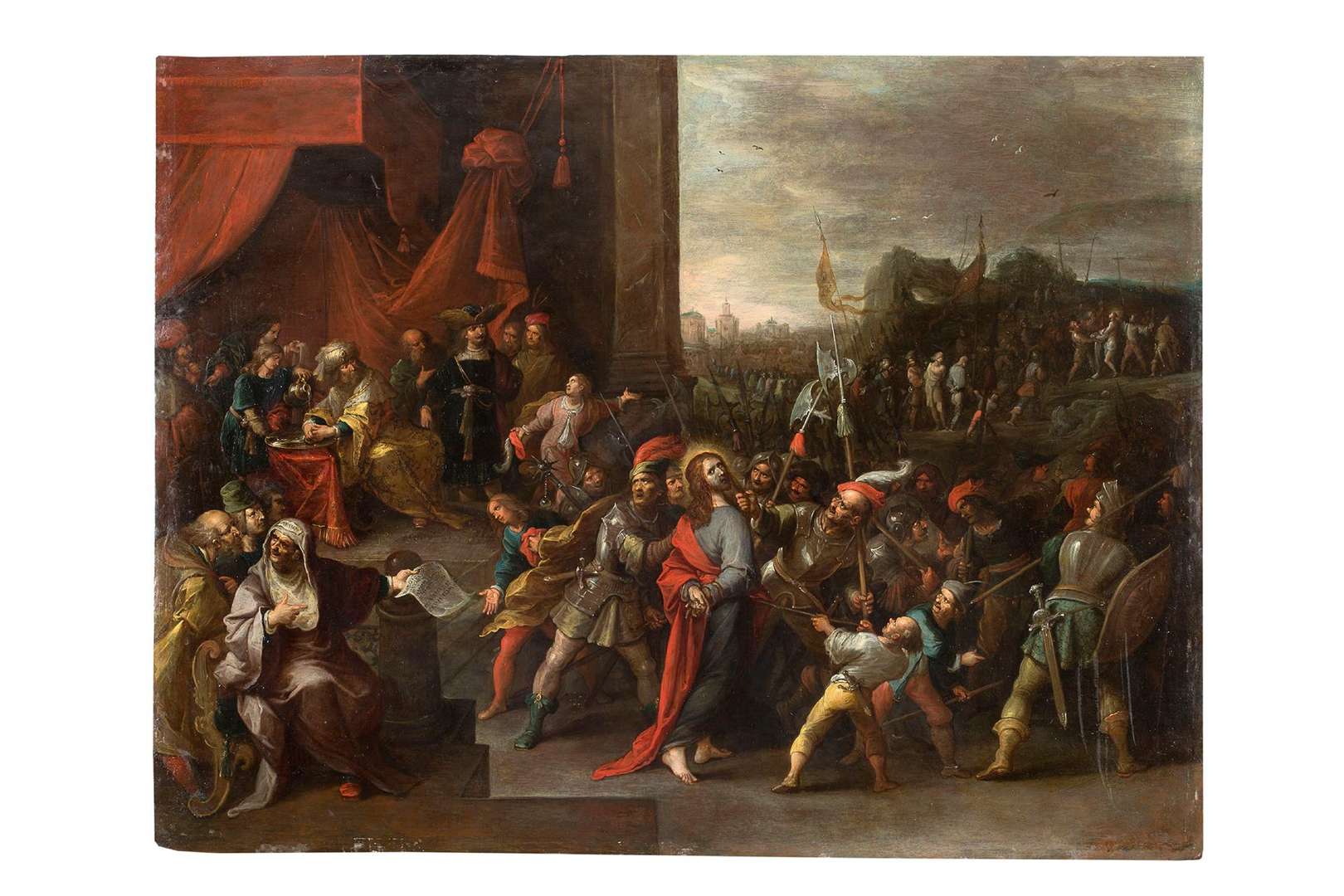
Frans FRANCKEN II (Antwerp, 1581 – 1642)
The Arrest of Christ
The Arrest of Christ
Copperplate
Signed lower right: f.franck IN f
56.5 x 73 cm – 22 1/4 – 28 3/4 in.
(Historical restoration)
Tajan auction, Paris, 9 December 1999, lot 26; acquired at this auction by the current owner, formerly in the collection of the Château de Cieurac, France.
Born in Antwerp in 1581, Frans Francken II was the fourth son of Frans Francken I (1542–1616). Based on the medieval tradition of trades and guilds, the apprenticeship system encouraged the passing down of artistic skills through the family. This was particularly true of the Franckens, who established themselves as one of the most prolific families in Flanders between the 16th and 17th centuries. Trained
naturally by his father, Frans II quickly demonstrated a distinct taste for scholarship. His paintings thus contain numerous literary, biblical and even esoteric references. A renowned painter of altarpieces, he also popularised the genre of cabinet of curiosities (Kunstkammer) painting. In these small-scale works intended for art lovers, he distinguished himself through his delicate and refined style. Focusing most often on religious, historical and mythological themes, the artist never failed to suggest an underlying moral. His small compositions depicting monkeys mimicking humans indulging in their vices would become a genre in their own right, influencing subsequent generations.
In 1605, he became master of the Guild of Saint Luke in Antwerp. Building on his success, he opened a studio and surrounded himself with a large number of assistants to meet his numerous commissions. Running a veritable commercial enterprise, he also employed his brothers and sons, and counted Jan Brueghel the Elder (1568–1625) among his most illustrious collaborators.
In the foreground, Francken captures the moment when Christ is led away whilst Pilate washes his hands, shifting the responsibility for the condemnation onto the people. In the middle and background, Christ continues his ascent towards Calvary, which can still be glimpsed in the background of the composition. Particularly dynamic, the main scene is teeming with figures whose movements, expressions and overall appearances the painter has rendered with great individuality. The rich palette features a multitude of colours, warmed by touches of deep red scattered throughout. A distinct refinement is evident in the gracefully flowing feathers, the trimmings of the halberds and the thick velvet of the canopy. Alongside the colour scheme so dear to the painter is one of his recurring motifs: the exquisite figure of Pontius Pilate, whose anachronistic costume in no way detracts from his particularly refined character. This figure, for instance, also appears in another composition on the same subject, held at the Prado Museum (Fig. 1). Having spent time in the studio of Frans Floris, himself influenced by Italy where he had stayed, it is possible to discern Italianate reminiscences in his work.
Among the most illustrious Antwerp painters of his time, Francken’s art would have a lasting influence on local production due to his virtuosity and the commercial success that ensued. As mentioned in relation to Jan Brueghel the Elder, he did not hesitate to collaborate with specialists in landscape or architectural painting. Abraham Govaerts (1589–1626) and Joos II de Momper (1564–1635) were among them, painters whose styles complemented each other wonderfully in collaborative works.