
&w=3840&q=75)
&w=3840&q=75)
&w=3840&q=75)
&w=3840&q=75)
&w=3840&q=75)
&w=3840&q=75)
&w=3840&q=75)
&w=3840&q=75)


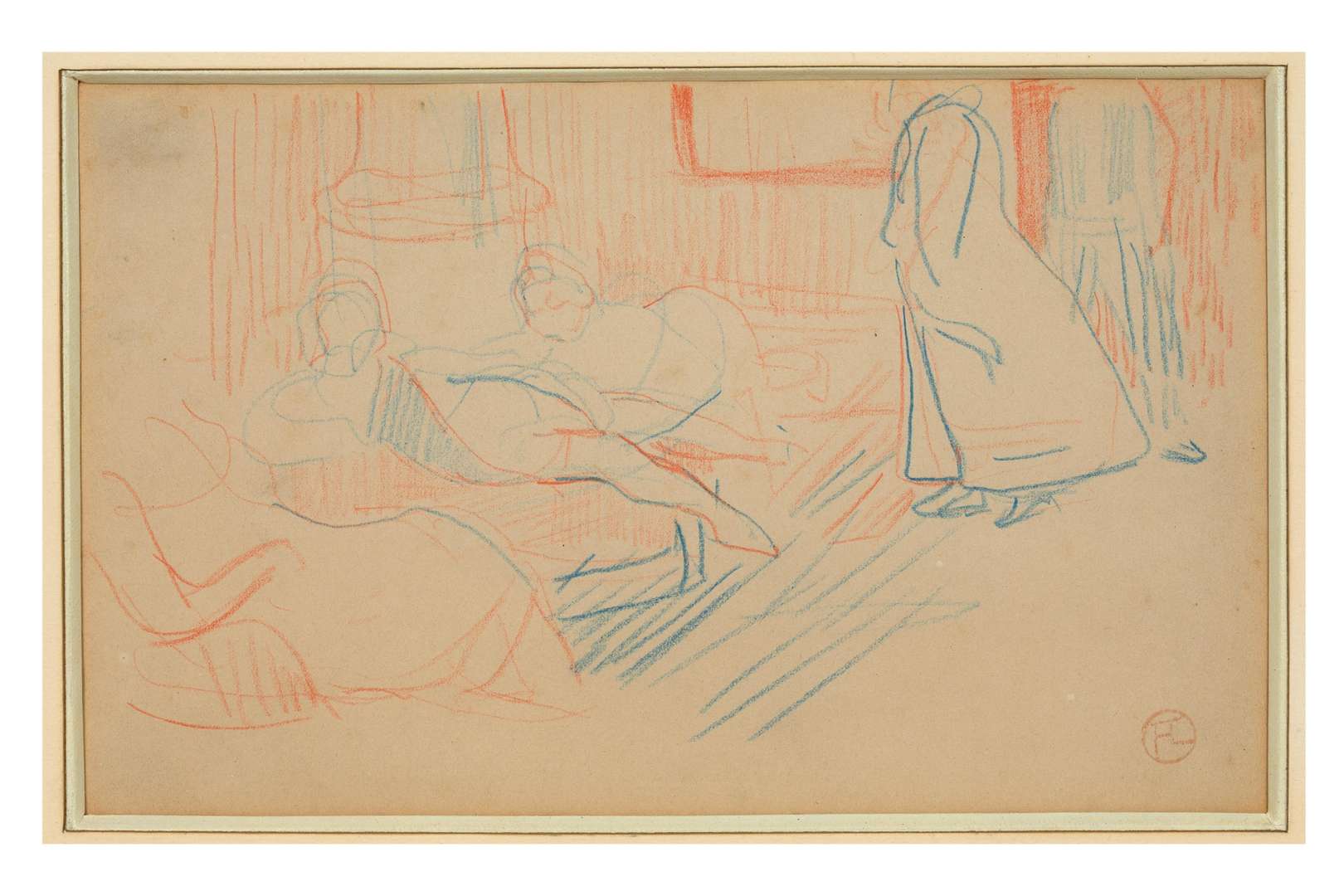
Henri de Toulouse-Lautrec (Albi 1864 – 1901, Saint-André-du-Bois)
At the Rue des Moulins Fair
Fees include commission and taxes.
At the Rue des Moulins Fair
Blue and red pencils on a notebook page,
15.5 × 25.5 cm – 6 1/8 × 10 1/16 in.
Monogram stamp in the lower right-hand corner (L. 5894); formerly in the Séré de Rivières collection, according to several labels on the reverse; anonymous sale, Versailles, 9 December 1962, lot 62, illustrated.
M. JOYANT, Henri de Toulouse-Lautrec 1864–1901, vol. II, H. Floury, 1927, p. 205, cited.
M. G. DORTU, Toulouse-Lautrec and his work, Collectors Editions New York, 1971, vol. V, pp. 592–593, no. D3556, reprinted in
C. FRECHES-THORY, A. ROQUEBERT, R. THOMSON, D. DEVYNCK, Toulouse-Lautrec, Réunion des Musées Nationaux, 1992, p. 424, cited in note 4.
Cinquantenaire Toulouse Lautrec, musée de l’Orangerie, Paris, 1951, n°131b.
This drawing is a preparatory sketch for *The Salon on Rue des Moulins*, held at the Albi Museum. (Inv. MTL.180; see C. Frèches-Thory, A. Roquebert, R. Thomson, D. Devynck, *Toulouse-Lautrec*, Réunion des Musées Nationaux, 1992, pp. 424–426).
Today, *Salon de la rue des Moulins* ranks among Toulouse-Lautrec’s most famous compositions (Fig. 1). As a preparatory study for this work, the drawing positions the models on a large sofa, whilst other elements of the setting, such as the column and secondary figures, help to structure the scene.
Whether a regular visitor or a resident of the Salon de la Fleur Blanche, the famous brothel on Rue des Moulins, he addressed the theme of prostitution in several works to which he gave a scale usually reserved for history painting. The Medical Inspection on Rue des Moulins, The House’s Laundryman and These Ladies in the Dining Hall thus form part of this series, in which he steps through the doors of this establishment, rendering the unsavoury respectable.
A familiar and much-loved figure at the brothel, Toulouse-Lautrec moved about freely there, observing the scenes unfolding without constraint. He became close to several of the women, such as Rolande, Marcelle, Gabrielle, and especially Mireille, to whom he became both a confidant and a friend. The numerous sketches produced during this period bear witness to an attentive and sincere gaze upon their private lives. Accompanied by one of his models, the artist is immortalised in his studio in front of the finished painting (Fig. 2).