
&w=3840&q=75)
&w=3840&q=75)
&w=3840&q=75)
&w=3840&q=75)
&w=3840&q=75)
&w=3840&q=75)
&w=3840&q=75)
&w=3840&q=75)


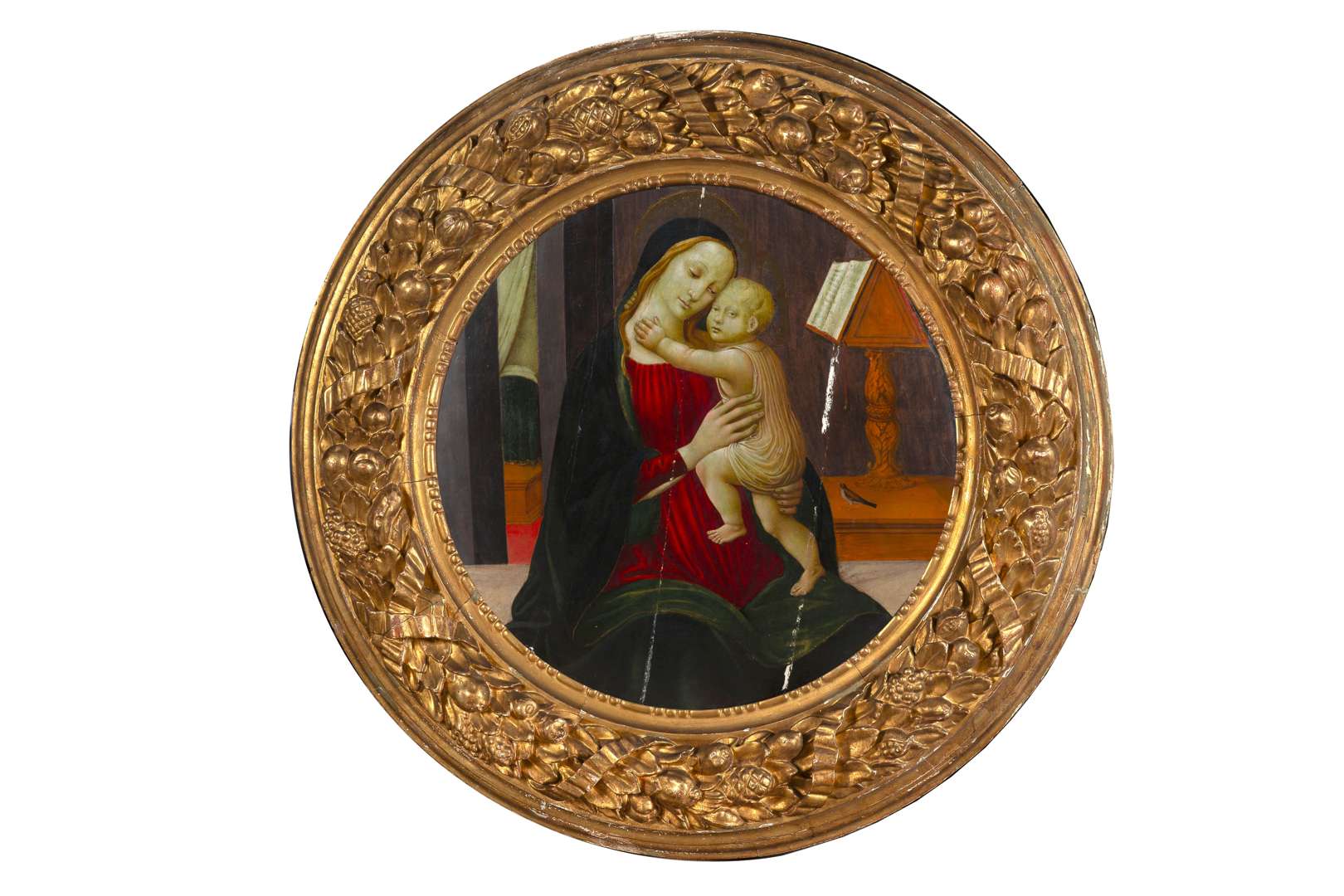
Arcangelo di Jacopo DEL SELLAIO (Florence, 1477/1478 – 1530)
The Virgin and Child
The Virgin and Child
Tempera on panel (parquet-style)
Diameter: 84.6 cm – Diameter: 33 1/3 in.
(Sold in a large gilded and carved wooden frame)
The attribution to Arcangelo di Jacopo del Sellaio was proposed by Everett Fahy on the basis of photographs.
Probably from the A. Tollin auction in Paris, Chevalier, 20–21 May 1897, lot 105, according to an old label on the reverse.
Arcangelo di Jacopo del Sellaio, a Florentine Renaissance painter, was the son and heir of Jacopo del Sellaio (1442–1493), whose artistic legacy he closely continued. Trained in his father’s workshop, he took over its management upon his father’s death in 1493, ensuring the continuity of a body of work intended largely for private devotion.
His work, long misidentified, has been largely reconstructed by Nicoletta Pons[1], who tends to identify him as the ‘Master of the Miller Tondo’, a group of paintings formerly attributed to an anonymous artist associated with the family workshop.
Arcangelo’s style remains deeply rooted in the tradition of the Florentine Quattrocento. He draws on the models developed by his father, who was himself influenced by Filippo Lippi (1457–1504), Sandro Botticelli (1445–1510) and Domenico Ghirlandaio (1448–1494). This fidelity is reflected in a body of work characterised by clear compositions, a legible devotional narrative and a taste for stylised landscapes, without any real adherence to the Mannerist innovations of the early 16th century.
His works—Madonnas and Child, Nativities or small sacred scenes—bear witness to a workshop practice where collaboration and the repetition of models often make it difficult to distinguish between the hand of the father and that of the son. Thus, several paintings now attributed to Arcangelo were long attributed to Jacopo or his circle.
An artist of continuity, Arcangelo di Jacopo del Sellaio thus emerges as one of the last representatives of a Florentine pictorial tradition dating from the late 15th century, whose formulas he perpetuated well into the early decades of the Cinquecento.
[1] On this subject, see Nicoletta PONS, ‘Arcangelo di Jacopo del Sellaio’, in Arte Cristiana, LXXXIV, September–October 1996, pp. 374–388.