
&w=3840&q=75)
&w=3840&q=75)
&w=3840&q=75)
&w=3840&q=75)
&w=3840&q=75)
&w=3840&q=75)
&w=3840&q=75)
&w=3840&q=75)


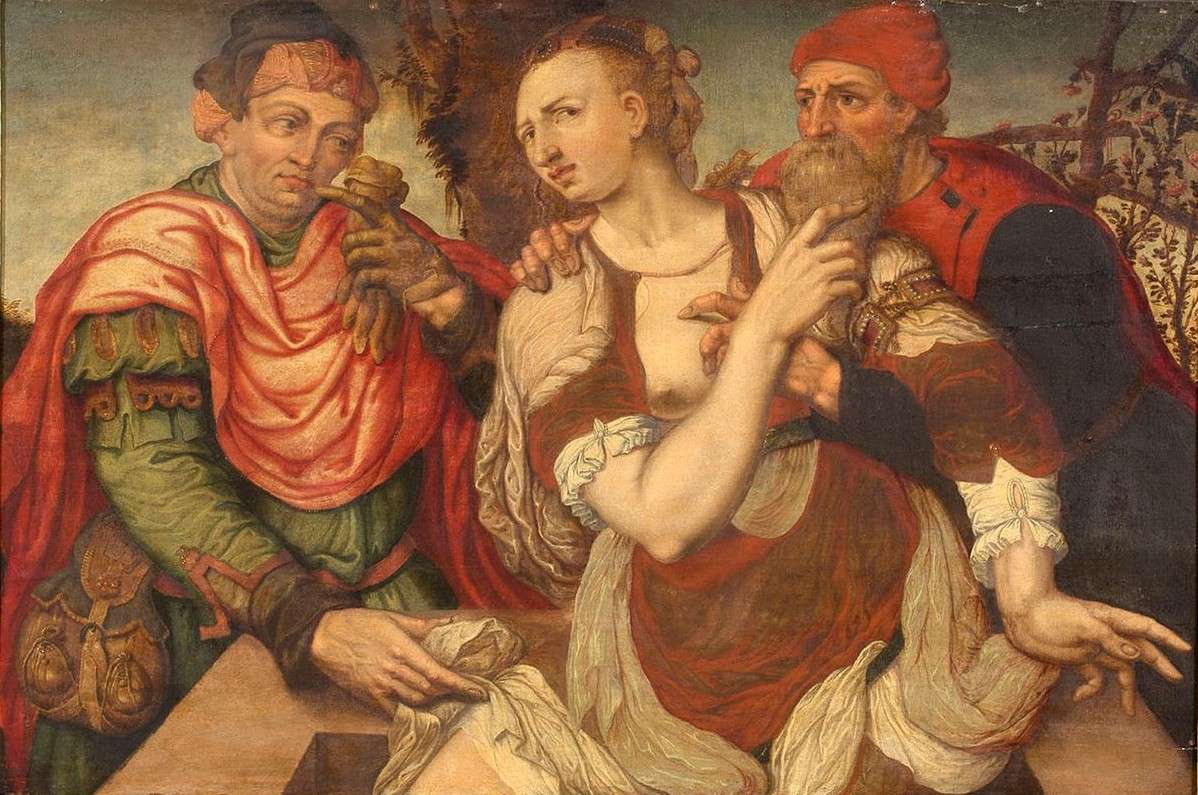
Attributed to the Master of the Prodigal Son (active in Antwerp between 1530 and 1560)
Suzanne and the Old Men
Fees include commission and taxes.
Suzanne and the Old Men
Panel (three boards, unparqueted; extended by 1 cm at the top)
68 x 105 cm – 26 3/4 x 41 5/16 in.
(Restorations, lifting)
Private collection, France.
In 1909, Hulin de Loo identified the Master of the Prodigal Son on the basis of a painting of the same name held at the Kunsthistorisches Museum in Vienna (inv. Gemäldegalerie, 986). In 1983, Jacques Foucart described the mysterious Master of the Prodigal Son as ‘one of the most captivating anonymous artists of the flourishing city of Antwerp at the height of its success’[1]. His style shows the combined influences of Pieter Coeck van Aelst (1502–1550), Pieter Aertsen (1508–1575) and Frans Floris (c. 1517–1570), with whom he was a contemporary. At the head of a workshop that was undoubtedly significant given his output, he also undertook tapestry projects. Here
, the Master tackles a subject he has addressed on numerous occasions, and variations of which have occasionally appeared on the market. Although he may not have travelled to Italy—a fact that sources cannot currently confirm—he was influenced by Frans Floris and the Fontainebleau school. This is evident in the Mannerist quality of his forms, his use of contortions and half-length figures, the refined colours of the drapery, and the almost marbled appearance of Suzanne’s pale flesh. The monumentality and heightened realism of the latter, meanwhile, are reminiscent of the painting of Aertsen or Coecke van Aelst. The full lips, the red colour—whether bold or diffused—and the expressiveness of the figures are stylistic elements found in other works within our painter’s oeuvre.
[1] Jacques FOUCART, ‘Tableaux des écoles du Nord : un bilan d'acquisition’, in Revue du Louvre et des Musées de France, 33, 1983, p. 360.