
&w=3840&q=75)
&w=3840&q=75)
&w=3840&q=75)
&w=3840&q=75)
&w=3840&q=75)
&w=3840&q=75)


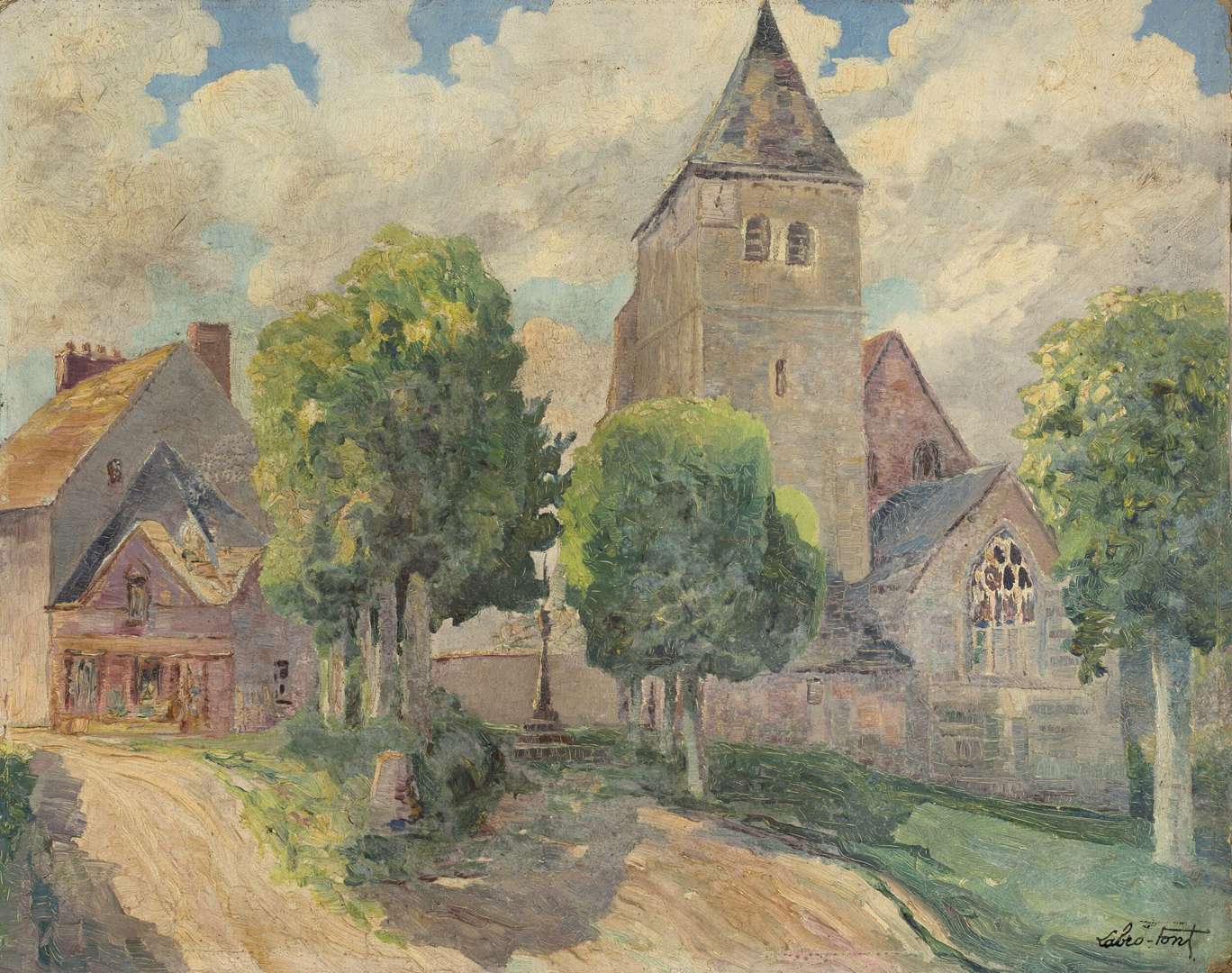
LOUIS LABRO-FONT (1881-1952)
Collection of seven paintings
Ailly (Eure), 1927 - Louviers (Eure), rue de Neubourg, 1927 - Louviers (Eure), 1928 - Autheuil-Authouillet (Eure), 1929 - Giverny (Eure) - Grand-Andely (Eure), 1928 - Rousset (Drôme), 1928
Oil on plywood panel or cardboard
Signature or signature stamp [non Lugt] at bottom
Situated, dated, annotated and signed a second time for the most part on the back
(Accidents with small gaps in the paint layer for some and soiling, the last with a missing lower part)
A set of seven paintings, oil on plywood panel or on cardboard, signed or stamped with the signature mark lower, dated, inscribed and signed again for most of the works on the reverse
50 x 65 cm - 19 3/4 x 25 5/8 in.
Provenance
Private collection, France
This lot is stored in our furniture repository in Gennevilliers (92230) where it must be collected by appointment after full payment. No transfer will be possible.
Note
Louis Labro-Font was born in Paris in 1881. Trained as an architect and Henri Deglane's pupil at the École des Beaux-Arts, he frequented the Parisian art scene, perhaps even Camille Pissarro's studio, as is sometimes reported. By 1917, he was living in Ermont, a few kilometers from Argenteuil. In the 1930s, Labro-Font moved closer to the Vaucluse and Drôme regions of France, where he had family ties. In 1938, he lent landscapes of the Ventoux and Provence regions to the Carpentras museum. The exhibition booklet is prefaced by Jean Giono and Frédéric Mistral, nephew of the great Provencal writer. The local press admired the clarity, finesse and simplicity of his art. In 1942, "La Croix Magazine" devoted a long article to his work, described as a poetic and musical painting: "symphony of colors, melody of lines", where the balance of tones and lights goes beyond the simple representation of the landscape to express the soul of the Haut-Comtat. Having settled permanently in Valréas, Labro-Font remained faithful to his friendships and to his region. After the war, he organized a circle of artists and intellectuals, a veritable "salon des arts et des lettres", attended by local personalities, musicians and literati. On July 21, 1952, he died in Valréas at the age of 71. His studio was dispersed by Me Blache, in Versailles, in the early 1970s, and in 1989 a trilingual monograph, co-authored by William Ward, Gerald Shurr and Claudine Danilo, paid tribute to him.
Collection of seven paintings
Ailly (Eure), 1927 - Louviers (Eure), rue de Neubourg, 1927 - Louviers (Eure), 1928 - Autheuil-Authouillet (Eure), 1929 - Giverny (Eure) - Grand-Andely (Eure), 1928 - Rousset (Drôme), 1928
Oil on plywood panel or cardboard
Signature or signature stamp [non Lugt] at bottom
Situated, dated, annotated and signed a second time for the most part on the back
(Accidents with small gaps in the paint layer for some and soiling, the last with a missing lower part)
A set of seven paintings, oil on plywood panel or on cardboard, signed or stamped with the signature mark lower, dated, inscribed and signed again for most of the works on the reverse
50 x 65 cm - 19 3/4 x 25 5/8 in.
Provenance
Private collection, France
This lot is stored in our furniture repository in Gennevilliers (92230) where it must be collected by appointment after full payment. No transfer will be possible.
Note
Louis Labro-Font was born in Paris in 1881. Trained as an architect and Henri Deglane's pupil at the École des Beaux-Arts, he frequented the Parisian art scene, perhaps even Camille Pissarro's studio, as is sometimes reported. By 1917, he was living in Ermont, a few kilometers from Argenteuil. In the 1930s, Labro-Font moved closer to the Vaucluse and Drôme regions of France, where he had family ties. In 1938, he lent landscapes of the Ventoux and Provence regions to the Carpentras museum. The exhibition booklet is prefaced by Jean Giono and Frédéric Mistral, nephew of the great Provencal writer. The local press admired the clarity, finesse and simplicity of his art. In 1942, "La Croix Magazine" devoted a long article to his work, described as a poetic and musical painting: "symphony of colors, melody of lines", where the balance of tones and lights goes beyond the simple representation of the landscape to express the soul of the Haut-Comtat. Having settled permanently in Valréas, Labro-Font remained faithful to his friendships and to his region. After the war, he organized a circle of artists and intellectuals, a veritable "salon des arts et des lettres", attended by local personalities, musicians and literati. On July 21, 1952, he died in Valréas at the age of 71. His studio was dispersed by Me Blache, in Versailles, in the early 1970s, and in 1989 a trilingual monograph, co-authored by William Ward, Gerald Shurr and Claudine Danilo, paid tribute to him.