
&w=3840&q=75)
&w=3840&q=75)
&w=3840&q=75)
&w=3840&q=75)
&w=3840&q=75)
&w=3840&q=75)
&w=3840&q=75)
&w=3840&q=75)


96
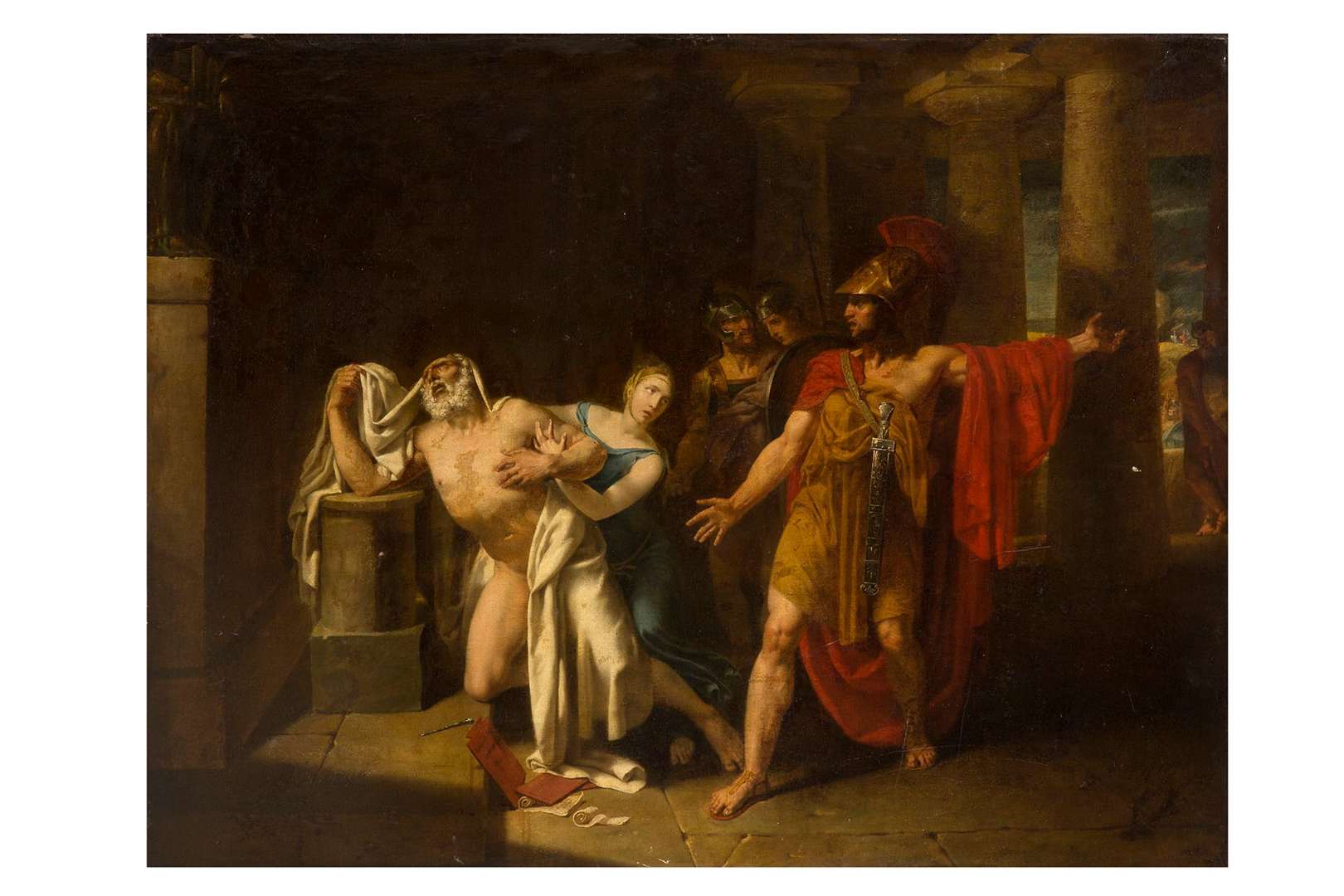
École française, vers 1805
The item was sold for 11 700 €
Fees include commission and taxes.
French school, circa 1805 La mort de Démosthène Canvas 114 x 173 cm - 44 7/8 x 68 1/8 in. The Death of Demosthenes, canvas PROVENANCE Private collection, France BIBLIOGRAPHY Philippe GRUNCHEC, "Les Concours des Prix de Rome 1797-1863, Tome II", Ecole nationale supérieure des Beaux-Arts, Paris, 1989, page 33, repr. p.34, pl. 3 (as anonymous) While the life of Demosthenes (384 BC- 322 BC) remains eminently fascinating, it was the moment when the philosopher put an end to it that the members of the Académie chose as the subject of the Grand Prix in 1805. A pupil of Plato (c. 425 BC - c. 348 BC), Demosthenes began his career as a logographer and political orator. A fervent defender of Athens and its policies, he violently opposed Philip II of Macedonia (382-336 BC) and his attempts to control Athenian clerouquies in Thrace as early as 351 BC, which he denounced in his First Philippic. Throughout his life, he defended his convictions, until he was exiled in 324 BC on charges of fraud. A year later, he was recalled and repeated his anti-Macedonian rhetoric. Despite this, he was soon forced to flee, taking refuge in the temple of Poseidon on the island of Cauria, now Poros. Cornered, he took his own life by chewing on the end of his poisoned calamus. The weapon of all his battles, it was the one he chose to end his life. Set up in 1663, the Prix de Rome was intended to reward the most promising pupils of the Académie royale. It would be three years before the Académie de France in Rome was officially inaugurated in February 1666. From that point onwards, it received the winners of the Académie's first and second prizes for a period of four years. Here we are in 1805, where art is strictly dictated by Davidian neoclassicism, whose codes are found here: frieze composition, pre-eminence of drawing, purity of line, an episode from ancient history relating to virtue, moral rigor and reason. Facing our young painter that year, the prize was won by Félix Boisselier (Fig. 1).