
&w=3840&q=75)
&w=3840&q=75)
&w=3840&q=75)
&w=3840&q=75)
&w=3840&q=75)
&w=3840&q=75)
&w=3840&q=75)
&w=3840&q=75)


61
Christoffel Jacobsz. van der LAMEN
The item was sold for 7 280 €
Fees include commission and taxes.
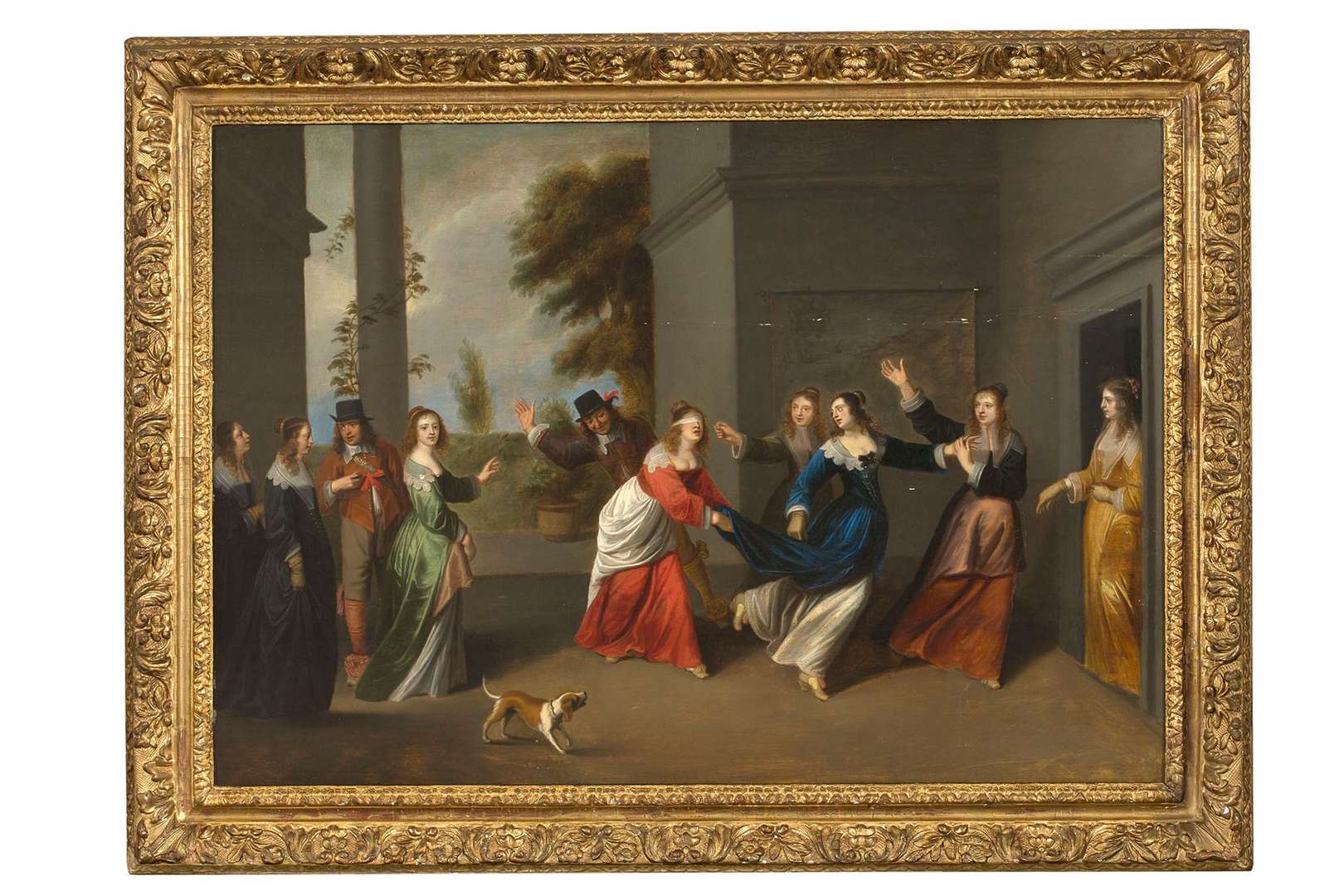
Christoffel Jacobsz. van der LAMEN Bruxelles, 1607 - 1651, Anvers La main chaude Oak panel (parqueté) 72 x 104 cm - 28 3/8 x 41 in. Blindman's buff, oak panel (cradled) PROVENANCE Private collection, Belgium Born in Brussels in 1607, Christoffel van der Lamen probably began and continued his apprenticeship with his father Jacob.
In 1636, he joined the Guilde de Saint-Luc in Antwerp, where he worked until his death in 1651. He soon specialized in vrolijke gezelschap, literally "merry companies". Sometimes gathered in the hushed atmosphere of a salon, sometimes set in the charming surroundings of a flower garden, elegant gatherings indulge in a variety of activities: card games, gallant conversations, impromptu concerts or lively discussions. More popular in the United Provinces, the genre had developed particularly in the wake of Willem Buytewech (1591 - 1624) and Esaias van de Velde (1587 - 1630). Among his followers were Dirck Hals (1591 - 1656) in Haarlem, Pieter Codde (1599 - 1678) and Willem Duyster (1599 - 1635) in Amsterdam. The success of these subjects reached our Flemish artist, who appropriated their codes: in the shelter of a porch protecting them from a stormy sky, a gathering of elegantly dressed young people is captured in the midst of a game of hot hand (handje-klap). A cousin of colin-maillard, the game consisted in blindfolding one of the participants, while another slapped him on the palm. All the other players also held out theirs, so the blinded person had to guess who had slapped him. The work is full of sound: laughter, conversation, barking dogs, clicking heels. The laughing face of the man in the middle, his gaze clearly directed as he raises a hand without really looking for his blindfolded partner's, mixes the apparent innocence of the scene with a more saucy dimension. As is often the case in these joyful companies, one of the characters invites us to enter the scene and take part in the ambient excitement. Here, in the midst of the hubbub, the player in the green dress looks beyond the picture and directly into ours. In this slightly blurred setting, van der Lamen finely works the satins and velvets of his fabrics. Secondary to this, the decor is almost entirely made up of gray and earthy tones, allowing the bright, colorful dresses to stand out all the more. The painter shows that he is also attentive to detail in his work on hairstyles, lace and the rendering of materials. More than his northern counterparts, he accentuates the decorative character of these elegant gatherings of figures.
In 1636, he joined the Guilde de Saint-Luc in Antwerp, where he worked until his death in 1651. He soon specialized in vrolijke gezelschap, literally "merry companies". Sometimes gathered in the hushed atmosphere of a salon, sometimes set in the charming surroundings of a flower garden, elegant gatherings indulge in a variety of activities: card games, gallant conversations, impromptu concerts or lively discussions. More popular in the United Provinces, the genre had developed particularly in the wake of Willem Buytewech (1591 - 1624) and Esaias van de Velde (1587 - 1630). Among his followers were Dirck Hals (1591 - 1656) in Haarlem, Pieter Codde (1599 - 1678) and Willem Duyster (1599 - 1635) in Amsterdam. The success of these subjects reached our Flemish artist, who appropriated their codes: in the shelter of a porch protecting them from a stormy sky, a gathering of elegantly dressed young people is captured in the midst of a game of hot hand (handje-klap). A cousin of colin-maillard, the game consisted in blindfolding one of the participants, while another slapped him on the palm. All the other players also held out theirs, so the blinded person had to guess who had slapped him. The work is full of sound: laughter, conversation, barking dogs, clicking heels. The laughing face of the man in the middle, his gaze clearly directed as he raises a hand without really looking for his blindfolded partner's, mixes the apparent innocence of the scene with a more saucy dimension. As is often the case in these joyful companies, one of the characters invites us to enter the scene and take part in the ambient excitement. Here, in the midst of the hubbub, the player in the green dress looks beyond the picture and directly into ours. In this slightly blurred setting, van der Lamen finely works the satins and velvets of his fabrics. Secondary to this, the decor is almost entirely made up of gray and earthy tones, allowing the bright, colorful dresses to stand out all the more. The painter shows that he is also attentive to detail in his work on hairstyles, lace and the rendering of materials. More than his northern counterparts, he accentuates the decorative character of these elegant gatherings of figures.