
&w=3840&q=75)
&w=3840&q=75)
&w=3840&q=75)
&w=3840&q=75)
&w=3840&q=75)
&w=3840&q=75)
&w=3840&q=75)
&w=3840&q=75)


58
Giacomo Francesco CIPPER, dit Il Todeschini
The item was sold for 10 400 €
Fees include commission and taxes.
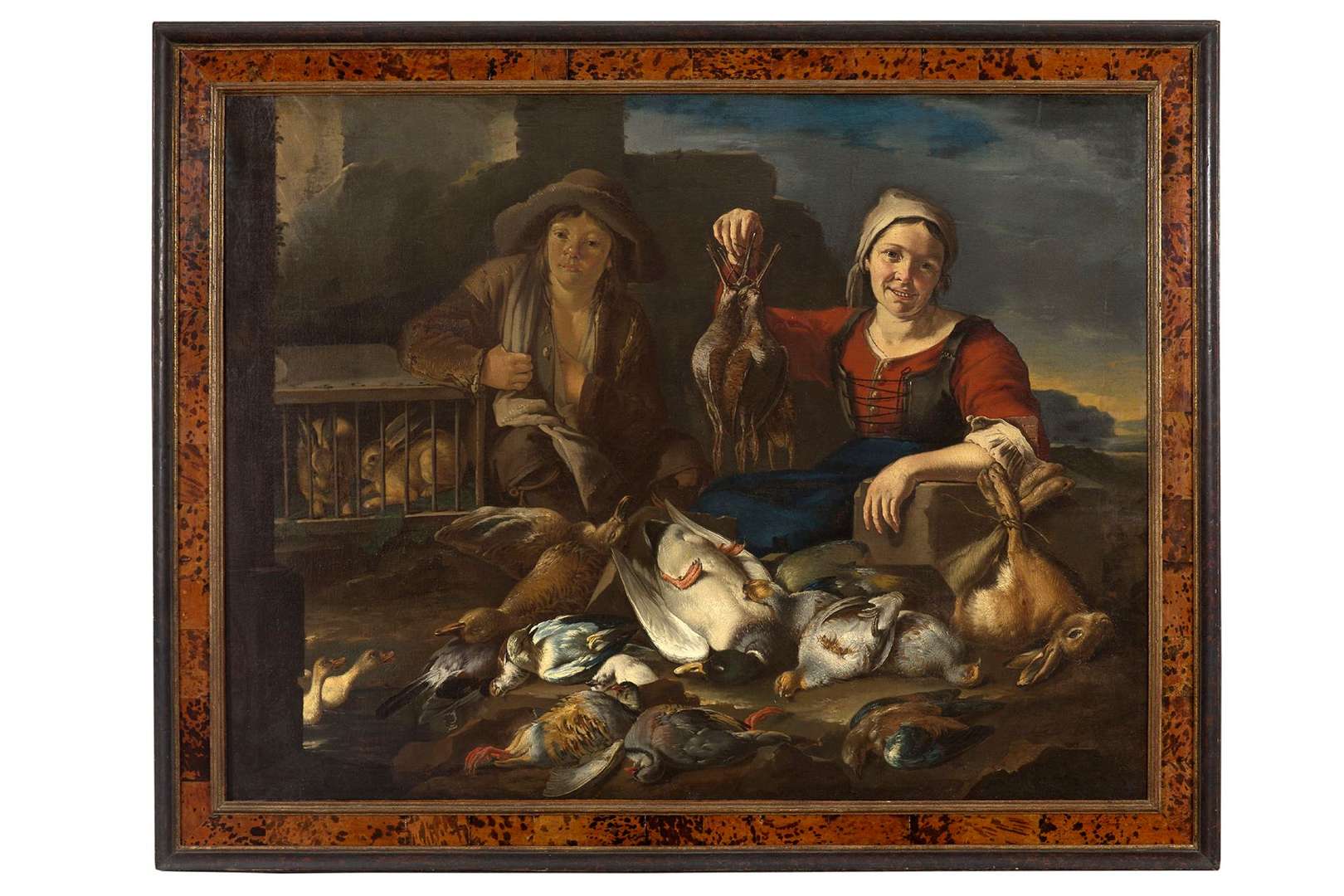
Giacomo Francesco CIPPER, known as Il Todeschini Feldkirch, c. 1664 - 1736, Milan Les petits marchands de gibier Canvas 125 x 160 cm - 49 1/4 x 63 in. Small game merchants, canvas PROVENANCE Private collection, Belgium. A painter of reality, of the everyday, a painter of the street and its men and women, Cipper devoted most of his work to the lives of the humble and to what constitutes them. Nicknamed "Il Todeschini" (the German) because of his place of birth, it is difficult to document the artist's life before his arrival in Milan in 1686. He was immediately drawn to the realist movement, which was well established in Lombardy from the 17th to the 18th century. He followed in the footsteps of precursors such as Bernardo Monsù (1624-1687) and Felice Boselli (1650-1732). Although he produced cycles on mythological and religious themes, it would appear that he also began as a still-life painter, so it's hardly surprising to find here a particular attention to detail in the display before us. Without collaboration, the artist demonstrates his mastery of both human and animal representation. Thus, against a background that is there merely to accommodate his extras, are a woman and a young boy, established on the ground where they gather their macabre booty. The first shot is an ostentatious display of colorful ducks and fowl. Perhaps the only intruders are the dead hare and the rabbits still alive, patiently waiting in their cage to be taken away with the rest. Cipper shows that he can paint plumage as well as fur, a dead animal as well as a live one. With her gesture of presentation, the dealer invites us to enter and participate in this innocuous scene of life. Modestly dressed, the child's faded hat, mended jacket and untidy hair, as well as the woman's too-tight corset, shawl and simple dress, all hint at the modesty of their origins. The emphasis on individualized, almost life-size, commonplace figures is reminiscent of the Flemish influence of Pieter Brueghel the Elder (1525-1569), for example. The realism of the treatment, meanwhile, stems directly from what the Carracci and Caravaggio (1571-1610) had begun some time earlier. A singular but recurring choice in Cipper's work is the merchant's laughing face, all teeth visible. A topos in the artist's work, laughter can be simple and spontaneous, as here, sometimes associated with playfulness and joking, or it can seem more ironic and provocative. Here, there's no question of procrastination, of denouncing the throes of misery. Rather, Cipper underlines his interest in the world of the street, which he shares with us. Having fallen into oblivion for some time, Il Todeschini is now back in the spotlight, with a retrospective entitled "Il Teatro del Quotidiano" at the Trento Museum in Italy. In 2005, the artist was also the subject of an exhibition jointly organized by the Beaux-Arts museums of Reims and Chambéry and the Malraux museum in Le Havre, with some twenty paintings held in French public collections.