
&w=3840&q=75)
&w=3840&q=75)
&w=3840&q=75)
&w=3840&q=75)
&w=3840&q=75)
&w=3840&q=75)
&w=3840&q=75)
&w=3840&q=75)


189
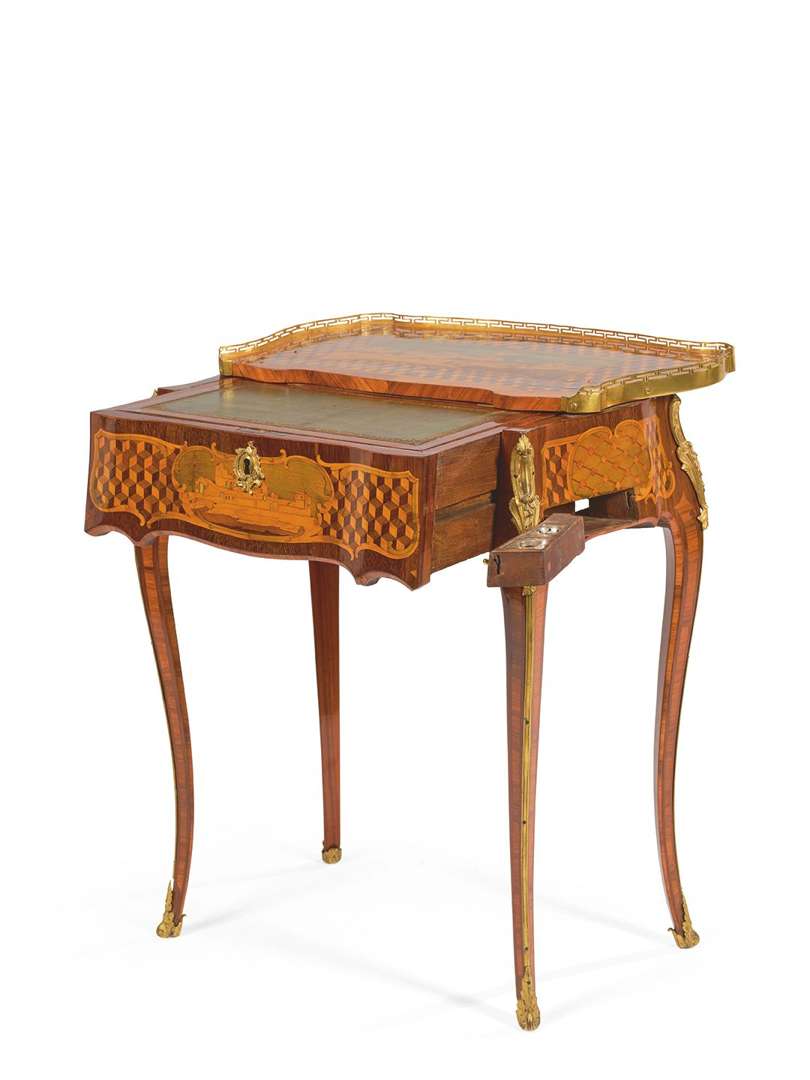
RARE TABLE À ÉCRIRE DITE « À LA POMPADOUR » de dame entièrement à décor de
The item was sold for 23 400 €
Fees include commission and taxes.
RARE LADY'S WRITING TABLE DITE "À LA POMPADOUR" entirely decorated with geometric marquetry of cubes and on the top of a landscape with figures and architecture in a reserve, as well as on the front with mother-of-pearl inlays.
The top is sliding, revealing a green leather-wrapped flap in a drawer revealing a reserve.
A small, discreet drawer on the side holds a silver-plated inkwell and hourglass. Chased and gilded bronze ornamentation. Stamped (twice) by Léonard
Boudin (received master in 1761) and Jurande.
France, second half of the 18th century.
Height: 72.6 cm - Width: 61 cm
Depth : 38 cm
(Accidents, restorations, replaced elements, small missing parts)
PROVENANCE Michel Baechler Collection
Throughout the 18th century, furniture was developed that not only introduced a new style, but also adapted to the new standards of comfort in the wealthy interiors of the
Kingdom of France.
Architect Jacques François Blondel took stock of these social changes, describing three types of apartment, each requiring a specific type of furniture to suit its use: apartments d'apparat, apartments de réception and private apartments.
It was in these latter apartments that luxurious furnishings were developed, including the writing tables attributed to the Marquise de Pompadour.
Marquise de Pompadour is credited with instigating the development of this type of furnishing.
The inlaid decor favored by their creators' contemporaries can easily be seen in the different interpretations of these writing tables, which bear different signatures and seem to demonstrate that their creators shared their knowledge with different workshops.
Our piece of furniture is twice stamped by Léonard Boudin. A pupil of Pierre Migeon, Boudin acquired a reputation among his peers that enabled him, in addition to his cabinetmaking business, to open his own store and employ several of his colleagues in his company, while continuing to affix his signature to the furniture resulting from this collaboration.
Modest in size, these flying pieces of furniture found their way into the intimacy of bedrooms and living rooms, discovering multiple functions while adorning themselves with opulent decor to justify the fortune of their patron.
Our table, which we can date to the 1770s, is part of the Transition period between the reigns of Louis XV and Louis XVI, and follows the same structure. It features a heterogeneous, colorful decor of different species, combining picturesque scenes with straight lines and cubic marquetry with their wine-like cartouches and scrolls forming rocailles. The movement of these forms demonstrates the decade's attachment to the forms inherited from the Rococo period, while at the same time revealing the evolution of the arts towards a "Greek-style" taste with more severe lines.
The furniture bearing his stamp may reveal the work of different cabinetmakers, such as the architectural decorations that can also be attributed to André Louis Gilbert.
Both a renowned cabinetmaker and a skilled dealer, Boudin's output was prolific, and writing tables bearing his stamp can be found in renowned museums both abroad and in France, notably at the Metropolitan Museum in New York, where a writing table of the same model as ours is preserved (inv. no. 69.9.4). Another example with a much more similar design was sold by Christie's London on November 12, 2020 (lot 24).
The top is sliding, revealing a green leather-wrapped flap in a drawer revealing a reserve.
A small, discreet drawer on the side holds a silver-plated inkwell and hourglass. Chased and gilded bronze ornamentation. Stamped (twice) by Léonard
Boudin (received master in 1761) and Jurande.
France, second half of the 18th century.
Height: 72.6 cm - Width: 61 cm
Depth : 38 cm
(Accidents, restorations, replaced elements, small missing parts)
PROVENANCE Michel Baechler Collection
Throughout the 18th century, furniture was developed that not only introduced a new style, but also adapted to the new standards of comfort in the wealthy interiors of the
Kingdom of France.
Architect Jacques François Blondel took stock of these social changes, describing three types of apartment, each requiring a specific type of furniture to suit its use: apartments d'apparat, apartments de réception and private apartments.
It was in these latter apartments that luxurious furnishings were developed, including the writing tables attributed to the Marquise de Pompadour.
Marquise de Pompadour is credited with instigating the development of this type of furnishing.
The inlaid decor favored by their creators' contemporaries can easily be seen in the different interpretations of these writing tables, which bear different signatures and seem to demonstrate that their creators shared their knowledge with different workshops.
Our piece of furniture is twice stamped by Léonard Boudin. A pupil of Pierre Migeon, Boudin acquired a reputation among his peers that enabled him, in addition to his cabinetmaking business, to open his own store and employ several of his colleagues in his company, while continuing to affix his signature to the furniture resulting from this collaboration.
Modest in size, these flying pieces of furniture found their way into the intimacy of bedrooms and living rooms, discovering multiple functions while adorning themselves with opulent decor to justify the fortune of their patron.
Our table, which we can date to the 1770s, is part of the Transition period between the reigns of Louis XV and Louis XVI, and follows the same structure. It features a heterogeneous, colorful decor of different species, combining picturesque scenes with straight lines and cubic marquetry with their wine-like cartouches and scrolls forming rocailles. The movement of these forms demonstrates the decade's attachment to the forms inherited from the Rococo period, while at the same time revealing the evolution of the arts towards a "Greek-style" taste with more severe lines.
The furniture bearing his stamp may reveal the work of different cabinetmakers, such as the architectural decorations that can also be attributed to André Louis Gilbert.
Both a renowned cabinetmaker and a skilled dealer, Boudin's output was prolific, and writing tables bearing his stamp can be found in renowned museums both abroad and in France, notably at the Metropolitan Museum in New York, where a writing table of the same model as ours is preserved (inv. no. 69.9.4). Another example with a much more similar design was sold by Christie's London on November 12, 2020 (lot 24).