
&w=3840&q=75)
&w=3840&q=75)
&w=3840&q=75)
&w=3840&q=75)
&w=3840&q=75)
&w=3840&q=75)
&w=3840&q=75)
&w=3840&q=75)


185
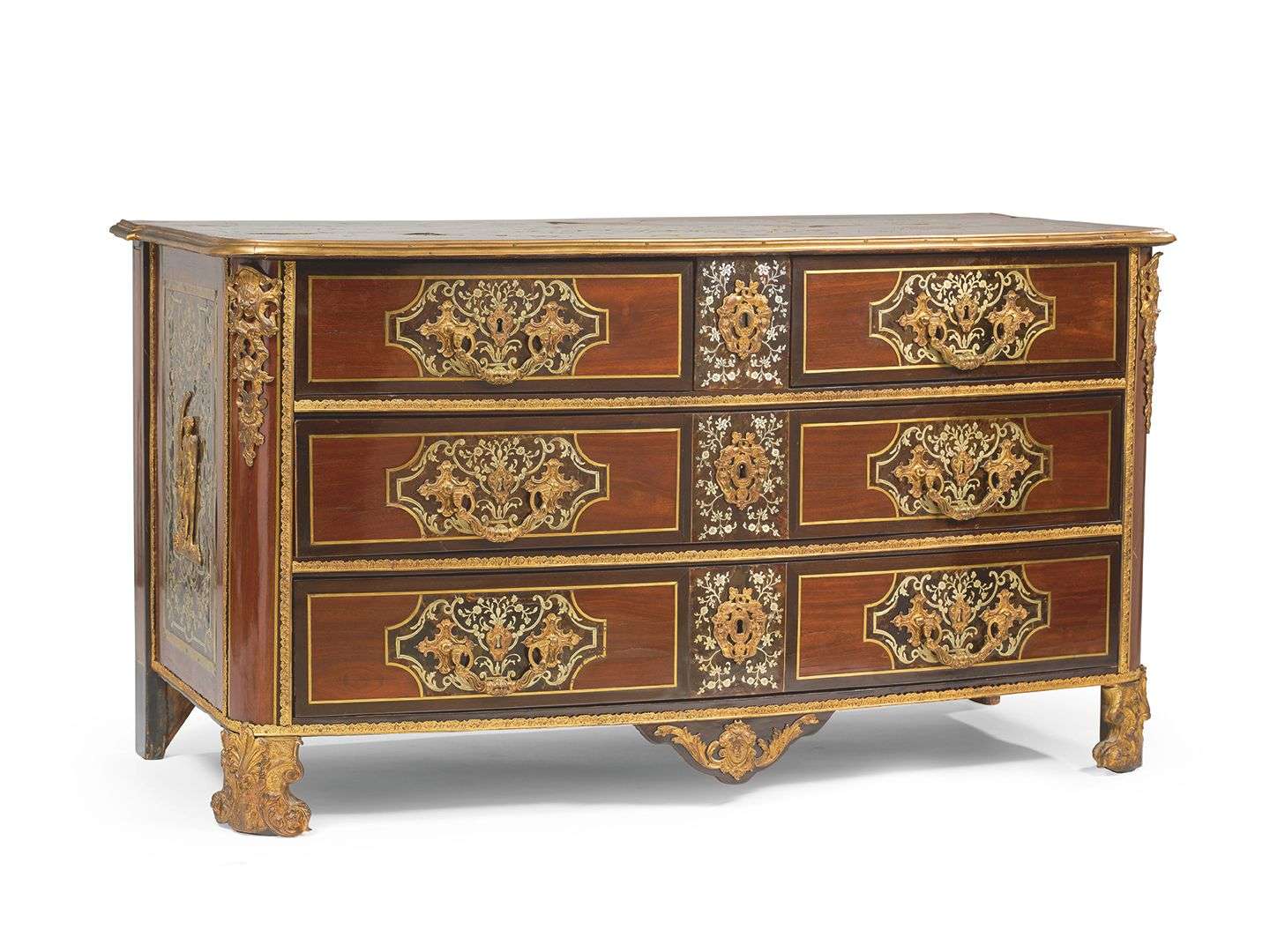
COMMODE LOUIS XIV ouvrant à quatre tiroirs sur trois rangs en bois de plac
The item was sold for 22 100 €
Fees include commission and taxes.
LOUIS XIV COMMODE opening to four drawers on three rows in veneered wood and inlaid decoration in engraved pewter marquetry on a brown tortoiseshell background in engraved brass frames. Alternating mahogany and amaranth wood base with brass fillets. The top is engraved with a central pair of satlimbanks in a cartouche with rich plant ornamentation. The sides feature applied gilded bronzes of a young Bacchus, and rich gilded bronze scrolls on the front legs.
Lock escutcheons with dolphins.
Louis XIV period, circa 1710 - 1715.
Height : 80 cm - Width : 148 cm
Depth : 68 cm
(Accidents, missing parts, restorations, added elements)
PROVENANCE
- Michel Baechler Collection
It wasn't until the end of the 17th century that the decorative arts underwent major changes, emancipating themselves from the rigor of the Baroque period, notably under the impetus of André Charles Boulle, who imagined a new furniture typology illustrated in his collection "Nouveaux desseins de meubles et ouvrages de bronze et de marqueterie".
Among these new pieces of furniture was the commode, first known as the "bureau en commode" (chest of drawers), drawing its initial forms from those of the Mazarin-style bureau. The corners, however, have been rounded off to match the new, more flexible ornamentation.
The pewter marquetry rinceaux on a tortoiseshell background illustrate the floral rinceaux taken from 17th-century floral marquetry decorations, as well as sinuous scrolls reminiscent of the ornamentation proposed to Boulle by his eldest son Jean-Philippe, who assisted him in the design of his furniture. In addition to this influence in the marquetry, the applied bronzes on the side panels are based on a model found on a piece of furniture with a height of support from a suite of four made by Boulle and now in the Musée du Louvre (inv. no.
OA 5455 to 5458).
The top of the set is decorated with rich interlacing around a couple of acrobats, reminiscent of the ornaments on the plates of Jean Bérain, a contemporary of Boulle who also lived at the Louvre, and who took a similar approach by publishing his collections of drawings, which were distributed throughout the workshops of the city of Paris.
Lock escutcheons with dolphins.
Louis XIV period, circa 1710 - 1715.
Height : 80 cm - Width : 148 cm
Depth : 68 cm
(Accidents, missing parts, restorations, added elements)
PROVENANCE
- Michel Baechler Collection
It wasn't until the end of the 17th century that the decorative arts underwent major changes, emancipating themselves from the rigor of the Baroque period, notably under the impetus of André Charles Boulle, who imagined a new furniture typology illustrated in his collection "Nouveaux desseins de meubles et ouvrages de bronze et de marqueterie".
Among these new pieces of furniture was the commode, first known as the "bureau en commode" (chest of drawers), drawing its initial forms from those of the Mazarin-style bureau. The corners, however, have been rounded off to match the new, more flexible ornamentation.
The pewter marquetry rinceaux on a tortoiseshell background illustrate the floral rinceaux taken from 17th-century floral marquetry decorations, as well as sinuous scrolls reminiscent of the ornamentation proposed to Boulle by his eldest son Jean-Philippe, who assisted him in the design of his furniture. In addition to this influence in the marquetry, the applied bronzes on the side panels are based on a model found on a piece of furniture with a height of support from a suite of four made by Boulle and now in the Musée du Louvre (inv. no.
OA 5455 to 5458).
The top of the set is decorated with rich interlacing around a couple of acrobats, reminiscent of the ornaments on the plates of Jean Bérain, a contemporary of Boulle who also lived at the Louvre, and who took a similar approach by publishing his collections of drawings, which were distributed throughout the workshops of the city of Paris.