
&w=3840&q=75)
&w=3840&q=75)
&w=3840&q=75)
&w=3840&q=75)
&w=3840&q=75)
&w=3840&q=75)
&w=3840&q=75)
&w=3840&q=75)


184
COMMODE LOUIS XIV entièrement à décor de marqueterie dite
The item was sold for 32 064 €
Fees include commission and taxes.
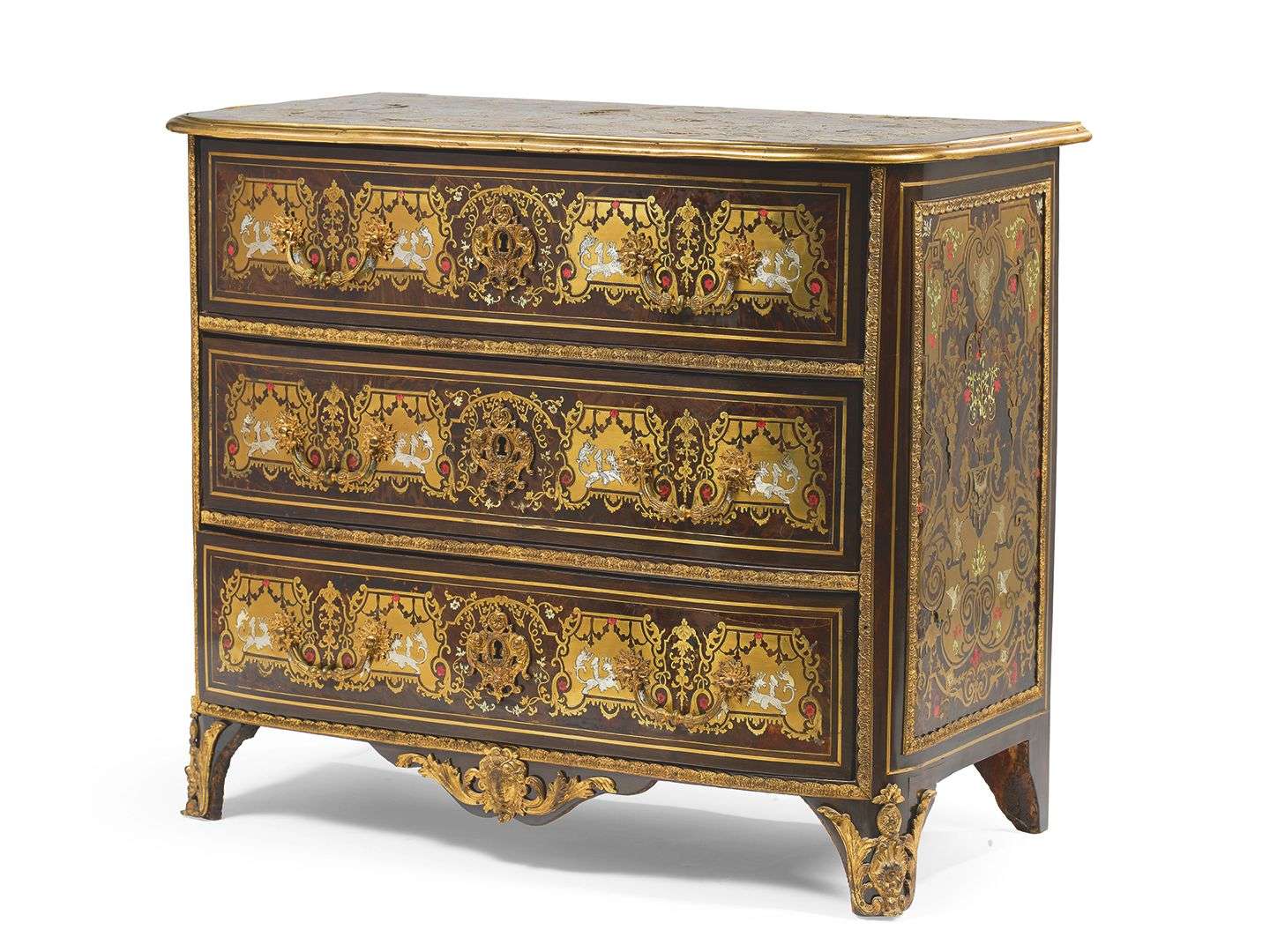
COMMODE LOUIS XIV entirely decorated with marquetry called
Boulle, mother-of-pearl, pewter and polychrome elements of green and red tinted horn, cut brass on a brown tortoiseshell background. It opens with three drawers. The top is entirely decorated with Ottoman-style marquetry featuring hunters and animals. The rails, uprights and sides feature gilded bronze baguettes, and the front legs and apron are richly decorated with gilded bronzes.
Louis XIV period, Paris, circa 1700 - 1710.
Height: 81 cm - Width: 96 cm
Depth : 53.5 cm
(Damage, missing parts and restorations)
PROVENANCE
- Michel Baechler Collection
Our rectangular chest of drawers, with its slightly curved front, features a rich decoration contrasting with its sober lines. Its sophisticated appearance is embellished with gilded bronzes forming frames and ornaments on the legs and apron, but is distinguished more by its "Boulle" marquetry. This décor features incredible ornamentation on each side, with figures dressed in Ottoman style, harquebusiers and fantastical animals in a dreamlike architectural setting of canopies with scrolled arches and stylized festoons.
The entire opulent decorative vocabulary was inspired by the designs of ornamentalist Jean Bérain, who succeeded Charles Le Brun as "dessinateur de la Chambre et du Cabinet du roi" in 1674.
This marked the beginning of a new style under the reign of King Louis XIV, which moved away from the hieratic, solemn forms promoted by Le Brun, and gave pride of place to the curves, curlicues and interlacing inherited from the Renaissance, which enjoyed a new lease of life at the dawn of the
18th century.
Although our chest of drawers is not stamped, its decoration features elements attributable to the cabinetmaker Nicolas Sageot, a master of the Faubourg Saint-Antoine in 1706.
Saint-Antoine.
Acknowledged by his contemporaries during his lifetime, his rich production, notably of commodes, desks and coats of arms, was characterized primarily by his work in metal marquetry, originally developed by Charles-André
Boulle (1642 - 1732), whose technical aspects Sageot was able to transpose into his designs from plates engraved by Bérain.
Similar decorations attributed to the cabinetmaker's production can be found in museum collections, such as the armoire in the Musée des Arts Décoratifs in Paris (inv. no. 21919), whose marquetry work bears similarities to our commode, or the "Mazarin" desk in the Petit Palais (inv. no. ODUT).
Petit Palais (inv. no. ODUT1500), with its rich Bérain-style decoration.
Commodes of the same type, also attributable to Sageot, have been presented at recent public auctions, such as one from the Dalrymple of Hailes collection sold at Christie's
London on June 30, 2022 (lot 124), a commode sold at Tajan on October 10, 2018 (lot 226) or another example sold by Artcurial on December 16, 2019 (lot 22).
Boulle, mother-of-pearl, pewter and polychrome elements of green and red tinted horn, cut brass on a brown tortoiseshell background. It opens with three drawers. The top is entirely decorated with Ottoman-style marquetry featuring hunters and animals. The rails, uprights and sides feature gilded bronze baguettes, and the front legs and apron are richly decorated with gilded bronzes.
Louis XIV period, Paris, circa 1700 - 1710.
Height: 81 cm - Width: 96 cm
Depth : 53.5 cm
(Damage, missing parts and restorations)
PROVENANCE
- Michel Baechler Collection
Our rectangular chest of drawers, with its slightly curved front, features a rich decoration contrasting with its sober lines. Its sophisticated appearance is embellished with gilded bronzes forming frames and ornaments on the legs and apron, but is distinguished more by its "Boulle" marquetry. This décor features incredible ornamentation on each side, with figures dressed in Ottoman style, harquebusiers and fantastical animals in a dreamlike architectural setting of canopies with scrolled arches and stylized festoons.
The entire opulent decorative vocabulary was inspired by the designs of ornamentalist Jean Bérain, who succeeded Charles Le Brun as "dessinateur de la Chambre et du Cabinet du roi" in 1674.
This marked the beginning of a new style under the reign of King Louis XIV, which moved away from the hieratic, solemn forms promoted by Le Brun, and gave pride of place to the curves, curlicues and interlacing inherited from the Renaissance, which enjoyed a new lease of life at the dawn of the
18th century.
Although our chest of drawers is not stamped, its decoration features elements attributable to the cabinetmaker Nicolas Sageot, a master of the Faubourg Saint-Antoine in 1706.
Saint-Antoine.
Acknowledged by his contemporaries during his lifetime, his rich production, notably of commodes, desks and coats of arms, was characterized primarily by his work in metal marquetry, originally developed by Charles-André
Boulle (1642 - 1732), whose technical aspects Sageot was able to transpose into his designs from plates engraved by Bérain.
Similar decorations attributed to the cabinetmaker's production can be found in museum collections, such as the armoire in the Musée des Arts Décoratifs in Paris (inv. no. 21919), whose marquetry work bears similarities to our commode, or the "Mazarin" desk in the Petit Palais (inv. no. ODUT).
Petit Palais (inv. no. ODUT1500), with its rich Bérain-style decoration.
Commodes of the same type, also attributable to Sageot, have been presented at recent public auctions, such as one from the Dalrymple of Hailes collection sold at Christie's
London on June 30, 2022 (lot 124), a commode sold at Tajan on October 10, 2018 (lot 226) or another example sold by Artcurial on December 16, 2019 (lot 22).