
&w=3840&q=75)
&w=3840&q=75)
&w=3840&q=75)
&w=3840&q=75)
&w=3840&q=75)
&w=3840&q=75)
&w=3840&q=75)
&w=3840&q=75)


172
GRAND BUREAU PLAT rectangulaire, bâti de bois blanc entièrement en placage
Estimate20 000 - 30 000 €
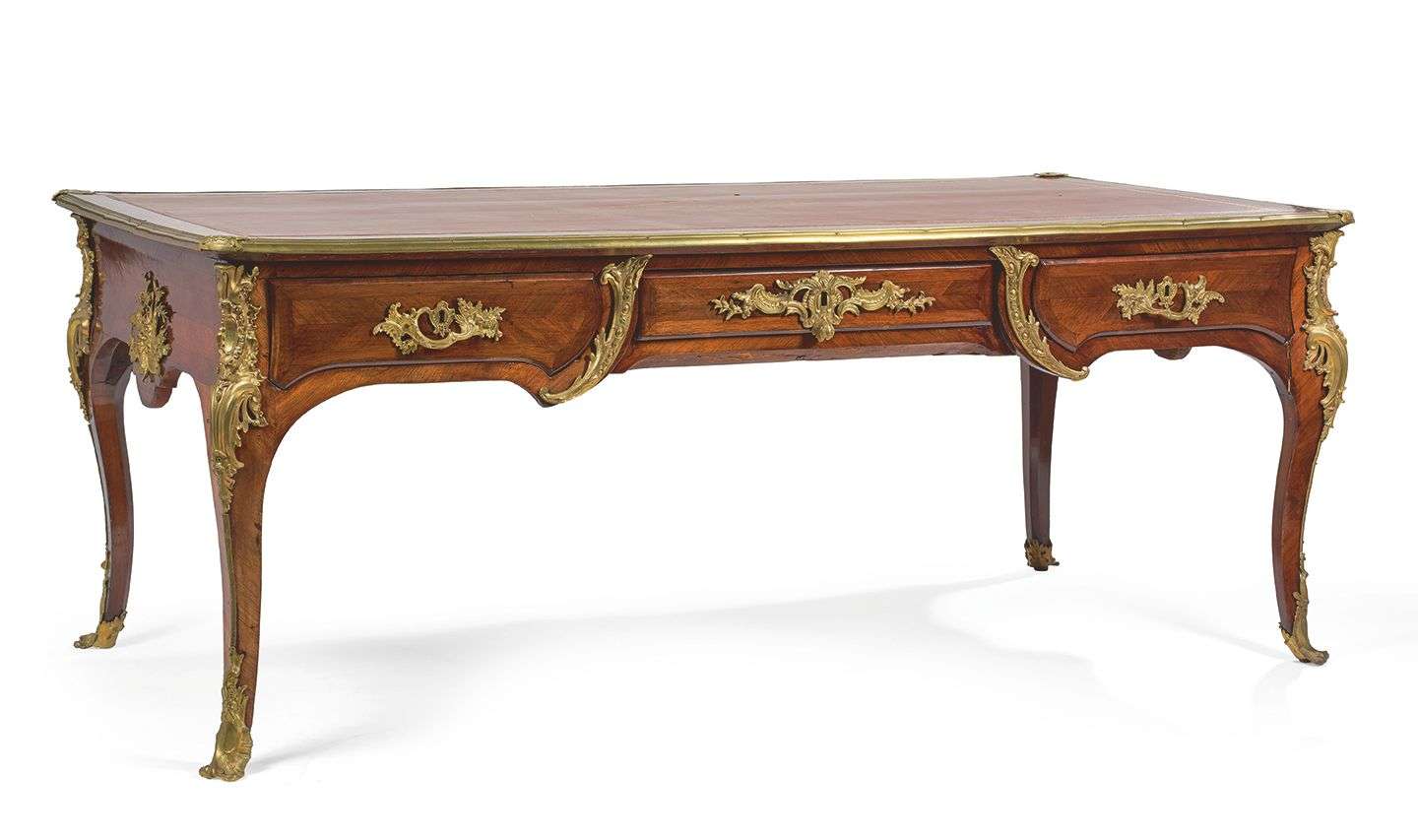
LARGE rectangular FLAT DESK, white wood frame entirely in amaranth veneer on all sides, opens with three drawers on the waistband, two of which are slightly boxed, the visitor's side with three false drawers.
The four legs are arched on the sides.
Stamped by Migeon below the belt, probably Pierre II Migeon (1701 - 1758).
Louis XV period, circa 1745.
Height : 77 cm - Width : 195 cm
Depth: 96.5 cm
Richly ornamented with brass falls, handles, sabots and lock escutcheons.
Gilded brown leather top.
(Restorations, patches, accidents and small chips, good overall condition).
Two letters signed in 1920 by Elisa Maillard, attaché and later curator at the Musée de Cluny, addressed to Georges Barrilleau, praising this desk and mentioning its publication. Two old photographs of the desk are also included.
PROVENANCE
- Georges Barrilleau (1853 - 1925)
- By inheritance to this day.
Born into the famous eponymous dynasty of cabinetmakers
Pierre II Migeon (IV) distinguished himself from his ancestors by his stamp and the new style of his furniture, contemporary with the rise of the rocaille style in the decorative arts at the dawn of the reign of Louis XV.
His products from his workshops on rue de Charenton were delivered to a prestigious clientele, including the Duc d'Orléans, son of the Regent, the Duchesse de Rohan, the Maréchal de Noailles and the Duchesse d'Epernon.
In addition, he received his first orders from the Garde-meuble de la Couronne and the Menus-Plaisirs, in line with the development of his clientele both in France and abroad.
In addition to the presence of his stamp, our desk has some of the strong characteristics that Migeon used to express his decorative vocabulary. Massive in form, with measured curves to soften the lines, it features a luxurious yet relatively sober décor, with a veneer of exotic wood, in this case amaranth, with butterfly-wing motifs.
The bronze ornamentation is discreet, employing decorative elements such as trophies, clasps and acanthus leaves, which were highly prized at the time.
These elements illustrate a furniture typology characteristic of flat desks in the mid
the mid-18th century, and were frequently commissioned.
Our desk can be compared with other examples of similar characteristics, notably one in the reserves of the Musée du Louvre (N° OA 9400).
The French State also owns two similar examples, the first of which is now in the Hôtel de Chazerat, now the headquarters of the Auvergne regional cultural affairs office (inv. no. AP80L100330) and the next, attributed to the cabinetmaker, in the Mobilier
National (inv. no. GME-15177 - 000)
The four legs are arched on the sides.
Stamped by Migeon below the belt, probably Pierre II Migeon (1701 - 1758).
Louis XV period, circa 1745.
Height : 77 cm - Width : 195 cm
Depth: 96.5 cm
Richly ornamented with brass falls, handles, sabots and lock escutcheons.
Gilded brown leather top.
(Restorations, patches, accidents and small chips, good overall condition).
Two letters signed in 1920 by Elisa Maillard, attaché and later curator at the Musée de Cluny, addressed to Georges Barrilleau, praising this desk and mentioning its publication. Two old photographs of the desk are also included.
PROVENANCE
- Georges Barrilleau (1853 - 1925)
- By inheritance to this day.
Born into the famous eponymous dynasty of cabinetmakers
Pierre II Migeon (IV) distinguished himself from his ancestors by his stamp and the new style of his furniture, contemporary with the rise of the rocaille style in the decorative arts at the dawn of the reign of Louis XV.
His products from his workshops on rue de Charenton were delivered to a prestigious clientele, including the Duc d'Orléans, son of the Regent, the Duchesse de Rohan, the Maréchal de Noailles and the Duchesse d'Epernon.
In addition, he received his first orders from the Garde-meuble de la Couronne and the Menus-Plaisirs, in line with the development of his clientele both in France and abroad.
In addition to the presence of his stamp, our desk has some of the strong characteristics that Migeon used to express his decorative vocabulary. Massive in form, with measured curves to soften the lines, it features a luxurious yet relatively sober décor, with a veneer of exotic wood, in this case amaranth, with butterfly-wing motifs.
The bronze ornamentation is discreet, employing decorative elements such as trophies, clasps and acanthus leaves, which were highly prized at the time.
These elements illustrate a furniture typology characteristic of flat desks in the mid
the mid-18th century, and were frequently commissioned.
Our desk can be compared with other examples of similar characteristics, notably one in the reserves of the Musée du Louvre (N° OA 9400).
The French State also owns two similar examples, the first of which is now in the Hôtel de Chazerat, now the headquarters of the Auvergne regional cultural affairs office (inv. no. AP80L100330) and the next, attributed to the cabinetmaker, in the Mobilier
National (inv. no. GME-15177 - 000)