
&w=3840&q=75)
&w=3840&q=75)
&w=3840&q=75)
&w=3840&q=75)
&w=3840&q=75)
&w=3840&q=75)
&w=3840&q=75)
&w=3840&q=75)


60
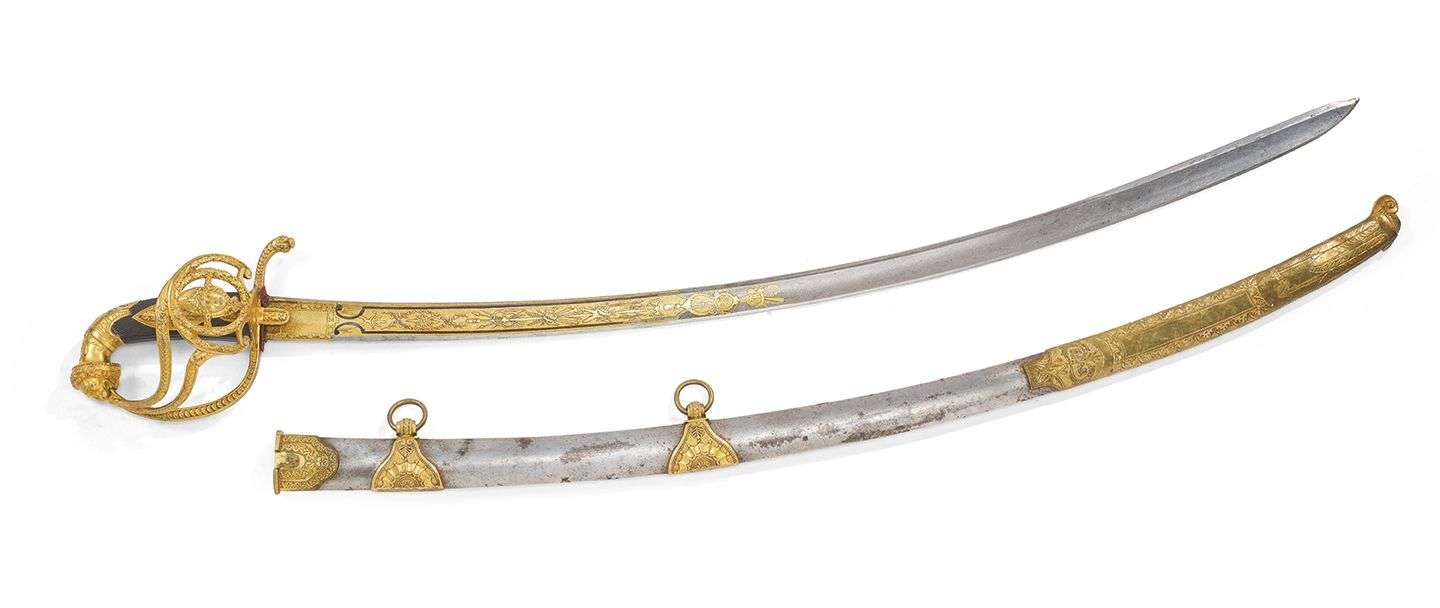
SABRE DU GÉNÉRAL MOUTON-DUVERNET (1770 - 1816)
The item was sold for 65 000 €
Fees include commission and taxes.
SABER OF GENERAL MOUTON-DUVERNET (1770 - 1816)
Chased gilt bronze and ebony mounting.
Lion-head crosier-shaped cap, scales and spider web on the skirt.
Joint arch decorated with geometric friezes from which two secondary branches emerge. They meet on an inverted openwork shield with a central Minerva head and oak-leaf frieze.
Baguette cruiser following the frame.
Squared ebony spindle with oval brass plate marked "A MOUTON duVernet" under crown.
Damascus blade with rim and hollow sides, counter-edge and carp tongue. Engraved on a gold background with trophy decoration and blue fillet highlights. Iron scabbard marked "PIRMET A PARIS" with four brass fittings. Chape en suite de la monture
Two bracelets decorated with a spider's web and bouterole decorated with friezes, palms and arrows. Dard en roquillard (wear).
France, First Empire period.
Total length: 99.5 cm
Two documents are attached: the purchase invoice by Montégudet dated 1911 and another on the letterhead of La Giberne magazine dated 1912.
BIBLIOGRAPHY
This saber was published and reproduced in the reference magazine "La Giberne" of July 1911
XIIIe année, numéro I, page 88.
PROVENANCE
- Roger de Montégudet Collection (1880 - 1925)
- By descent to the present day.
After volunteering in 1785, this promising officer began his military career in the colonies, notably Guadeloupe, where he served in the local regiment. At just 19, he joined the corps as a private and quickly rose through the ranks to become captain adjutant-major. During the siege of Toulon in 1793, he played an active role, distinguishing himself by his composure. He went on to take part in all the major campaigns of the Revolution and Empire, and particularly stood out during the Italian campaign, notably at the Battle of Arcole.
On 26 brumaire an V (November 16, 1796), leading some twenty men, he managed to hold off the enemy on the causeway from the Pont d'Arcole to the dike, despite numerical superiority and the presence of enemy artillery. Badly wounded in the right thigh, he refused to leave his post, protecting a cannon whose crew had been decimated. It was only when reinforcements arrived and the enemy had been repulsed that he agreed to be evacuated.
On January 8, 1800, he embarked on the warship Le Généreux, tasked with supplying the French garrison besieged in the port of Valletta in Malta. But on February 18, during the Battle of the Malta Convoy, Le Généreux was boarded by the British frigate HMS Success, and taken prisoner. In 1806, he was sent to Spain with the rank of colonel.
He returned to Spain as a major general, and took part in the difficult campaigns of 1813 and 1814. Taken prisoner at the surrender of Dresden, he was interned before being released after Napoleon's abdication. During the First Restoration, he was appointed military governor of Valence. But during the Hundred Days, he once again rallied to Napoleon, who appointed him deputy for Haute-Loire to the House of Representatives.
He remained loyal to the Emperor to the very end: after Waterloo, he refused to recognize the return of the Bourbons. On July 2, 1815, he was appointed Governor of Lyon, which sealed his fate.
The royal decree of July 24, 1815, designed to suppress Napoleon's supporters, designated him a traitor to the king, liable to court martial.
Forced to flee, he hid for almost a year with a royalist friend, the Vicomte de Meaux.
Believing that tempers had subsided, he finally came out of hiding, and registered as a prisoner with Tassin de Nonneville, Prefect of the Loire.
Despite his loyalty to France and his military past, he was sentenced to death by a war council on July 15, 1816. His wife's pleas to King Louis XVIII were in vain. On July 27, 1816, he was shot at the Chemin des Étroits in Lyon, now in the city's 5th arrondissement.
Chased gilt bronze and ebony mounting.
Lion-head crosier-shaped cap, scales and spider web on the skirt.
Joint arch decorated with geometric friezes from which two secondary branches emerge. They meet on an inverted openwork shield with a central Minerva head and oak-leaf frieze.
Baguette cruiser following the frame.
Squared ebony spindle with oval brass plate marked "A MOUTON duVernet" under crown.
Damascus blade with rim and hollow sides, counter-edge and carp tongue. Engraved on a gold background with trophy decoration and blue fillet highlights. Iron scabbard marked "PIRMET A PARIS" with four brass fittings. Chape en suite de la monture
Two bracelets decorated with a spider's web and bouterole decorated with friezes, palms and arrows. Dard en roquillard (wear).
France, First Empire period.
Total length: 99.5 cm
Two documents are attached: the purchase invoice by Montégudet dated 1911 and another on the letterhead of La Giberne magazine dated 1912.
BIBLIOGRAPHY
This saber was published and reproduced in the reference magazine "La Giberne" of July 1911
XIIIe année, numéro I, page 88.
PROVENANCE
- Roger de Montégudet Collection (1880 - 1925)
- By descent to the present day.
After volunteering in 1785, this promising officer began his military career in the colonies, notably Guadeloupe, where he served in the local regiment. At just 19, he joined the corps as a private and quickly rose through the ranks to become captain adjutant-major. During the siege of Toulon in 1793, he played an active role, distinguishing himself by his composure. He went on to take part in all the major campaigns of the Revolution and Empire, and particularly stood out during the Italian campaign, notably at the Battle of Arcole.
On 26 brumaire an V (November 16, 1796), leading some twenty men, he managed to hold off the enemy on the causeway from the Pont d'Arcole to the dike, despite numerical superiority and the presence of enemy artillery. Badly wounded in the right thigh, he refused to leave his post, protecting a cannon whose crew had been decimated. It was only when reinforcements arrived and the enemy had been repulsed that he agreed to be evacuated.
On January 8, 1800, he embarked on the warship Le Généreux, tasked with supplying the French garrison besieged in the port of Valletta in Malta. But on February 18, during the Battle of the Malta Convoy, Le Généreux was boarded by the British frigate HMS Success, and taken prisoner. In 1806, he was sent to Spain with the rank of colonel.
He returned to Spain as a major general, and took part in the difficult campaigns of 1813 and 1814. Taken prisoner at the surrender of Dresden, he was interned before being released after Napoleon's abdication. During the First Restoration, he was appointed military governor of Valence. But during the Hundred Days, he once again rallied to Napoleon, who appointed him deputy for Haute-Loire to the House of Representatives.
He remained loyal to the Emperor to the very end: after Waterloo, he refused to recognize the return of the Bourbons. On July 2, 1815, he was appointed Governor of Lyon, which sealed his fate.
The royal decree of July 24, 1815, designed to suppress Napoleon's supporters, designated him a traitor to the king, liable to court martial.
Forced to flee, he hid for almost a year with a royalist friend, the Vicomte de Meaux.
Believing that tempers had subsided, he finally came out of hiding, and registered as a prisoner with Tassin de Nonneville, Prefect of the Loire.
Despite his loyalty to France and his military past, he was sentenced to death by a war council on July 15, 1816. His wife's pleas to King Louis XVIII were in vain. On July 27, 1816, he was shot at the Chemin des Étroits in Lyon, now in the city's 5th arrondissement.