
&w=3840&q=75)
&w=3840&q=75)
&w=3840&q=75)
&w=3840&q=75)
&w=3840&q=75)
&w=3840&q=75)
&w=3840&q=75)
&w=3840&q=75)


41
SABRE DE RÉCOMPENSE DÉCERNÉ PAR LES CONSULS DE LA RÉPUBLIQUE À JEAN-JOSEPH
The item was sold for 54 600 €
Fees include commission and taxes.
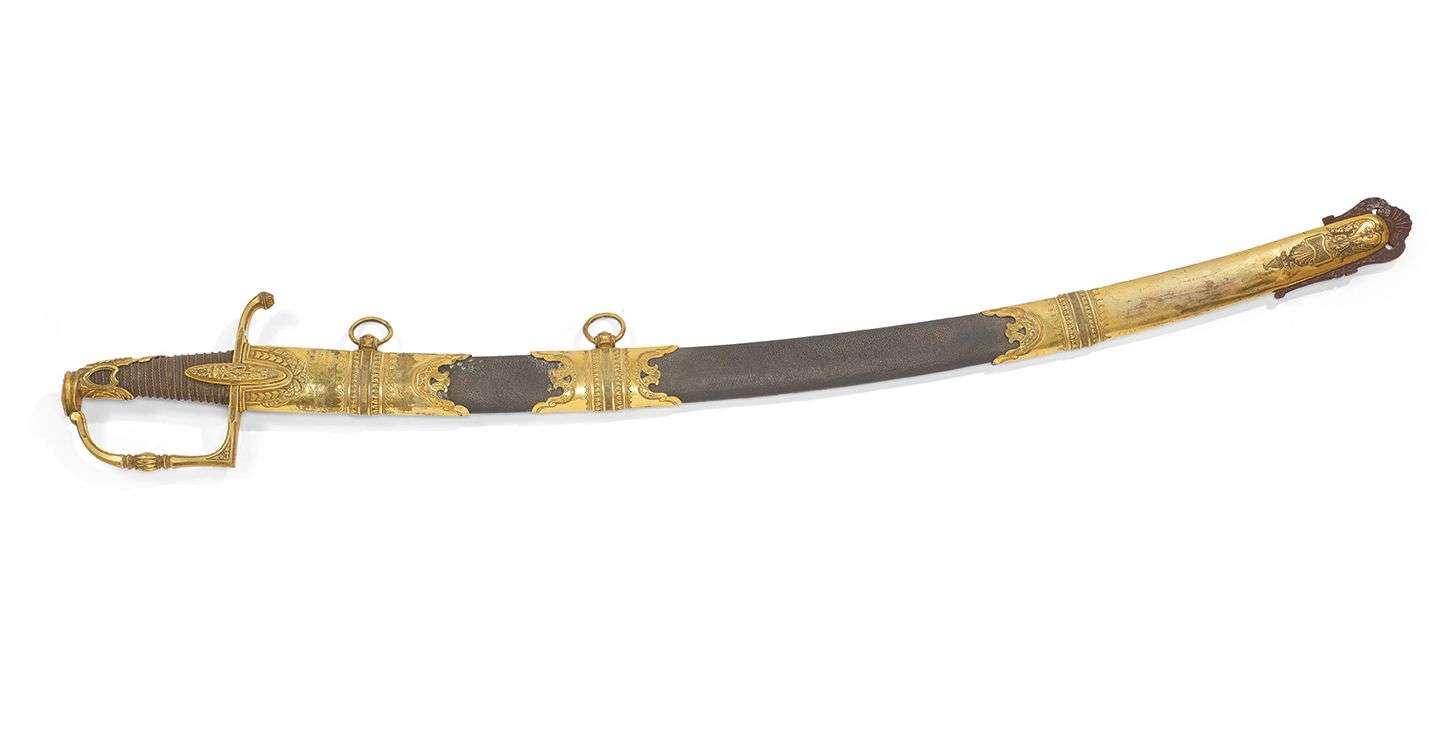
SABER AWARDED BY THE CONSULS OF THE REPUBLIC TO JEAN-JOSEPH CASTAGNIER (1753 - 1807)
Awarded by the Consuls of the Republic.
Chased brass mounting with burnished and matte gilding. Openwork cap with small oval German-style plate and palmette and acanthus leaf decoration.
Joint arch with hollow sides and melon rim. Slightly curved quillon ending in a button. It is hallmarked "LD", supposedly Lamogène directeur, "AB", unidentified, and "Boutet Directeur".
Artiste Manuf re a Versailles". Cruiser decorated with plant crowns, trumpet of fame and foliage. Wooden spindle with alternating double copper filigree. Blade with strong counter-edge and carp tongue, gilded, chased and one-third blued.
KLINGENTHAL" engraved on the right back.
Wooden core scabbard covered with blackened chagrin-type leather and three cut, openwork, finely chased and gilded brass fittings. Signed "DONNÉ Au CHEF De DIVISION CASTAGNIER Par Les CONSULS De La REPUBLIQUE".
Le 7 FRIMAIRE AN 8".
Iron dart in the shape of a scallop shell.
Jacques shell. Dried leathers making the saber difficult to remove.
France, Consulate period.
Overall length: 93 cm
Saber close to a known model of the "Saint Cloud" prize awarded on 19 brumaire an VIII (10 nov 1799).
Ours, awarded on Frimaire 7, An VIII (Nov 28, 1799), i.e. 18 days later, must have been part of the same order to Versailles.
Attached is a handwritten document for a down payment made by Mr. Montégudet in 1911 in settlement of "a saber from the Castagner division chief".
PROVENANCE
- Roger de Montégudet Collection (1880 - 1925)
- By descent to the present day.
The rank of "Chef de Division" referred to here (i.e. marine division) corresponds to the rank of general officer. The Minister of the Navy addressed Castagnier in this capacity in a letter dated August 4, 1800.
JEAN-JOSEPH CASTAGNIER (1753 - 1807) : PRIVATEER OF THE REVOLUTION
Born into a modest family, Jean-Joseph Castagnier was the son of Jean Castagnier, a sailor from Sète| his mother, Catherine Abeille, was a Martégale. He turned to the sea at a very early age: he was not yet ten when he embarked as a cabin boy on a merchant ship. Living conditions on board were harsh, but the coastal boy quickly adapted. At 14, he joined the navy as a novice, before becoming a seaman at 17.
Gifted with a real sense of seamanship and a natural aptitude for command, he quickly climbed the ranks in the King's navy, then in that of the young Republic. He eventually reached the rank of Captain. At just 24, he took command of the Comte de Maurepas, a 36-gun vessel, and distinguished himself during the American War of Independence (1775 - 1783). During this period, he was considered one of the most brilliant French privateer captains of his generation. In 1793, he came to the attention of the young general Lazare Hoche, then commander of Dunkirk.
Hoche appointed him chief of flag, in charge of coastal defense during the siege imposed by the powerful English navy. Castagnier's service record bears witness to an exceptional career: second-in-command of the privateer frigate Le Rohan Soubise (which he eventually commanded himself), he went on to command La Belle Angélique, then La Poursuivante.
Aboard the 26-gun corvette La République, he led the landing maneuver in Wales during the Fishguard expedition. Although this operation ended in failure, his role was decisive. Recognized for his efficiency and courage, he was appointed Commander of the Northern Fleet in 1797, succeeding the prestigious Rear Admiral Pierre Jean Van Stabel, who died that same year. In 1804, under the Empire, Jean-Joseph Castagnier was made a Knight of the Legion of Honor. He died three years later, on February 5, 1807, in Rochefort, Charente-Maritime, never to return to his native town. In 1894, in tribute to his heroism during the blockade of Dunkirk, the town named one of its squares after him, thus perpetuating the memory of this daring sailor, a faithful servant of France in times of great upheaval.
Awarded by the Consuls of the Republic.
Chased brass mounting with burnished and matte gilding. Openwork cap with small oval German-style plate and palmette and acanthus leaf decoration.
Joint arch with hollow sides and melon rim. Slightly curved quillon ending in a button. It is hallmarked "LD", supposedly Lamogène directeur, "AB", unidentified, and "Boutet Directeur".
Artiste Manuf re a Versailles". Cruiser decorated with plant crowns, trumpet of fame and foliage. Wooden spindle with alternating double copper filigree. Blade with strong counter-edge and carp tongue, gilded, chased and one-third blued.
KLINGENTHAL" engraved on the right back.
Wooden core scabbard covered with blackened chagrin-type leather and three cut, openwork, finely chased and gilded brass fittings. Signed "DONNÉ Au CHEF De DIVISION CASTAGNIER Par Les CONSULS De La REPUBLIQUE".
Le 7 FRIMAIRE AN 8".
Iron dart in the shape of a scallop shell.
Jacques shell. Dried leathers making the saber difficult to remove.
France, Consulate period.
Overall length: 93 cm
Saber close to a known model of the "Saint Cloud" prize awarded on 19 brumaire an VIII (10 nov 1799).
Ours, awarded on Frimaire 7, An VIII (Nov 28, 1799), i.e. 18 days later, must have been part of the same order to Versailles.
Attached is a handwritten document for a down payment made by Mr. Montégudet in 1911 in settlement of "a saber from the Castagner division chief".
PROVENANCE
- Roger de Montégudet Collection (1880 - 1925)
- By descent to the present day.
The rank of "Chef de Division" referred to here (i.e. marine division) corresponds to the rank of general officer. The Minister of the Navy addressed Castagnier in this capacity in a letter dated August 4, 1800.
JEAN-JOSEPH CASTAGNIER (1753 - 1807) : PRIVATEER OF THE REVOLUTION
Born into a modest family, Jean-Joseph Castagnier was the son of Jean Castagnier, a sailor from Sète| his mother, Catherine Abeille, was a Martégale. He turned to the sea at a very early age: he was not yet ten when he embarked as a cabin boy on a merchant ship. Living conditions on board were harsh, but the coastal boy quickly adapted. At 14, he joined the navy as a novice, before becoming a seaman at 17.
Gifted with a real sense of seamanship and a natural aptitude for command, he quickly climbed the ranks in the King's navy, then in that of the young Republic. He eventually reached the rank of Captain. At just 24, he took command of the Comte de Maurepas, a 36-gun vessel, and distinguished himself during the American War of Independence (1775 - 1783). During this period, he was considered one of the most brilliant French privateer captains of his generation. In 1793, he came to the attention of the young general Lazare Hoche, then commander of Dunkirk.
Hoche appointed him chief of flag, in charge of coastal defense during the siege imposed by the powerful English navy. Castagnier's service record bears witness to an exceptional career: second-in-command of the privateer frigate Le Rohan Soubise (which he eventually commanded himself), he went on to command La Belle Angélique, then La Poursuivante.
Aboard the 26-gun corvette La République, he led the landing maneuver in Wales during the Fishguard expedition. Although this operation ended in failure, his role was decisive. Recognized for his efficiency and courage, he was appointed Commander of the Northern Fleet in 1797, succeeding the prestigious Rear Admiral Pierre Jean Van Stabel, who died that same year. In 1804, under the Empire, Jean-Joseph Castagnier was made a Knight of the Legion of Honor. He died three years later, on February 5, 1807, in Rochefort, Charente-Maritime, never to return to his native town. In 1894, in tribute to his heroism during the blockade of Dunkirk, the town named one of its squares after him, thus perpetuating the memory of this daring sailor, a faithful servant of France in times of great upheaval.