
&w=3840&q=75)
&w=3840&q=75)
&w=3840&q=75)
&w=3840&q=75)
&w=3840&q=75)
&w=3840&q=75)

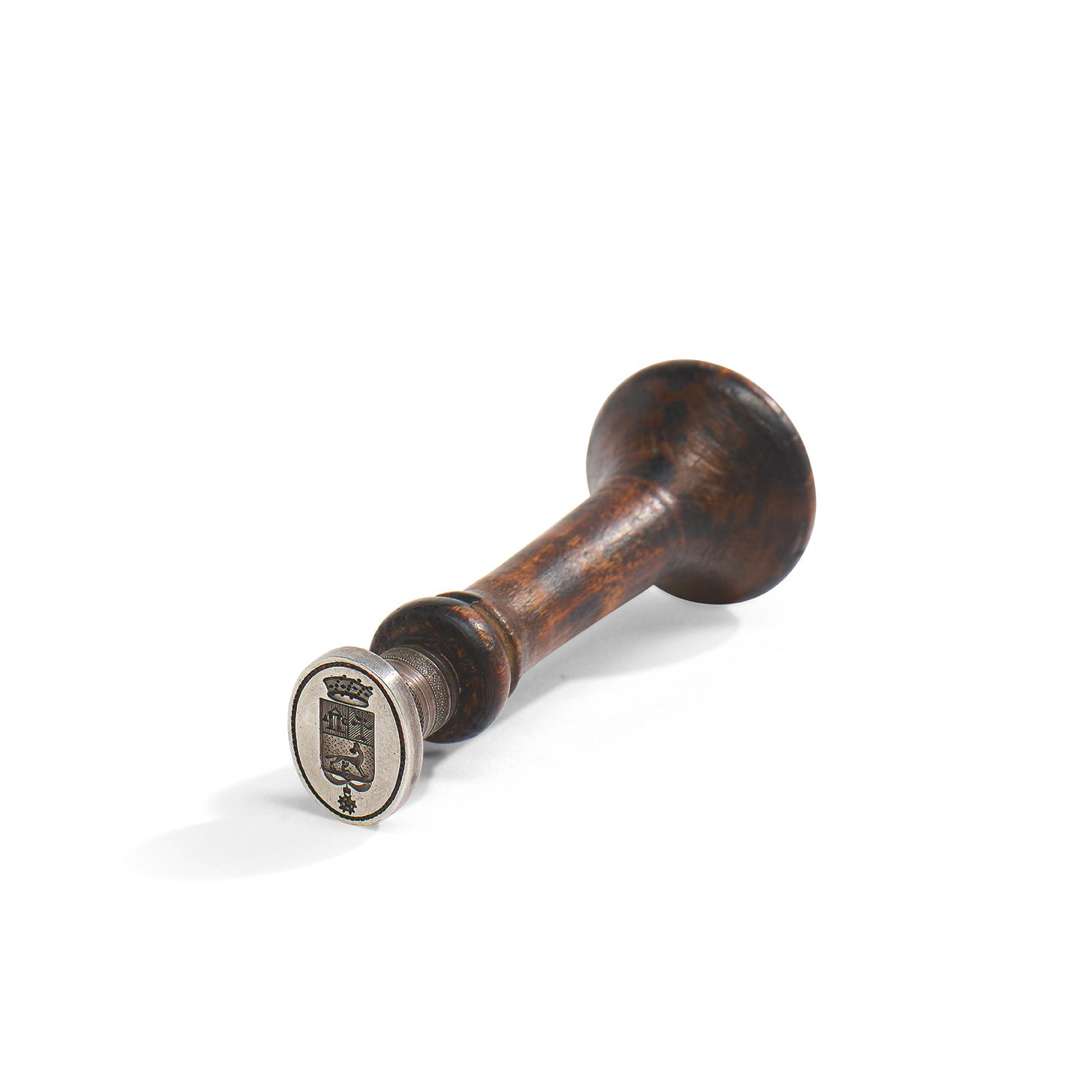
SEAL OF ANTOINE
BARON DUBOIS (1756 - 1837)
Silver die, the oval field engraved with a shield bearing the coat of arms of Antoine baron Dubois
Dubois and of the Empire: "Per fess: in I, per pale vert a lotus flower argent and of the quarter of the Barons:
Officiers de la Maison de l'Empereur| in II, Or, a she-wolf proper suckling a child of carnation, all set on a vert terrace."
Under a baron's crown, Legion of Honor cross below, oval fillet. Tinted turned wood handle.
Early 19th century.
Field height : 2 cm - Field width : 1 cm
Net weight: 11.40 g Total height: 8.6 cm
(Good condition)
Antoine Dubois, Baron de l'Empire (17567 - 1837), was a leading figure in French surgery in the early 19th century. Born in Gramat, he distinguished himself as surgeon-in-chief during the Egyptian expedition of 1798. He is most famous for assisting Empress
Marie-Louise at the birth of the King of Rome in 1811, earning him the title of Baron de l'Empire. A professor at the Paris Faculty of Medicine, he contributed to the improvement of surgical instruments, notably the forceps. In recognition of his services, a Paris street now bears his name.
BARON DUBOIS (1756 - 1837)
Silver die, the oval field engraved with a shield bearing the coat of arms of Antoine baron Dubois
Dubois and of the Empire: "Per fess: in I, per pale vert a lotus flower argent and of the quarter of the Barons:
Officiers de la Maison de l'Empereur| in II, Or, a she-wolf proper suckling a child of carnation, all set on a vert terrace."
Under a baron's crown, Legion of Honor cross below, oval fillet. Tinted turned wood handle.
Early 19th century.
Field height : 2 cm - Field width : 1 cm
Net weight: 11.40 g Total height: 8.6 cm
(Good condition)
Antoine Dubois, Baron de l'Empire (17567 - 1837), was a leading figure in French surgery in the early 19th century. Born in Gramat, he distinguished himself as surgeon-in-chief during the Egyptian expedition of 1798. He is most famous for assisting Empress
Marie-Louise at the birth of the King of Rome in 1811, earning him the title of Baron de l'Empire. A professor at the Paris Faculty of Medicine, he contributed to the improvement of surgical instruments, notably the forceps. In recognition of his services, a Paris street now bears his name.