
&w=3840&q=75)
&w=3840&q=75)
&w=3840&q=75)
&w=3840&q=75)
&w=3840&q=75)
&w=3840&q=75)
&w=3840&q=75)
&w=3840&q=75)


114
CHINE XVIIe SIÈCLE
The item was sold for 13 120 €
Fees include commission and taxes.
CHINA 17th CENTURY
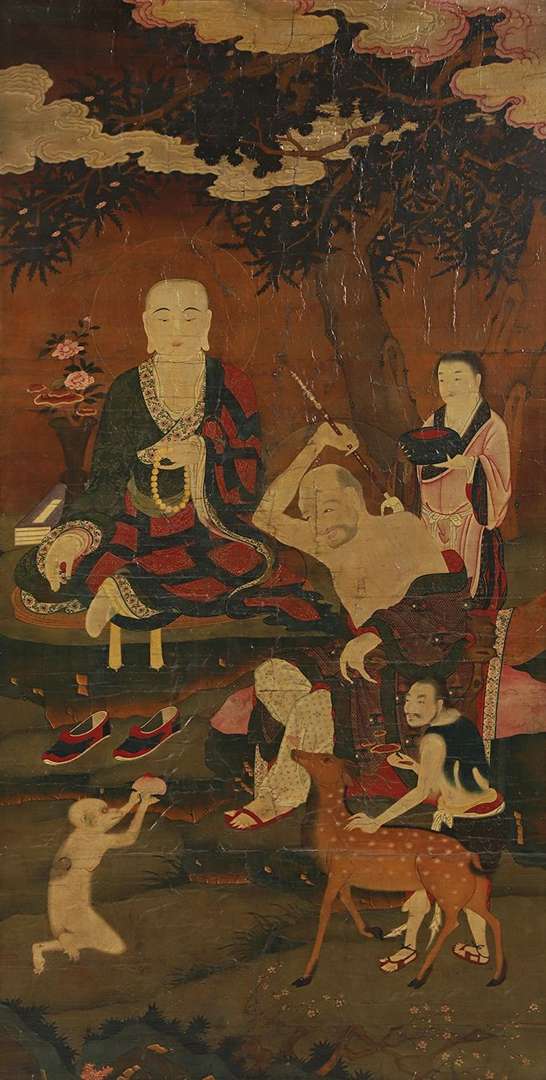
Important ink and color painting on silk depicting two luohan and their attendants under a tree. The first, with a youthful, serene face, is seated on a rock, wearing a monastic robe, his left hand shelling a rosary.
He is accompanied by an attendant holding an alms bowl. The second, elderly, is seated in bhadrasana on a seat, scratching his back with a carved stick ending in a carved hand. He is richly dressed, in the foreign fashion, in pants and a long coat revealing his torso and back. He is accompanied by a clothed attendant handing him a lingzhi mushroom and a deer, while at his feet a white-coated monkey presents him with a peach of immortality. The scene takes place in a rocky landscape, in the shade of a tall tree whose lacy foliage mingles with elegant pastel clouds. Two Minzhong Si Changzhu Ji ("Mark of the Monks of the Temple of the Mourning of the Loyal Preux") seals, one on the upper right, the other on the lower left. Marouflaged on a wooden panel and in a later frame.
Dim. tot. 210 x 117 cm | Dim. (view) 195 x 100 cm
PROVENANCE Sale on Saturday, December 15, 1973, Hôtel des ventes du Prado, 11 rue Borde, MARSEILLE (8e) Illustrated in the catalog with the description " CHINE époque XVIIIe Peinture sur soie marouflée sur panneau. Height 1.80 - Width 0.50".
NOTE The luohan (Sanskrit for "arhat") are characters from Buddhist mythology, considered to be holy men who have reached the final stage of wisdom and enlightenment. The original Buddhist canon describes their group as ten disciples of Buddha
Shakyamuni, but Chinese tradition puts their number at sixteen or eighteen. Particularly revered in Chan or Zen Buddhism, they are regarded as models of good conduct, and from the
Song dynasty (960 - 1279), they became a particularly inspiring iconographic subject for artists, their popularity growing with each successive dynasty and the development of Buddhism in China.
The present painting is in the tradition of academic painting, with a highly refined, elegant style and delicate nuances. The composition, although depicting a religious subject, evokes traditional models of court painting, notably in its high-quality, highly detailed execution, with particular attention paid to retranscribing the beauties of Nature, through the various plant essences that appear, but also in the sumptuousness of the fabrics, the expensive objects depicted and the delicacy of the faces. The composition, featuring two luohans, as well as the presence of a deer, the mount of the immortals, and the numerous references to the lingzhi, the mushroom of immortality in Taoist tradition, is part of an eminently Chinese iconographic program that blends Buddhist subjects with Taoist references.
The two seals, Minzhongsi Changzhu Ji (憫 忠寺常住記 "Mark of the Monks of the Temple of the Mourning of the Loyal Preux"), are particularly interesting as they give us clues as to the destination of this large painting, which
could have been part of a large ensemble featuring the sixteen luohans, possibly within a temple. The Minzhongsi (憫忠寺 "Temple of the Mourning of the Loyal Preux"), now known as the Fayuansi (法源寺 "Temple of the Original Law"), is one of Beijing's oldest and most famous Buddhist temples, built to commemorate the dead of the Korean Expedition of 645. It was finally renamed Fayuansi in 1734 during the reign of Emperor Yongzheng.
Important ink and color painting on silk depicting two luohan and their attendants under a tree. The first, with a youthful, serene face, is seated on a rock, wearing a monastic robe, his left hand shelling a rosary.
He is accompanied by an attendant holding an alms bowl. The second, elderly, is seated in bhadrasana on a seat, scratching his back with a carved stick ending in a carved hand. He is richly dressed, in the foreign fashion, in pants and a long coat revealing his torso and back. He is accompanied by a clothed attendant handing him a lingzhi mushroom and a deer, while at his feet a white-coated monkey presents him with a peach of immortality. The scene takes place in a rocky landscape, in the shade of a tall tree whose lacy foliage mingles with elegant pastel clouds. Two Minzhong Si Changzhu Ji ("Mark of the Monks of the Temple of the Mourning of the Loyal Preux") seals, one on the upper right, the other on the lower left. Marouflaged on a wooden panel and in a later frame.
Dim. tot. 210 x 117 cm | Dim. (view) 195 x 100 cm
PROVENANCE Sale on Saturday, December 15, 1973, Hôtel des ventes du Prado, 11 rue Borde, MARSEILLE (8e) Illustrated in the catalog with the description " CHINE époque XVIIIe Peinture sur soie marouflée sur panneau. Height 1.80 - Width 0.50".
NOTE The luohan (Sanskrit for "arhat") are characters from Buddhist mythology, considered to be holy men who have reached the final stage of wisdom and enlightenment. The original Buddhist canon describes their group as ten disciples of Buddha
Shakyamuni, but Chinese tradition puts their number at sixteen or eighteen. Particularly revered in Chan or Zen Buddhism, they are regarded as models of good conduct, and from the
Song dynasty (960 - 1279), they became a particularly inspiring iconographic subject for artists, their popularity growing with each successive dynasty and the development of Buddhism in China.
The present painting is in the tradition of academic painting, with a highly refined, elegant style and delicate nuances. The composition, although depicting a religious subject, evokes traditional models of court painting, notably in its high-quality, highly detailed execution, with particular attention paid to retranscribing the beauties of Nature, through the various plant essences that appear, but also in the sumptuousness of the fabrics, the expensive objects depicted and the delicacy of the faces. The composition, featuring two luohans, as well as the presence of a deer, the mount of the immortals, and the numerous references to the lingzhi, the mushroom of immortality in Taoist tradition, is part of an eminently Chinese iconographic program that blends Buddhist subjects with Taoist references.
The two seals, Minzhongsi Changzhu Ji (憫 忠寺常住記 "Mark of the Monks of the Temple of the Mourning of the Loyal Preux"), are particularly interesting as they give us clues as to the destination of this large painting, which
could have been part of a large ensemble featuring the sixteen luohans, possibly within a temple. The Minzhongsi (憫忠寺 "Temple of the Mourning of the Loyal Preux"), now known as the Fayuansi (法源寺 "Temple of the Original Law"), is one of Beijing's oldest and most famous Buddhist temples, built to commemorate the dead of the Korean Expedition of 645. It was finally renamed Fayuansi in 1734 during the reign of Emperor Yongzheng.