
&w=3840&q=75)
&w=3840&q=75)
&w=3840&q=75)
&w=3840&q=75)
&w=3840&q=75)
&w=3840&q=75)


98
SINO-TIBETAIN DYNASTIE QING, XVIIIe SIÈCLE
The item was sold for 314 880 €
Fees include commission and taxes.
SINO-TIBETAIN QING DYNASTY, 18th CENTURY
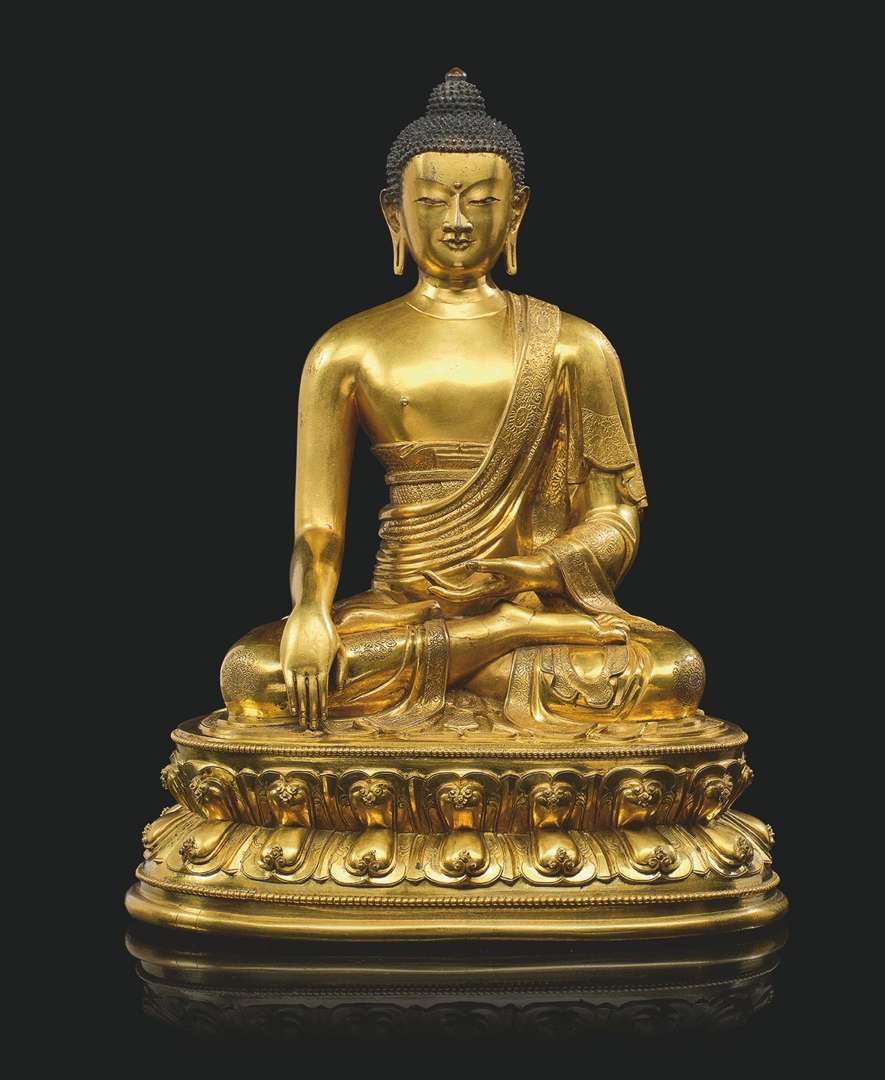
Gilded bronze statue of Shakyamuni, the Buddha seated in vajrasana on a double lotiform base with richly worked petals, his right hand in bhumiparshamudra, the left hand resting in dhyanamudra on the legs.
He is dressed in a dhoti that rises to his torso, finely incised with geometric motifs.
The body is draped in a monastic robe, richly decorated with lotus medallions and edged with foliage, revealing the right shoulder and falling in elegant cascades of folds. The face is fine, with a pointed chin, stretched eyes surmounted by a marked superciliary arch, straight nose and small mouth.
Unsealed base.
H. 34 cm
PROVENANCE
- Private collection, Northern France
- Then by descent.
This figure represents Shakyamuni Buddha in an iconography that embodies his spiritual victory and authority.
This gesture, in which the right hand touches the ground while the left rests in meditation on his knees, symbolizes the moment
when Siddhartha Gautama, on the threshold of enlightenment, calls upon the earth to bear witness to his merits in the face of the temptations of the demon Mara. The technical quality of this piece, as well as its size and weight, are particularly significant. Indeed, it is a lost-wax casting, and not repoussé work, a technique usually used under the Qing for large pieces. Cast iron guarantees exceptional solidity and density, while allowing for greater finesse in the sculpted details. The gilding is also of the highest quality. These elements suggest that it was designed for an official context, possibly a devotional image worthy of imperial worship, a gift from the Qing court to a high dignitary or an influential monastery. Situated at a stylistic crossroads, this statue testifies to the artistic vitality of the Qing dynasty and its ability to integrate varied traditions into a harmonious synthesis. It is interesting to compare it with a triad featuring Shakyamuni surrounded by Vajrapani and Avalokiteshvara, of similar dimensions, dated 18th century and sold by Bonhams Hong-Kong, November 30, 2022, "Images of Devotion", lot 1027. It testifies to the political importance of Tibetan Buddhism in the early Qing dynasty (1644 - 1911) and the need to bring politics, religion and art together to build a lasting peace between the Celestial Empire and its allies. The Qing emperors' support for Tibetan Buddhism offered both political and personal advantages, ensuring a diplomatic alliance with Mongol and Tibetan neighbors, while guaranteeing rapid progress towards enlightenment through personal devotion. This is how the three great
The three great emperors of 18th-century China left many material traces of this spirituality, through the production of statues, paintings and other ritual objects, and the construction of Buddhist monasteries and shrines throughout the country, particularly in the northern and western border regions of the empire. Our Buddha incorporates stylistic elements from both the Mongol and Qing registers, reflecting the political alliance between these two nations, with Tibetan Buddhism as the link. Indeed, this majestic representation of Shakyamuni is inspired by models from the famous Zanabazar school, the national pride of the Khalkha Mongols.
Öndör Gegeen Zanabazar (1635 - 1723) was a singular figure who ushered in a period of artistic renewal
in Mongolia. He was both a powerful political and religious figure, but also a visionary artist who created a style of great sophistication.
of great sophistication. Having received solid religious training in Tibet, he founded a workshop in Mongolia and developed one of the most sublime sculptural styles of the period, a synthesis of Indo-Nepalese sensuality, Tibetan power and Chinese precision, imbued with an inventiveness all his own.
His models clearly influenced the canon of our statue, notably the arched waist, broad shoulders, aquiline nose topped by a sharp arch of the eyebrows, arched eyebrows and pointed chin.
However, our figure shows subtle differences from Zanabazar's productions. The features are sharper, with less smooth lines and modelling. These variations suggest a Qing workshop and patron.
The Buddha's robe, draped with remarkable fluidity, is a striking example of Qing aesthetics.
Gilded bronze statue of Shakyamuni, the Buddha seated in vajrasana on a double lotiform base with richly worked petals, his right hand in bhumiparshamudra, the left hand resting in dhyanamudra on the legs.
He is dressed in a dhoti that rises to his torso, finely incised with geometric motifs.
The body is draped in a monastic robe, richly decorated with lotus medallions and edged with foliage, revealing the right shoulder and falling in elegant cascades of folds. The face is fine, with a pointed chin, stretched eyes surmounted by a marked superciliary arch, straight nose and small mouth.
Unsealed base.
H. 34 cm
PROVENANCE
- Private collection, Northern France
- Then by descent.
This figure represents Shakyamuni Buddha in an iconography that embodies his spiritual victory and authority.
This gesture, in which the right hand touches the ground while the left rests in meditation on his knees, symbolizes the moment
when Siddhartha Gautama, on the threshold of enlightenment, calls upon the earth to bear witness to his merits in the face of the temptations of the demon Mara. The technical quality of this piece, as well as its size and weight, are particularly significant. Indeed, it is a lost-wax casting, and not repoussé work, a technique usually used under the Qing for large pieces. Cast iron guarantees exceptional solidity and density, while allowing for greater finesse in the sculpted details. The gilding is also of the highest quality. These elements suggest that it was designed for an official context, possibly a devotional image worthy of imperial worship, a gift from the Qing court to a high dignitary or an influential monastery. Situated at a stylistic crossroads, this statue testifies to the artistic vitality of the Qing dynasty and its ability to integrate varied traditions into a harmonious synthesis. It is interesting to compare it with a triad featuring Shakyamuni surrounded by Vajrapani and Avalokiteshvara, of similar dimensions, dated 18th century and sold by Bonhams Hong-Kong, November 30, 2022, "Images of Devotion", lot 1027. It testifies to the political importance of Tibetan Buddhism in the early Qing dynasty (1644 - 1911) and the need to bring politics, religion and art together to build a lasting peace between the Celestial Empire and its allies. The Qing emperors' support for Tibetan Buddhism offered both political and personal advantages, ensuring a diplomatic alliance with Mongol and Tibetan neighbors, while guaranteeing rapid progress towards enlightenment through personal devotion. This is how the three great
The three great emperors of 18th-century China left many material traces of this spirituality, through the production of statues, paintings and other ritual objects, and the construction of Buddhist monasteries and shrines throughout the country, particularly in the northern and western border regions of the empire. Our Buddha incorporates stylistic elements from both the Mongol and Qing registers, reflecting the political alliance between these two nations, with Tibetan Buddhism as the link. Indeed, this majestic representation of Shakyamuni is inspired by models from the famous Zanabazar school, the national pride of the Khalkha Mongols.
Öndör Gegeen Zanabazar (1635 - 1723) was a singular figure who ushered in a period of artistic renewal
in Mongolia. He was both a powerful political and religious figure, but also a visionary artist who created a style of great sophistication.
of great sophistication. Having received solid religious training in Tibet, he founded a workshop in Mongolia and developed one of the most sublime sculptural styles of the period, a synthesis of Indo-Nepalese sensuality, Tibetan power and Chinese precision, imbued with an inventiveness all his own.
His models clearly influenced the canon of our statue, notably the arched waist, broad shoulders, aquiline nose topped by a sharp arch of the eyebrows, arched eyebrows and pointed chin.
However, our figure shows subtle differences from Zanabazar's productions. The features are sharper, with less smooth lines and modelling. These variations suggest a Qing workshop and patron.
The Buddha's robe, draped with remarkable fluidity, is a striking example of Qing aesthetics.