
&w=3840&q=75)
&w=3840&q=75)
&w=3840&q=75)
&w=3840&q=75)
&w=3840&q=75)
&w=3840&q=75)
&w=3840&q=75)
&w=3840&q=75)


20
LÊ QUỐC LỘC (1918-1987)
The item was sold for 223 040 €
Fees include commission and taxes.
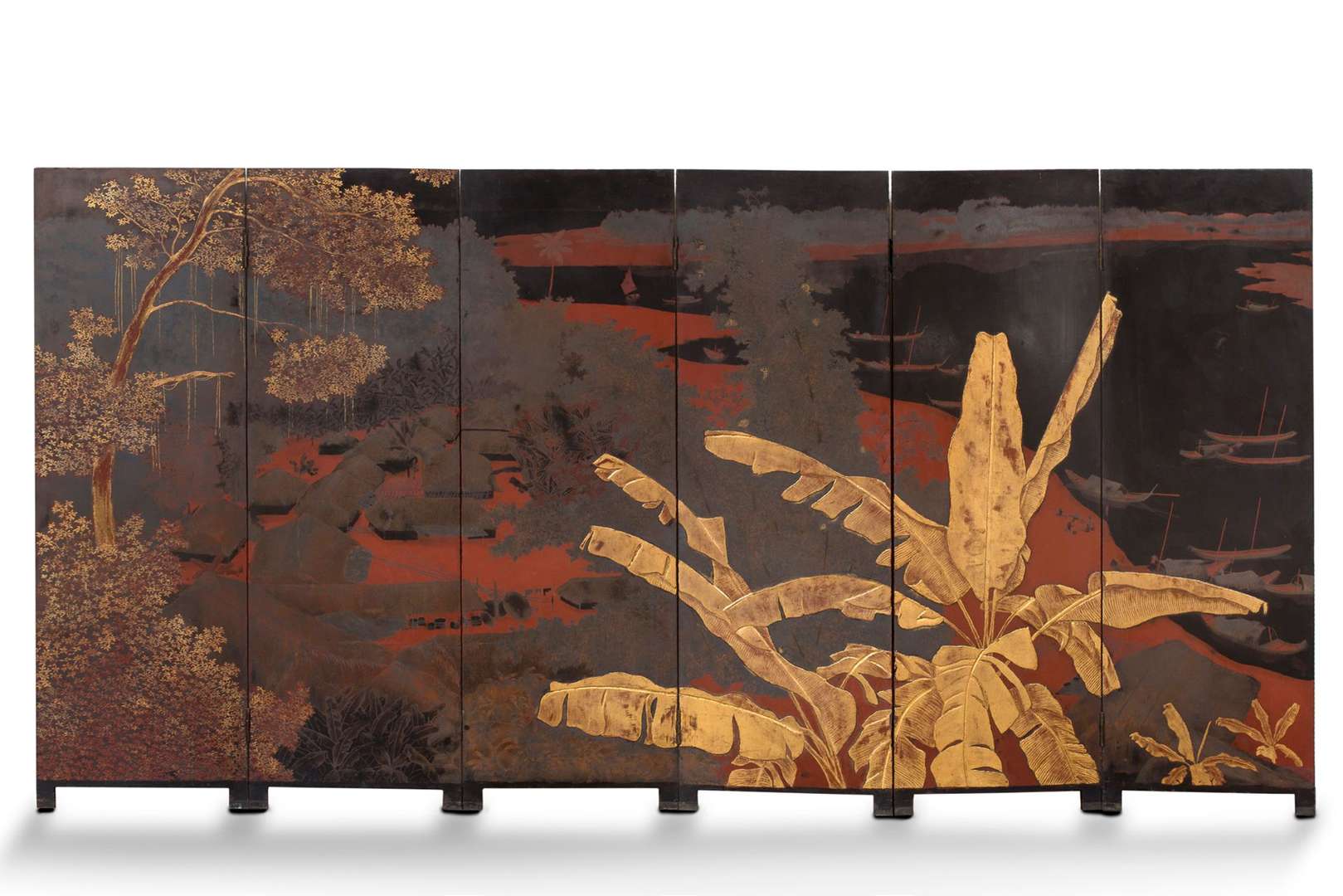
LÊ QUỐC LỘC (1918-1987)
Banana trees on the banks of the Red River, 1943
Lacquer with gold highlights, screen in six panels, signed and dated lower right
99.5 x 196 cm - 39 1/8 x 77 1/8 in.
Lacquer with gold highlights, six panel screen, signed and dated lower right.
PROVENANCE:
Private collection, Saigon (acquired before 1946)
Private collection, France (descended from previous owner).
Teaching lacquerware techniques at the Indochina School of Fine Arts
Victor Tardieu's interest in the art of lacquering began as soon as the school was founded in Hanoi. For him, this technique had a role to play in the revival of Vietnamese art.
As early as 1929, he planned to install a "Lacquer Salon" in the pavilion dedicated to Indochina at the 1931 Colonial Exhibition. Joseph Inguimberty, joined by Alix Aymé, then took lacquer teaching in new directions.
In 1938, Évariste Jonchère succeeded Victor Tardieu as director of the school, and enrolled the lacquerware course in the fine arts section, giving this technique new artistic recognition.
Giảng dạy kỹ thuật sơn mài tại Trường Cao đẳng Mỹ thuật Đông Dương
Nghệ thuật sơn mài đã thu hút sự quan tâm của Victor Tardieu ngay từ khi ông mới sáng lập Trường Mỹ thuật tại Hà Nội. Đối với ông, kỹ thuật sơn mài đóng một vai trò quan trọng trong công cuộc canh tân nghệ thuật Việt Nam.
Ngay từ năm 1929, ông đã dự kiến thiết lập một "Phòng trưng mài sơn mài" trong khu triển lãm Đông Dương tại Triển lãm Thuộc địa năm 1931 Việc giảng dạy sơn mài sau đó được Joseph Inguimberty và Alix Aymé tiếp nối, những người đã nỗ lực dẫn dắt học trò trên những nẻo đường còn chưa được khai phá.
Năm 1938, Évariste Jonchère kế nhiệm Victor Tardieu trong vai trò Hiệu trưởng Trường, và chính thức đưa bộ môn sơn mài vào chương trình đào tạo mỹ thuật, giúp cho kỹ thuật này được công nhận như một lĩnh vực nghệ mới.
Teaching lacquer techniques at the School of Fine Arts in Indochina
The art of lacquer caught Victor Tardieu's attention as soon as the school was founded in Hanoi. He believed that this technique had a role to play in the revival of Vietnamese art. In 1929, he planned to set up a "Lacquer Salon" in the pavilion dedicated to Indochina at the 1931 Colonial Exhibition. The teaching of lacquer was then taken up by Joseph Inguimberty, joined by Alix Aymé, who were keen to take their students in new and unexplored directions.
Évariste Jonchère succeeded Victor Tardieu in 1938 as director of the school and included lacquer in the fine arts curriculum, giving this technique new artistic recognition.
The lacquer technique and the Art Deco movement: a technical and artistic dialogue between Paris and Hanoi
When he produced this screen in 1943, Lê Quốc Lộc had just completed his training in the lacquer section of the École des Beaux-Arts as part of the Class XII (1938 - 1943).
Several slightly different versions of this décor are known, including two also dated 1943. That same year, Lê Quốc Lộc opened a lacquer workshop in Hanoi.
At the time, he was considered one of the great Vietnamese lacquerers. He produced a variety of decorative objects and furniture, such as the armoire previously sold at Aguttes.
With this folding screen, Lê Quốc Lộc demonstrates his attraction to the Art Deco aesthetic. The work of Jean Dunand (1877 - 1942), a master in the field since 1912 in Paris, can be cited as a direct influence.
Trained in Paris by Japanese master lacquerer Seizo Sugawara, Jean Dunand made this technique one of the hallmarks of the Art Deco style. His art travels far and wide, thanks in particular to the sublime decorations the artist has created for the liners that sail from Marseille to Haiphong. For example, Dunand worked alongside Jacques-Émile Ruhlmann (1879 - 1933) to decorate the Île-de-France 3 liner in 1927, and the Normandie in 1931. A panel preserved at the Musée des Arts Décoratifs was part of the La Chasse ensemble decorating the first-class smoking room
of the Normandie liner.
Lê Quốc Lộc's style is a perfect exercise in simplified plant motifs, contrasting flat tints and gold highlights.
Banana trees on the banks of the Red River, 1943
Lacquer with gold highlights, screen in six panels, signed and dated lower right
99.5 x 196 cm - 39 1/8 x 77 1/8 in.
Lacquer with gold highlights, six panel screen, signed and dated lower right.
PROVENANCE:
Private collection, Saigon (acquired before 1946)
Private collection, France (descended from previous owner).
Teaching lacquerware techniques at the Indochina School of Fine Arts
Victor Tardieu's interest in the art of lacquering began as soon as the school was founded in Hanoi. For him, this technique had a role to play in the revival of Vietnamese art.
As early as 1929, he planned to install a "Lacquer Salon" in the pavilion dedicated to Indochina at the 1931 Colonial Exhibition. Joseph Inguimberty, joined by Alix Aymé, then took lacquer teaching in new directions.
In 1938, Évariste Jonchère succeeded Victor Tardieu as director of the school, and enrolled the lacquerware course in the fine arts section, giving this technique new artistic recognition.
Giảng dạy kỹ thuật sơn mài tại Trường Cao đẳng Mỹ thuật Đông Dương
Nghệ thuật sơn mài đã thu hút sự quan tâm của Victor Tardieu ngay từ khi ông mới sáng lập Trường Mỹ thuật tại Hà Nội. Đối với ông, kỹ thuật sơn mài đóng một vai trò quan trọng trong công cuộc canh tân nghệ thuật Việt Nam.
Ngay từ năm 1929, ông đã dự kiến thiết lập một "Phòng trưng mài sơn mài" trong khu triển lãm Đông Dương tại Triển lãm Thuộc địa năm 1931 Việc giảng dạy sơn mài sau đó được Joseph Inguimberty và Alix Aymé tiếp nối, những người đã nỗ lực dẫn dắt học trò trên những nẻo đường còn chưa được khai phá.
Năm 1938, Évariste Jonchère kế nhiệm Victor Tardieu trong vai trò Hiệu trưởng Trường, và chính thức đưa bộ môn sơn mài vào chương trình đào tạo mỹ thuật, giúp cho kỹ thuật này được công nhận như một lĩnh vực nghệ mới.
Teaching lacquer techniques at the School of Fine Arts in Indochina
The art of lacquer caught Victor Tardieu's attention as soon as the school was founded in Hanoi. He believed that this technique had a role to play in the revival of Vietnamese art. In 1929, he planned to set up a "Lacquer Salon" in the pavilion dedicated to Indochina at the 1931 Colonial Exhibition. The teaching of lacquer was then taken up by Joseph Inguimberty, joined by Alix Aymé, who were keen to take their students in new and unexplored directions.
Évariste Jonchère succeeded Victor Tardieu in 1938 as director of the school and included lacquer in the fine arts curriculum, giving this technique new artistic recognition.
The lacquer technique and the Art Deco movement: a technical and artistic dialogue between Paris and Hanoi
When he produced this screen in 1943, Lê Quốc Lộc had just completed his training in the lacquer section of the École des Beaux-Arts as part of the Class XII (1938 - 1943).
Several slightly different versions of this décor are known, including two also dated 1943. That same year, Lê Quốc Lộc opened a lacquer workshop in Hanoi.
At the time, he was considered one of the great Vietnamese lacquerers. He produced a variety of decorative objects and furniture, such as the armoire previously sold at Aguttes.
With this folding screen, Lê Quốc Lộc demonstrates his attraction to the Art Deco aesthetic. The work of Jean Dunand (1877 - 1942), a master in the field since 1912 in Paris, can be cited as a direct influence.
Trained in Paris by Japanese master lacquerer Seizo Sugawara, Jean Dunand made this technique one of the hallmarks of the Art Deco style. His art travels far and wide, thanks in particular to the sublime decorations the artist has created for the liners that sail from Marseille to Haiphong. For example, Dunand worked alongside Jacques-Émile Ruhlmann (1879 - 1933) to decorate the Île-de-France 3 liner in 1927, and the Normandie in 1931. A panel preserved at the Musée des Arts Décoratifs was part of the La Chasse ensemble decorating the first-class smoking room
of the Normandie liner.
Lê Quốc Lộc's style is a perfect exercise in simplified plant motifs, contrasting flat tints and gold highlights.