
&w=3840&q=75)
&w=3840&q=75)
&w=3840&q=75)
&w=3840&q=75)
&w=3840&q=75)
&w=3840&q=75)
&w=3840&q=75)
&w=3840&q=75)


9
LÊ PHỔ (1907-2001)
The item was sold for 2 022 959 €
Fees include commission and taxes.
LÊ PHỔ (1907-2001)
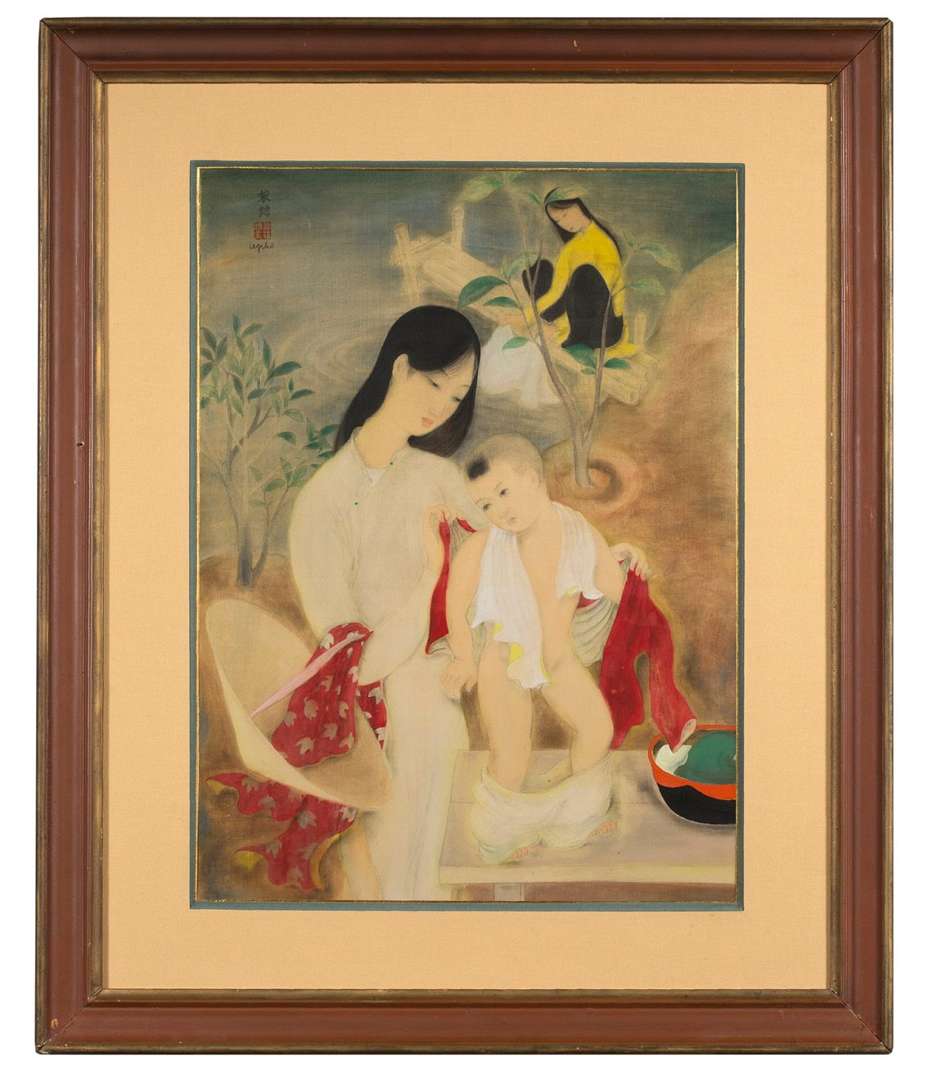
The Bath, circa 1938
Ink, gouache and colors on silk, signed upper left
61 x 45.5 cm à vue - 24 x 17 7/8 in. on sight
Ink, gouache and colors on silk, signed upper left
A certificate of inclusion in the artist's catalog raisonné currently being prepared by Charlotte Aguttes-Reynier for the Association des Artistes d'Asie à Paris will be given to the purchaser.
PROVENANCE
Private collection, Paris (acquired circa 1938 and since inherited).
Son of the viceroy of Tonkin, Lê Phổ was born in 1907 in Hadong, northern Vietnam. He showed a keen interest in the arts from an early age, and in 1925 entered the Indochina School of Fine Arts. During his formative years in Hanoi, he met his two principal masters, the Frenchmen Victor Tardieu and Joseph Inguimberty, who were to play a major role in shaping his style.
his style. In 1931, on the occasion of the colonial exhibition organized in the Bois de Vincennes, he undertook a two-year trip to Europe. He visited France, Belgium, the Netherlands and Italy, and developed a passion for Renaissance art, Western religious painting and modern painting. In 1933, he returned to Hanoi to teach drawing. A year later, during a trip to Beijing, he deepened his knowledge of traditional Chinese painting thanks to art collectors and enthusiasts. In 1937, Lê Phổ settled permanently in Paris. He began exhibiting his works, with subjects of women, children, bouquets of flowers and an oriental technique that would make him famous in Algeria and France... He marveled at museums and also took an interest in the work of painters he met, such as Bonnard or
Matisse. His reputation took a further boost in 1963, when he signed an agreement with Findlay Gallery to be exhibited in North America. From then on, he became one of the most renowned Vietnamese painters of the 20th century.
Lê Phổ and the lesson
of the Italian Renaissance Hanoi-trained artist Lê Phổ first discovered France in 1931, when Victor Tardieu chose him as an assistant for the Colonial Exhibition in Vincennes. The young graduate took advantage of his stay to explore museums and immerse himself in the work of the great masters. He was captivated by the primitives and the Italian Renaissance, and this trip left its mark on his work. Lê Phổ returned to Paris in 1937. He represented his master Victor Tardieu,
as artistic director of the "Indochina" section of the Universal Exhibition set up on the Ile aux Cygnes. He never returns to Vietnam1. The Bath was painted shortly afterwards, probably around 1938. In this delicate silk,
the artist depicts a mother drying her child after a swim, while in the background, a young woman washes a sheet in the stream. Lê Phổ transposes onto silk the lessons of the Italian Renaissance that he had encountered a few years earlier: a play of diagonals organizes the space between water and land. Lê Phổ also retained the lessons of pyramidal
of pyramidal composition, which Raphael used extensively in his Virgins with Child (ill. 1). It is to this motif of the Virgin and Child that Lê Phổ refers with Le bain: the work can, for example, be compared to Perugino's Virgin and Child, painted in the 1515s (ill. 2). The Virgin stands upright, while Christ stands in a contrapposto position
contrapposto position, just like the child in Lê Phổ's silk. Particular attention is paid to the treatment of the cloth drapes surrounding the child. The latter reuses the red color of the Virgin's garment.
Composing and recomposing an image
The background, meanwhile, contrasts with the influence of the Italian Renaissance since
Lê Phổ doesn't opt for a classical perspective, but instead uses flat tints to give an almost vertical appearance. The pontoon is a motif that the artist represents on several occasions, notably as the main subject: with Mother Drying Her Child around 1935 (ill. 3) or Young Woman at the Water's Edge (ill. 4). In his art, Lê Phổ skilfully combines recurring motifs
with diverse influences.
Exhibiting in Paris
From 1931 onwards, Lê Phổ regularly exhibited his work in Paris, particularly at the Salon des Artistes Français, the Agindo2, the Salon des artistes indépendants and the Salon des Tuileries. It was probably at one of these exhibitions that Le bain was acquired by the ancestors of the current owners. In 1939, Raymond Lécuyer, a journalist with Le Figaro, wrote of an exhibition in Paris that featured Le bain: "Trois artistes indochinois, Nous avions aux Indépendants...
The Bath, circa 1938
Ink, gouache and colors on silk, signed upper left
61 x 45.5 cm à vue - 24 x 17 7/8 in. on sight
Ink, gouache and colors on silk, signed upper left
A certificate of inclusion in the artist's catalog raisonné currently being prepared by Charlotte Aguttes-Reynier for the Association des Artistes d'Asie à Paris will be given to the purchaser.
PROVENANCE
Private collection, Paris (acquired circa 1938 and since inherited).
Son of the viceroy of Tonkin, Lê Phổ was born in 1907 in Hadong, northern Vietnam. He showed a keen interest in the arts from an early age, and in 1925 entered the Indochina School of Fine Arts. During his formative years in Hanoi, he met his two principal masters, the Frenchmen Victor Tardieu and Joseph Inguimberty, who were to play a major role in shaping his style.
his style. In 1931, on the occasion of the colonial exhibition organized in the Bois de Vincennes, he undertook a two-year trip to Europe. He visited France, Belgium, the Netherlands and Italy, and developed a passion for Renaissance art, Western religious painting and modern painting. In 1933, he returned to Hanoi to teach drawing. A year later, during a trip to Beijing, he deepened his knowledge of traditional Chinese painting thanks to art collectors and enthusiasts. In 1937, Lê Phổ settled permanently in Paris. He began exhibiting his works, with subjects of women, children, bouquets of flowers and an oriental technique that would make him famous in Algeria and France... He marveled at museums and also took an interest in the work of painters he met, such as Bonnard or
Matisse. His reputation took a further boost in 1963, when he signed an agreement with Findlay Gallery to be exhibited in North America. From then on, he became one of the most renowned Vietnamese painters of the 20th century.
Lê Phổ and the lesson
of the Italian Renaissance Hanoi-trained artist Lê Phổ first discovered France in 1931, when Victor Tardieu chose him as an assistant for the Colonial Exhibition in Vincennes. The young graduate took advantage of his stay to explore museums and immerse himself in the work of the great masters. He was captivated by the primitives and the Italian Renaissance, and this trip left its mark on his work. Lê Phổ returned to Paris in 1937. He represented his master Victor Tardieu,
as artistic director of the "Indochina" section of the Universal Exhibition set up on the Ile aux Cygnes. He never returns to Vietnam1. The Bath was painted shortly afterwards, probably around 1938. In this delicate silk,
the artist depicts a mother drying her child after a swim, while in the background, a young woman washes a sheet in the stream. Lê Phổ transposes onto silk the lessons of the Italian Renaissance that he had encountered a few years earlier: a play of diagonals organizes the space between water and land. Lê Phổ also retained the lessons of pyramidal
of pyramidal composition, which Raphael used extensively in his Virgins with Child (ill. 1). It is to this motif of the Virgin and Child that Lê Phổ refers with Le bain: the work can, for example, be compared to Perugino's Virgin and Child, painted in the 1515s (ill. 2). The Virgin stands upright, while Christ stands in a contrapposto position
contrapposto position, just like the child in Lê Phổ's silk. Particular attention is paid to the treatment of the cloth drapes surrounding the child. The latter reuses the red color of the Virgin's garment.
Composing and recomposing an image
The background, meanwhile, contrasts with the influence of the Italian Renaissance since
Lê Phổ doesn't opt for a classical perspective, but instead uses flat tints to give an almost vertical appearance. The pontoon is a motif that the artist represents on several occasions, notably as the main subject: with Mother Drying Her Child around 1935 (ill. 3) or Young Woman at the Water's Edge (ill. 4). In his art, Lê Phổ skilfully combines recurring motifs
with diverse influences.
Exhibiting in Paris
From 1931 onwards, Lê Phổ regularly exhibited his work in Paris, particularly at the Salon des Artistes Français, the Agindo2, the Salon des artistes indépendants and the Salon des Tuileries. It was probably at one of these exhibitions that Le bain was acquired by the ancestors of the current owners. In 1939, Raymond Lécuyer, a journalist with Le Figaro, wrote of an exhibition in Paris that featured Le bain: "Trois artistes indochinois, Nous avions aux Indépendants...