
&w=3840&q=75)
&w=3840&q=75)
&w=3840&q=75)
&w=3840&q=75)
&w=3840&q=75)
&w=3840&q=75)
&w=3840&q=75)
&w=3840&q=75)


6
LƯƠNG XUÂN NHỊ (1914-2006)
The item was sold for 101 024 €
Fees include commission and taxes.
LƯƠNG XUÂN NHỊ (1914-2006)
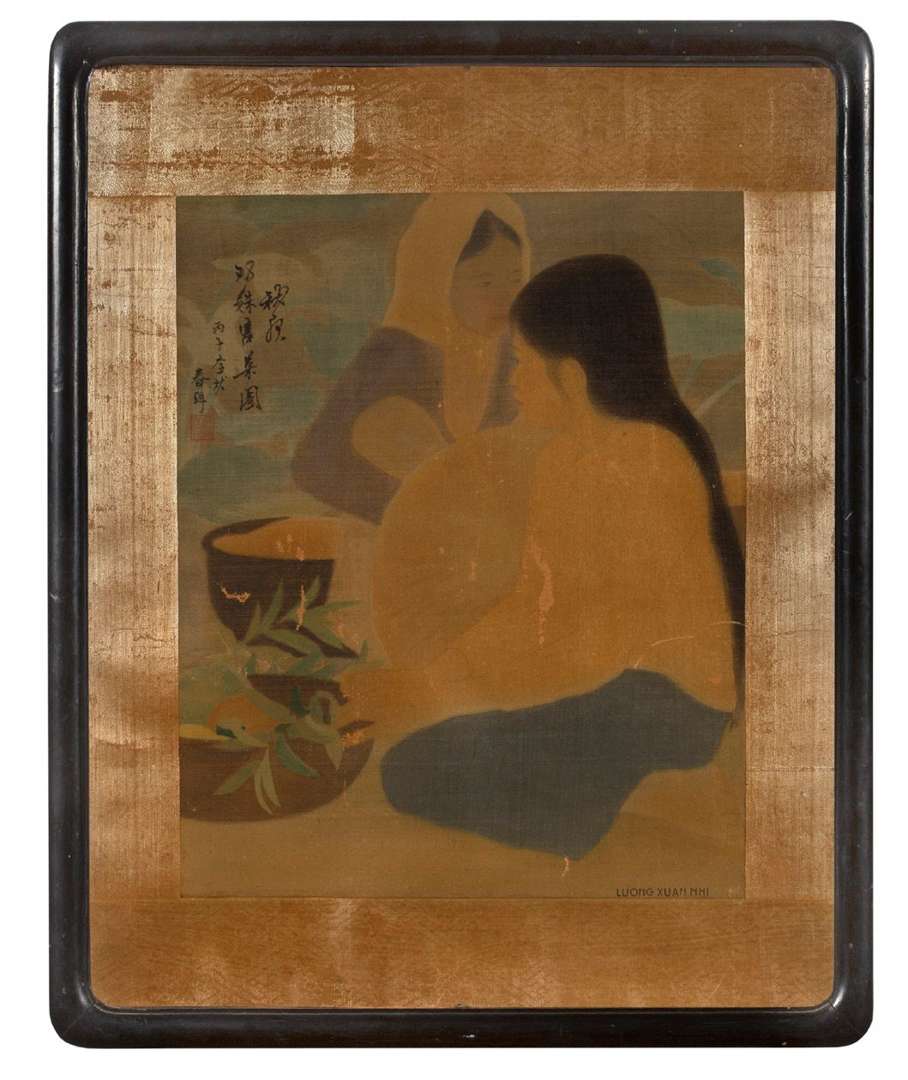
Two young girls selling tea, autumn 1936
Ink and colors on silk, signed lower right, countersigned, dated and titled upper left. In original frame 49.5 x 40.5 cm - 19 1/2 x 16 in. on sight
Ink and color on silk, signed lower right, countersigned, dated and titled upper left. In its original frame
PROVENANCE
Private collection, Hanoi then France (acquired in Vietnam between 1936 and 1938)
Private collection, France (inherited from the preceding owner)
EXHIBITION
Probably Salon de la SADEAI, Hanoi, 1936
Lương Xuân Nhị was born in Hanoi in 1914. He entered the Class VIII of the Indochina School of Fine Arts in 1932, graduating top of his class in 1937. Even during his formative years, his talent and production were recognized: he received the silver medal at the Sadeai 1 exhibition in Hanoi, the gold medal in 1936 and a "special prize" in 1937.
His work was soon exhibited in France. For the 1937 Universal Exhibition, eighty-six of the artist's silk paintings were exhibited in the Indochina pavilion. The Paris Exposition, dedicated to the applied arts, had a commercial orientation. Typical" stores and workshops were presented,
in which craftsmen - selected by Victor Tardieu - worked in full view of the public 2. Committed to imparting an education of exacting standards and excellence, Lương Xuân Nhị founded the Farta (Foyer de l'Art Annamite) in Saigon in 1942 with Lê Văn Đệ, Tô Ngọc Vân, Georges Khánh and Trần Văn Cẩn3.
1 Société Annamite d'Encouragement à l'Art et à l'Industrie.
2 2025, Symposium "Asian Artists in Paris: New Narratives", co-organized by the National Gallery Singapore and Musée Cernuschi, Musée Cernuschi, Paris, February 20, 2025.
3 Charlotte Aguttes-Reynier, L'art moderne en Indochine, éditions In Fine, Paris, 2023, p. 261-262.
The work presented today is dated autumn 1936. Lương Xuân Nhị was then completing his studies at the Indochina School of Fine Arts. It depicts a classic subject of everyday life in the countryside, two young girls selling tea, seated on the ground. One is handling a bowl containing tea leaves, while the other is seated in the background. The silk is presented in its original frame similar to those adorning the walls of the 1936 Salon de la Sadeai, of which we are aware thanks to photographs held in the Fonds Tardieu archives at the INHA.
Lương Xuân Nhị made the choice, right from the start of his career, to depict rural Vietnam. Thus, the traditional subject is put to the service of a modern technique, the artist mixing Chinese, Vietnamese and Western influences and using a soft, sober chromatic range4. This work can be compared with L'Atelier de Broderie in the delicacy of its choice of subject, tonality and technique.
Lương Xuân Nhị was born in Hanoi in 1914. He joined the eighth class of the Indochina School of Fine Arts in 1932 and graduated at the top of his class in 1937. His talent and work were recognized early on: he received the silver medal at
the Sadeai 1 exhibition in Hanoi, the gold medal in 1936, and a "special prize" in 1937. His works were quickly exhibited in France. At the 1937 World's Fair, eighty-six of the artist's silk paintings were exhibited in the Indochina pavilion. The Paris exhibition, dedicated to applied arts, had a commercial focus. Traditional shops and workshops were presented, in which
artisans selected by Victor Tardieu worked in full view of the public 2. Committed to passing on a rigorous and excellent
education, Lương Xuân Nhị founded the Farta (Foyer de l'Art Annamite) in Saigon in 1942 with Lê Văn Đệ, Tô Ngọc Vân, Georges Khánh, and Trần Văn Cẩn 3.
The work presented here dates from the fall of 1936. Lương Xuân Nhị was then completing his studies at the School of Fine Arts in Indochina. He depicts a classic scene from everyday life in the countryside, with two young girls selling tea while seated on the ground. One is handling a bowl containing tea leaves while the other is sitting in the background. The silk is presented in its original frame, similar to those that adorned the walls of the 1936 Salon de la Sadeai, which we know from photographs preserved in the Tardieu Fund archives at the INHA. From the beginning of his career, Lương Xuân Nhị chose to depict rural Vietnam. Thus, traditional subjects are rendered using modern techniques, with the artist blending Chinese, Vietnamese, and Western influences and using a soft and sober color palette 4. This work can be compared to L'Atelier de
Broderie in terms of the delicacy of the subje
Two young girls selling tea, autumn 1936
Ink and colors on silk, signed lower right, countersigned, dated and titled upper left. In original frame 49.5 x 40.5 cm - 19 1/2 x 16 in. on sight
Ink and color on silk, signed lower right, countersigned, dated and titled upper left. In its original frame
PROVENANCE
Private collection, Hanoi then France (acquired in Vietnam between 1936 and 1938)
Private collection, France (inherited from the preceding owner)
EXHIBITION
Probably Salon de la SADEAI, Hanoi, 1936
Lương Xuân Nhị was born in Hanoi in 1914. He entered the Class VIII of the Indochina School of Fine Arts in 1932, graduating top of his class in 1937. Even during his formative years, his talent and production were recognized: he received the silver medal at the Sadeai 1 exhibition in Hanoi, the gold medal in 1936 and a "special prize" in 1937.
His work was soon exhibited in France. For the 1937 Universal Exhibition, eighty-six of the artist's silk paintings were exhibited in the Indochina pavilion. The Paris Exposition, dedicated to the applied arts, had a commercial orientation. Typical" stores and workshops were presented,
in which craftsmen - selected by Victor Tardieu - worked in full view of the public 2. Committed to imparting an education of exacting standards and excellence, Lương Xuân Nhị founded the Farta (Foyer de l'Art Annamite) in Saigon in 1942 with Lê Văn Đệ, Tô Ngọc Vân, Georges Khánh and Trần Văn Cẩn3.
1 Société Annamite d'Encouragement à l'Art et à l'Industrie.
2 2025, Symposium "Asian Artists in Paris: New Narratives", co-organized by the National Gallery Singapore and Musée Cernuschi, Musée Cernuschi, Paris, February 20, 2025.
3 Charlotte Aguttes-Reynier, L'art moderne en Indochine, éditions In Fine, Paris, 2023, p. 261-262.
The work presented today is dated autumn 1936. Lương Xuân Nhị was then completing his studies at the Indochina School of Fine Arts. It depicts a classic subject of everyday life in the countryside, two young girls selling tea, seated on the ground. One is handling a bowl containing tea leaves, while the other is seated in the background. The silk is presented in its original frame similar to those adorning the walls of the 1936 Salon de la Sadeai, of which we are aware thanks to photographs held in the Fonds Tardieu archives at the INHA.
Lương Xuân Nhị made the choice, right from the start of his career, to depict rural Vietnam. Thus, the traditional subject is put to the service of a modern technique, the artist mixing Chinese, Vietnamese and Western influences and using a soft, sober chromatic range4. This work can be compared with L'Atelier de Broderie in the delicacy of its choice of subject, tonality and technique.
Lương Xuân Nhị was born in Hanoi in 1914. He joined the eighth class of the Indochina School of Fine Arts in 1932 and graduated at the top of his class in 1937. His talent and work were recognized early on: he received the silver medal at
the Sadeai 1 exhibition in Hanoi, the gold medal in 1936, and a "special prize" in 1937. His works were quickly exhibited in France. At the 1937 World's Fair, eighty-six of the artist's silk paintings were exhibited in the Indochina pavilion. The Paris exhibition, dedicated to applied arts, had a commercial focus. Traditional shops and workshops were presented, in which
artisans selected by Victor Tardieu worked in full view of the public 2. Committed to passing on a rigorous and excellent
education, Lương Xuân Nhị founded the Farta (Foyer de l'Art Annamite) in Saigon in 1942 with Lê Văn Đệ, Tô Ngọc Vân, Georges Khánh, and Trần Văn Cẩn 3.
The work presented here dates from the fall of 1936. Lương Xuân Nhị was then completing his studies at the School of Fine Arts in Indochina. He depicts a classic scene from everyday life in the countryside, with two young girls selling tea while seated on the ground. One is handling a bowl containing tea leaves while the other is sitting in the background. The silk is presented in its original frame, similar to those that adorned the walls of the 1936 Salon de la Sadeai, which we know from photographs preserved in the Tardieu Fund archives at the INHA. From the beginning of his career, Lương Xuân Nhị chose to depict rural Vietnam. Thus, traditional subjects are rendered using modern techniques, with the artist blending Chinese, Vietnamese, and Western influences and using a soft and sober color palette 4. This work can be compared to L'Atelier de
Broderie in terms of the delicacy of the subje