
&w=3840&q=75)
&w=3840&q=75)
&w=3840&q=75)
&w=3840&q=75)
&w=3840&q=75)
&w=3840&q=75)
&w=3840&q=75)
&w=3840&q=75)


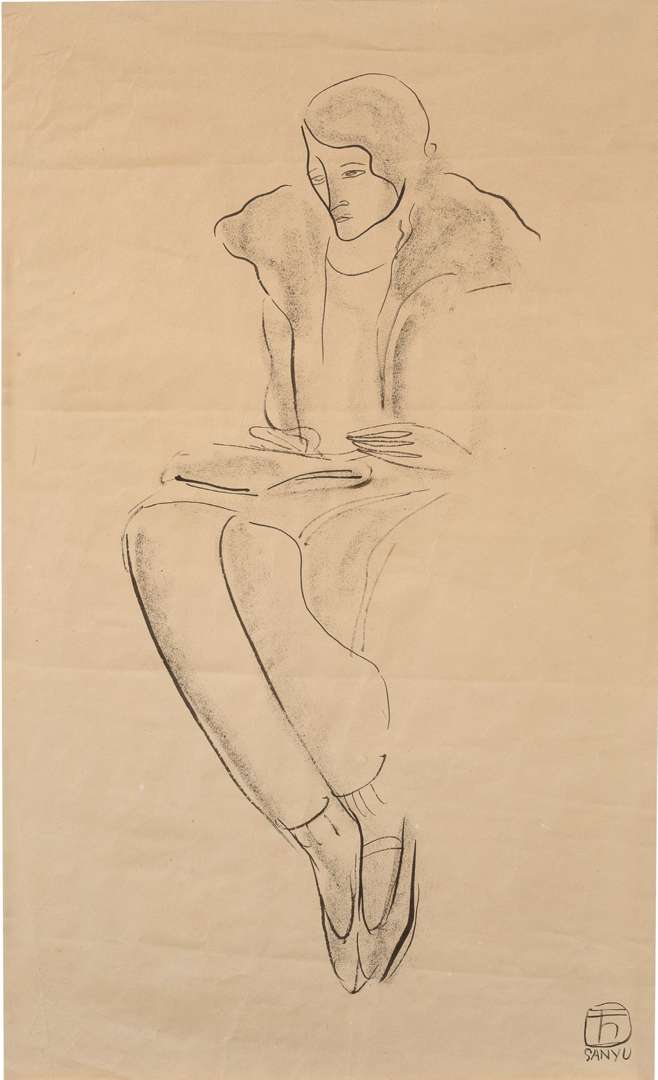
SANYU (1895-1966)
Seated woman
Ink on paper, signed lower right
44.5 x 27.5 cm - 17 1/2 x 10 7/8 in.
PROVENANCE
Michel Habart Collection
Private collection, Paris (family heirloom)
La Femme assise is one of a series of inks acquired by Michel Habart at a sale at Drouot in the early 1970s. The owner of a suitcase full of drawings and watercolors, Michel Habart was captivated by the talent of this recently deceased artist, who was still unknown in the art market at the time. In this work, Sanyu depicts a motif that was dear to him and that he had worked on many times in ink on paper: that of the woman drawing beside him, also a student at the Académie de La Grande Chaumière 1...
BIBLIOGRAPHY FOR RELATED WORKS
BIBLIOGRAPHY FOR RELATED WORKS
相关作品参考书目
Rita Wong, Sanyu Catalogue raisonné: drawings and watercolors - electronical index of drawings, Taipei, 2014, no. D2001, D2007, D2010, repr. coul.
1 Our drawing can be related to many of the drawings referenced by Rita Wong in Sanyu's catalog raisonné
raisonné de Sanyu en ligne (sanyu.org): D2001| D2007| D2010| etc.
我们拍卖的这幅画作可以与衣淑凡在常玉在线作品全集(sanyu.org)中提及的许多画作进行比较:D2001;D2007;D2010;等等。
Sanyu born in 1895 in Nanchong in China's Sichuan province. His father, an animal painter specializing in the study of lions and horses, taught him the rudiments of his art. His elder brother, head of the family business, encouraged him in his passion. With considerable financial support, he enabled him to follow the teachings of Zhao Xi, a renowned calligrapher, and then to attend Shanghai University. Sanyu discovered France in 1921, where he stayed for some time before moving to Berlin for 2 years. While his contemporaries Xu Beihong and Lin Fengmian decided to return to China after a time, thereby gaining rapid recognition from their peers, he chose to pursue his own research in the Parisian circle, which he found so stimulating. When he moved to Paris in 1923, he turned to the Académie de la Grande Chaumière, where he studied nudes based on live models, in an environment where teaching advocated freedom. A trained calligrapher, Sanyu made drawing his favorite mode of expression. He practiced it non-stop, whether on paper or on the
placemats in the cafés he frequented 1. The two drawings we're selling are typical of this production, showing his lively line and his favorite subject: the study of people he came across and captured on the spot, often classmates absorbed in their work or models posing. The artist never returned to China and died
Paris in 1966.
Ink on paper, signed lower right 纸本水墨,署名于右下角
PROVENANCE
Michel Habart Collection
Private collection, Paris (by family transmission from the previous owner)
The Femme assise is an ink drawing from the collection acquired by Michel Habart at an auction held in the early 1970s at Drouot. The owner of a suitcase full of drawings and watercolors, Michel Habart was captivated by the talent of this recently deceased artist, who was still unknown in the art world at the time. In this work, Sanyu depicts a motif that was dear to him
and which he worked on many times in ink on paper: that of the woman drawing beside him, also a student at the Académie de La Grande Chaumière 1...
Sanyu was born in 1895 in Nanchong, Sichuan Province, China. His father, an animal painter specializing in lions and horses, taught him the basics of his art. His older brother, who ran the family business, encouraged him in his passion.
With significant financial support, he was able to study under Zhao Xi, a renowned calligrapher, and then attend Shanghai University. Sanyu discovered France in 1921, where he stayed for a while before moving to Berlin for two years.
While his contemporaries Xu Beihong and Lin Fengmian decided after a while to return to China, where they quickly gained recognition from their peers, he chose to pursue his own research in the Parisian circle he found so stimulating. When he settled in Paris in 1923, he turned to the Académie de la Grande Chaumière, where he studied mainly nude modeling in an environment where teaching emphasized freedom.
Trained as a calligrapher, Sanyu made drawing his favorite form of expression. He practiced it constantly, whether on paper or on the tablecloths of the cafés he frequented 1. The two drawings we are offering for sale are typical of this period, with his lively lines and favorite subject: the study of people encountered and captured on the spot, often classmates absorbed in their work or models posing.
Seated woman
Ink on paper, signed lower right
44.5 x 27.5 cm - 17 1/2 x 10 7/8 in.
PROVENANCE
Michel Habart Collection
Private collection, Paris (family heirloom)
La Femme assise is one of a series of inks acquired by Michel Habart at a sale at Drouot in the early 1970s. The owner of a suitcase full of drawings and watercolors, Michel Habart was captivated by the talent of this recently deceased artist, who was still unknown in the art market at the time. In this work, Sanyu depicts a motif that was dear to him and that he had worked on many times in ink on paper: that of the woman drawing beside him, also a student at the Académie de La Grande Chaumière 1...
BIBLIOGRAPHY FOR RELATED WORKS
BIBLIOGRAPHY FOR RELATED WORKS
相关作品参考书目
Rita Wong, Sanyu Catalogue raisonné: drawings and watercolors - electronical index of drawings, Taipei, 2014, no. D2001, D2007, D2010, repr. coul.
1 Our drawing can be related to many of the drawings referenced by Rita Wong in Sanyu's catalog raisonné
raisonné de Sanyu en ligne (sanyu.org): D2001| D2007| D2010| etc.
我们拍卖的这幅画作可以与衣淑凡在常玉在线作品全集(sanyu.org)中提及的许多画作进行比较:D2001;D2007;D2010;等等。
Sanyu born in 1895 in Nanchong in China's Sichuan province. His father, an animal painter specializing in the study of lions and horses, taught him the rudiments of his art. His elder brother, head of the family business, encouraged him in his passion. With considerable financial support, he enabled him to follow the teachings of Zhao Xi, a renowned calligrapher, and then to attend Shanghai University. Sanyu discovered France in 1921, where he stayed for some time before moving to Berlin for 2 years. While his contemporaries Xu Beihong and Lin Fengmian decided to return to China after a time, thereby gaining rapid recognition from their peers, he chose to pursue his own research in the Parisian circle, which he found so stimulating. When he moved to Paris in 1923, he turned to the Académie de la Grande Chaumière, where he studied nudes based on live models, in an environment where teaching advocated freedom. A trained calligrapher, Sanyu made drawing his favorite mode of expression. He practiced it non-stop, whether on paper or on the
placemats in the cafés he frequented 1. The two drawings we're selling are typical of this production, showing his lively line and his favorite subject: the study of people he came across and captured on the spot, often classmates absorbed in their work or models posing. The artist never returned to China and died
Paris in 1966.
Ink on paper, signed lower right 纸本水墨,署名于右下角
PROVENANCE
Michel Habart Collection
Private collection, Paris (by family transmission from the previous owner)
The Femme assise is an ink drawing from the collection acquired by Michel Habart at an auction held in the early 1970s at Drouot. The owner of a suitcase full of drawings and watercolors, Michel Habart was captivated by the talent of this recently deceased artist, who was still unknown in the art world at the time. In this work, Sanyu depicts a motif that was dear to him
and which he worked on many times in ink on paper: that of the woman drawing beside him, also a student at the Académie de La Grande Chaumière 1...
Sanyu was born in 1895 in Nanchong, Sichuan Province, China. His father, an animal painter specializing in lions and horses, taught him the basics of his art. His older brother, who ran the family business, encouraged him in his passion.
With significant financial support, he was able to study under Zhao Xi, a renowned calligrapher, and then attend Shanghai University. Sanyu discovered France in 1921, where he stayed for a while before moving to Berlin for two years.
While his contemporaries Xu Beihong and Lin Fengmian decided after a while to return to China, where they quickly gained recognition from their peers, he chose to pursue his own research in the Parisian circle he found so stimulating. When he settled in Paris in 1923, he turned to the Académie de la Grande Chaumière, where he studied mainly nude modeling in an environment where teaching emphasized freedom.
Trained as a calligrapher, Sanyu made drawing his favorite form of expression. He practiced it constantly, whether on paper or on the tablecloths of the cafés he frequented 1. The two drawings we are offering for sale are typical of this period, with his lively lines and favorite subject: the study of people encountered and captured on the spot, often classmates absorbed in their work or models posing.