
&w=3840&q=75)
&w=3840&q=75)
&w=3840&q=75)
&w=3840&q=75)
&w=3840&q=75)
&w=3840&q=75)
&w=3840&q=75)
&w=3840&q=75)


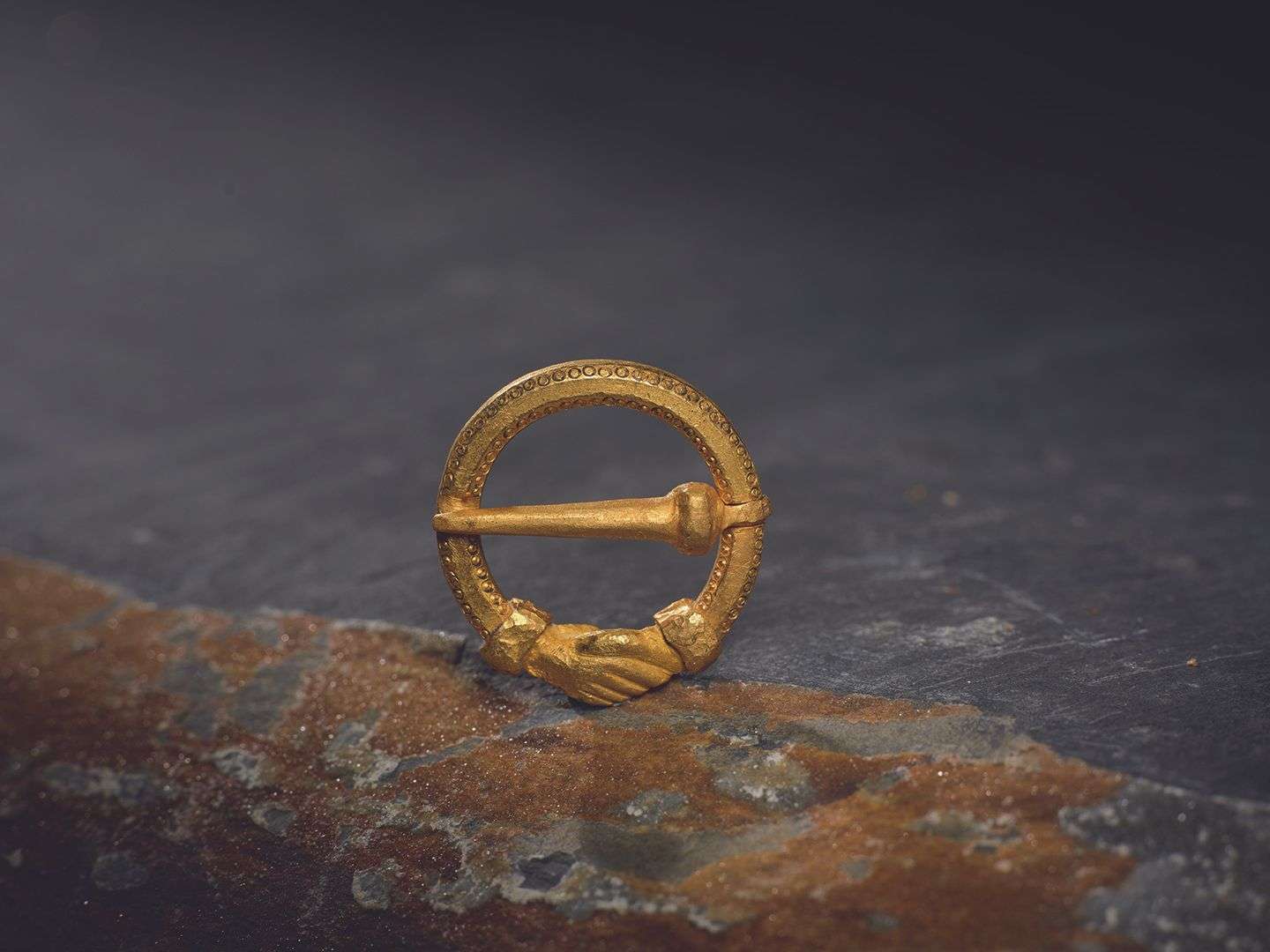
COURTLY LOVE FERMAIL
in chased yellow gold,
the five-sided ring decorated with ocelli friezes
of ocelli and surmounted by a heraldic "faith" motif
heraldic motif: a handful of two hands
clasping each other.
Original nail-shaped barb.
England, 14th century.
Diameter : 2.2 cm - Weight : 11.3 g
(Very good condition)
We have chosen to locate the origin of this object in
object in England, since it was in this country
that the greatest number were discovered there. Often
with amorous inscriptions in Latin or French
or French, as a token of promise.
were intended for ladies, given their small size.
their small size. These rare objects with their wide
symbolic repertoire are evidence of the
promise of love in the manner of an engagement
like an engagement ring. An extremely similar fermail
was discovered in Winwick, England, in August
2006 [2006 T549] bearing the inscription "pense de
is currently on loan to the Warrington Museum.
Warrington Museum. Another hexagonal fermail
with the same handshake motif is in the
at the Musée de Cluny [Cl.15148].
in chased yellow gold,
the five-sided ring decorated with ocelli friezes
of ocelli and surmounted by a heraldic "faith" motif
heraldic motif: a handful of two hands
clasping each other.
Original nail-shaped barb.
England, 14th century.
Diameter : 2.2 cm - Weight : 11.3 g
(Very good condition)
We have chosen to locate the origin of this object in
object in England, since it was in this country
that the greatest number were discovered there. Often
with amorous inscriptions in Latin or French
or French, as a token of promise.
were intended for ladies, given their small size.
their small size. These rare objects with their wide
symbolic repertoire are evidence of the
promise of love in the manner of an engagement
like an engagement ring. An extremely similar fermail
was discovered in Winwick, England, in August
2006 [2006 T549] bearing the inscription "pense de
is currently on loan to the Warrington Museum.
Warrington Museum. Another hexagonal fermail
with the same handshake motif is in the
at the Musée de Cluny [Cl.15148].