
&w=3840&q=75)
&w=3840&q=75)
&w=3840&q=75)
&w=3840&q=75)
&w=3840&q=75)
&w=3840&q=75)
&w=3840&q=75)
&w=3840&q=75)


Gabriel ENGELS
Hamburg, 1592 - 1654
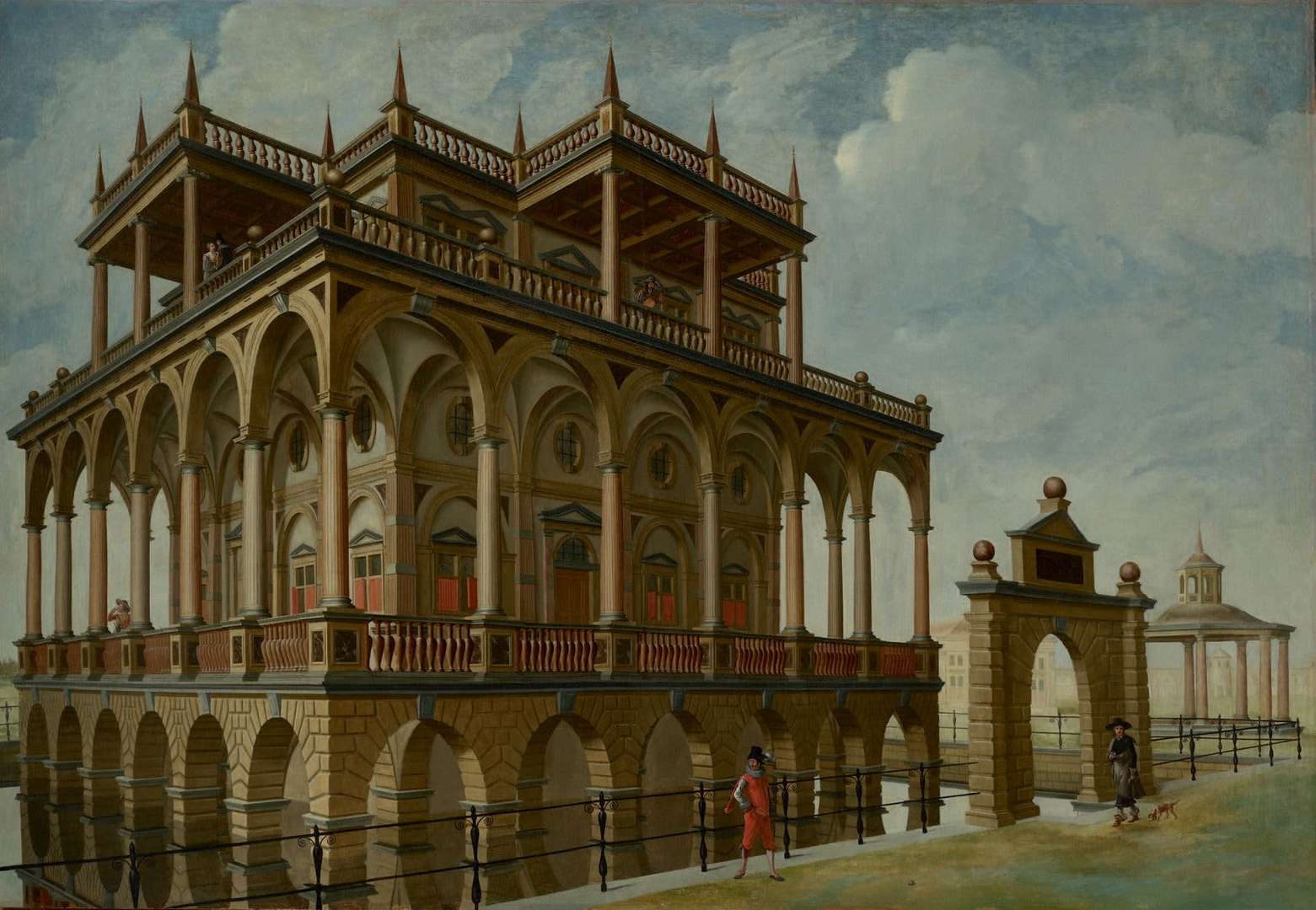
The five senses in an imaginary palace
Canvas
128 x 186 cm - 50 3/8 x 73 1/4 in.
The five senses in an imaginary palace, canvas
(Old restorations)
PROVENANCE
Private collection, France.
A mad architectural vision, it is the ideal pretext for representing the five senses, which the artist embodies in the guise of various characters. Spread throughout the composition, they discreetly take over the terraces and surroundings of the building. On the highest level, a couple's licentious interview evokes the sense of touch| just a few steps away, a musician plays the lute. Under the gallery on the middle level, a drinker is captured in action, glass in mouth, decanter in other hand. Finally, along the quay of the strange palace, a man, dagger under arm, gazes into the distance, while behind him comes a walker accompanied by his dog, a rose held in his fingertips.
The painting is in the vein of the fantastic palaces created by Hans Vredeman de Vries (1527-1609) and his son Paul (1567-1617), of whom Engels was one of the best students. These compositions, widely disseminated by the engravings of Hieronymus Cock (1518-1570), led to a renewal of the decorative repertoire in the Netherlands from the 1550s onwards, leaving a lasting mark on the representation of perspective in architectures used as backdrops for religious as well as secular scenes, as seen in Sébastien Vrancx (1573-1647) and Dirk van Delen (1605-1671), for example. This influence, visible as far away as Italy (with the Codazzi in particular), benefited painters in Flanders who specialized in church interiors, such as Pieter Neefs le Vœux (1578-1656/1661), Hendrik van Steenwijk (c. 1550-1603), Gerard Hougkgeest (1600-1661) and Bartholomeus van Bassen (1590-1652).
Our painting can be compared with the imaginary palace in the Statens Museum for Kunst, Copenhagen (Fig. 1), as well as with the one on sale in London at Bonhams on December 9, 2019, no. 48. Engels always uses a very low viewpoint, numerous columns and arches forming a labyrinth of mirrors.
Hamburg, 1592 - 1654
The five senses in an imaginary palace
Canvas
128 x 186 cm - 50 3/8 x 73 1/4 in.
The five senses in an imaginary palace, canvas
(Old restorations)
PROVENANCE
Private collection, France.
A mad architectural vision, it is the ideal pretext for representing the five senses, which the artist embodies in the guise of various characters. Spread throughout the composition, they discreetly take over the terraces and surroundings of the building. On the highest level, a couple's licentious interview evokes the sense of touch| just a few steps away, a musician plays the lute. Under the gallery on the middle level, a drinker is captured in action, glass in mouth, decanter in other hand. Finally, along the quay of the strange palace, a man, dagger under arm, gazes into the distance, while behind him comes a walker accompanied by his dog, a rose held in his fingertips.
The painting is in the vein of the fantastic palaces created by Hans Vredeman de Vries (1527-1609) and his son Paul (1567-1617), of whom Engels was one of the best students. These compositions, widely disseminated by the engravings of Hieronymus Cock (1518-1570), led to a renewal of the decorative repertoire in the Netherlands from the 1550s onwards, leaving a lasting mark on the representation of perspective in architectures used as backdrops for religious as well as secular scenes, as seen in Sébastien Vrancx (1573-1647) and Dirk van Delen (1605-1671), for example. This influence, visible as far away as Italy (with the Codazzi in particular), benefited painters in Flanders who specialized in church interiors, such as Pieter Neefs le Vœux (1578-1656/1661), Hendrik van Steenwijk (c. 1550-1603), Gerard Hougkgeest (1600-1661) and Bartholomeus van Bassen (1590-1652).
Our painting can be compared with the imaginary palace in the Statens Museum for Kunst, Copenhagen (Fig. 1), as well as with the one on sale in London at Bonhams on December 9, 2019, no. 48. Engels always uses a very low viewpoint, numerous columns and arches forming a labyrinth of mirrors.