
&w=3840&q=75)
&w=3840&q=75)
&w=3840&q=75)
&w=3840&q=75)
&w=3840&q=75)
&w=3840&q=75)
&w=3840&q=75)
&w=3840&q=75)


SWISS WORK
"Martin Martine
Early 19th century
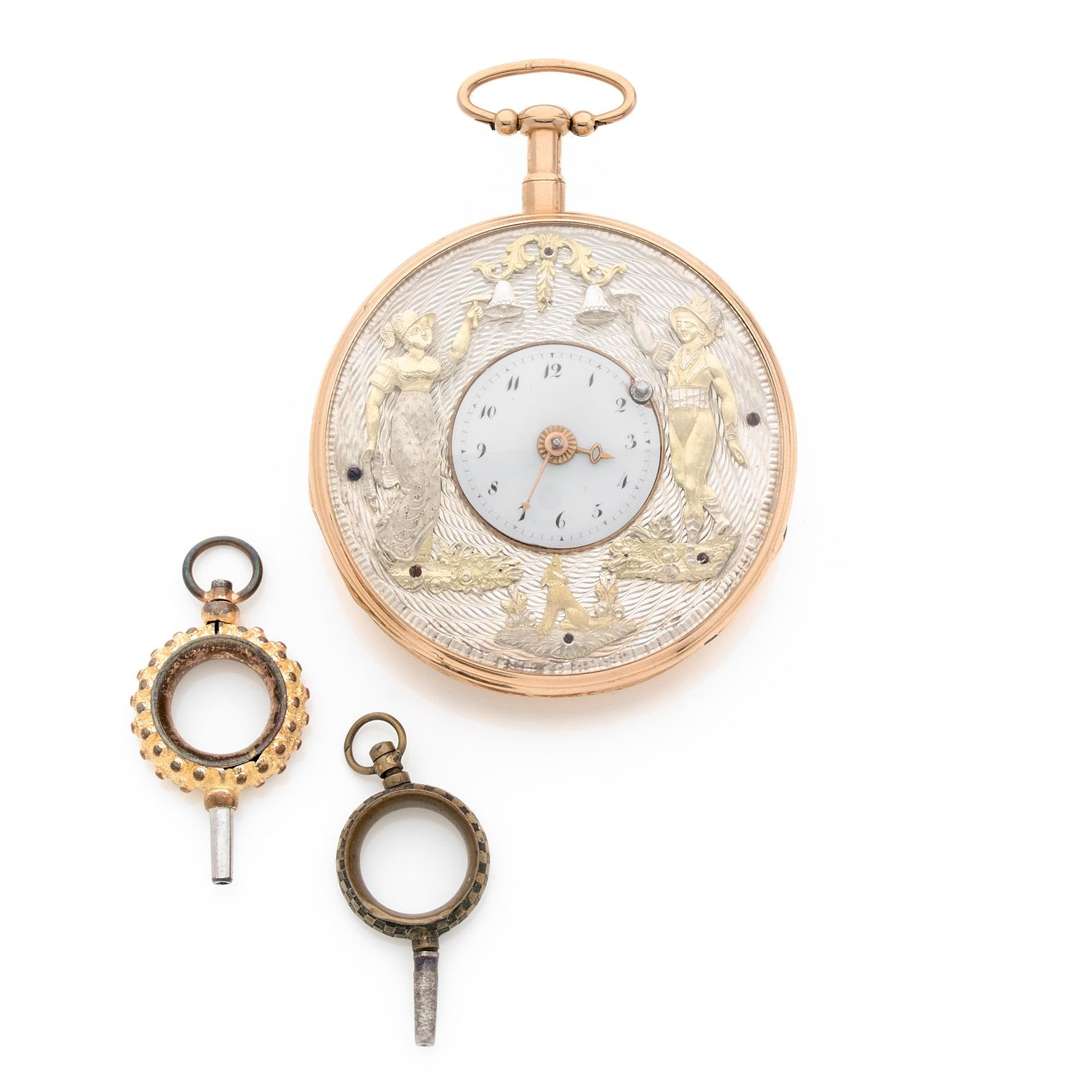
Gold "Martin Martine" Jacquemarts automaton watch with quarter repeater
Case: round, hinged opening, smooth back, stylized middle, gilded metal bowl
Dial: enamel, Arabic numerals, minute track, square winding mechanism, surrounded on either side by two "Martin Martine" Jaquemarts automata, on a guilloché background
Movement: mechanical with key winding, quarter striking mechanism operated at the same time as the two "Martin Martine" Jacquemarts automata.
Diameter: 56.5 mm
Gross weight. 127,3 g.
With: 2 winding keys
A gold key winding pocket watch with two automatons and quarter repeating, with two extra keys
When, at the turn of the 19th century, European watchmaking reached new heights in terms of precision, the time was ripe to offer customers even more ingenious and sophisticated curiosities and diversions, and the trend towards repeating and automaton watches was born. The subjects that lent themselves to automata were varied: the most common were jaquemarts, imitating those installed on large steeple clocks and other campaniles. Arranged on the face of the watch dial or on a plate hidden beneath the case bowl, executed in colored golds, the little figures stand out against a background of enameled or engraved decoration, dressed in antique or fashionable costumes. Our example is typical of early 19th-century production.
When, at the turn of the 19th century, European watchmaking reached new heights in terms of precision, the time was right to offer customers even more ingenious and sophisticated curiosities and entertainments, the trend for repeater and automaton watches was born. The subjects that lend themselves to automata are varied: the most common consists of jaquemarts, imitated from those installed on large bell tower clocks and other campaniles. Arranged on the face of the watch dial or on a plate hidden under the bowl of the case, executed in colored gold, the small characters stand out against a background of enameled or engraved decoration, costumed in the antique style or according to fashion. Our example is typical of early 19th century production.
Condition report given for information only:
Movement in working order at time of catalog writing
Traces of wear and tear, signs of polishing visible on all parts.
A service will be required to ensure that the watch meets chronometric standards.
Sold as is, without warranty
Condition report given as an indication :
At the time of cataloguing, movement is ticking, overhaul recommended to be fully operational. Please be advised all watches are sold "as is". No guarantee is given as to the working order of the watch.
"Martin Martine
Early 19th century
Gold "Martin Martine" Jacquemarts automaton watch with quarter repeater
Case: round, hinged opening, smooth back, stylized middle, gilded metal bowl
Dial: enamel, Arabic numerals, minute track, square winding mechanism, surrounded on either side by two "Martin Martine" Jaquemarts automata, on a guilloché background
Movement: mechanical with key winding, quarter striking mechanism operated at the same time as the two "Martin Martine" Jacquemarts automata.
Diameter: 56.5 mm
Gross weight. 127,3 g.
With: 2 winding keys
A gold key winding pocket watch with two automatons and quarter repeating, with two extra keys
When, at the turn of the 19th century, European watchmaking reached new heights in terms of precision, the time was ripe to offer customers even more ingenious and sophisticated curiosities and diversions, and the trend towards repeating and automaton watches was born. The subjects that lent themselves to automata were varied: the most common were jaquemarts, imitating those installed on large steeple clocks and other campaniles. Arranged on the face of the watch dial or on a plate hidden beneath the case bowl, executed in colored golds, the little figures stand out against a background of enameled or engraved decoration, dressed in antique or fashionable costumes. Our example is typical of early 19th-century production.
When, at the turn of the 19th century, European watchmaking reached new heights in terms of precision, the time was right to offer customers even more ingenious and sophisticated curiosities and entertainments, the trend for repeater and automaton watches was born. The subjects that lend themselves to automata are varied: the most common consists of jaquemarts, imitated from those installed on large bell tower clocks and other campaniles. Arranged on the face of the watch dial or on a plate hidden under the bowl of the case, executed in colored gold, the small characters stand out against a background of enameled or engraved decoration, costumed in the antique style or according to fashion. Our example is typical of early 19th century production.
Condition report given for information only:
Movement in working order at time of catalog writing
Traces of wear and tear, signs of polishing visible on all parts.
A service will be required to ensure that the watch meets chronometric standards.
Sold as is, without warranty
Condition report given as an indication :
At the time of cataloguing, movement is ticking, overhaul recommended to be fully operational. Please be advised all watches are sold "as is". No guarantee is given as to the working order of the watch.