
&w=3840&q=75)
&w=3840&q=75)
&w=3840&q=75)
&w=3840&q=75)
&w=3840&q=75)
&w=3840&q=75)


114
ABBÉ PIERRE CALÈS (1870-1961)
The item was sold for 500 €
Fees include commission and taxes.
ABBÉ PIERRE CALÈS (1870-1961)
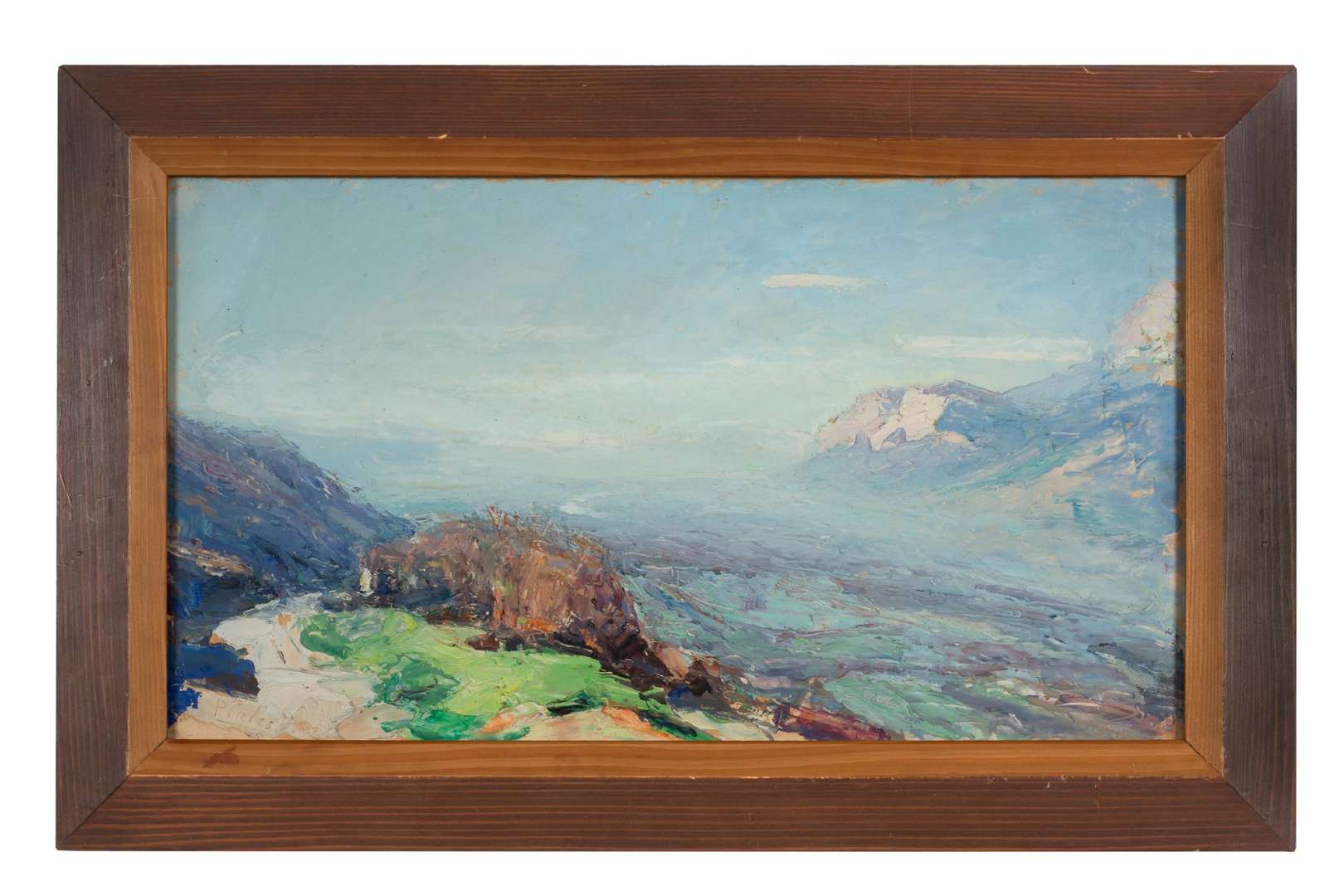
View of the Grésivaudan Valley, 1945
Oil on cardboard
Signed and dated '[19]45' lower left
Oil on cardboard, signed and dated '[19]45' lower left
(Small gaps in the paint layer)
35,5 x 64 cm - 14 x 25 1/4 in.
Provenance
Private collection, France
Note
At the age of 20, Abbé Calès enrolled at the Rondeau minor seminary in Grenoble, where he received guidance from Abbé Laurent Guétal, but was not greatly influenced by him. His teacher was Philippe Charlemagne, himself a pupil of Jean Achard. Initially appointed curate in Rives, then parish priest in Hurtières, he moved to the parish of Tencin in 1902, where he remained ever since. He is known for his Dauphiné landscapes, and his favorite subject is the Grésivaudan valley, which he paints with the passing seasons. His paintings are often panoramic, with thick brushstrokes. His exuberant colors can be compared with those of the Impressionists and Post-Impressionists, as well as the Fauves. Several of his paintings are in the Musée de Grenoble. In 1963, rue Pelletan was renamed rue de l'abbé Pierre Calès in his native Vienne.
View of the Grésivaudan Valley, 1945
Oil on cardboard
Signed and dated '[19]45' lower left
Oil on cardboard, signed and dated '[19]45' lower left
(Small gaps in the paint layer)
35,5 x 64 cm - 14 x 25 1/4 in.
Provenance
Private collection, France
Note
At the age of 20, Abbé Calès enrolled at the Rondeau minor seminary in Grenoble, where he received guidance from Abbé Laurent Guétal, but was not greatly influenced by him. His teacher was Philippe Charlemagne, himself a pupil of Jean Achard. Initially appointed curate in Rives, then parish priest in Hurtières, he moved to the parish of Tencin in 1902, where he remained ever since. He is known for his Dauphiné landscapes, and his favorite subject is the Grésivaudan valley, which he paints with the passing seasons. His paintings are often panoramic, with thick brushstrokes. His exuberant colors can be compared with those of the Impressionists and Post-Impressionists, as well as the Fauves. Several of his paintings are in the Musée de Grenoble. In 1963, rue Pelletan was renamed rue de l'abbé Pierre Calès in his native Vienne.